
XAUUSD resumes its decline after a correction and could hit a new all-time low
After rising by almost 4% during the previous trading session, the precious metal has come under pressure again, with prices currently standing at 3,523 USD. Discover more in our analysis for 25 November 2026.
XAUUSD forecast: key takeaways
- The Conference Board Consumer Confidence Index rose from 91.9 to 103.3 points in November, above a forecast of 92.4 points
- JPMorgan forecasts a recovery in the precious metal's prices to 4,500 USD by the end of 2027
- XAUUSD forecast for 25 November 2026: 3,375
Fundamental analysis
The decline in gold prices is primarily driven by the Federal Reserve's persistently hawkish monetary policy rhetoric, the high likelihood of further interest rate hikes, and investors reducing their positions amid instability in the US stock market.
US macroeconomic data released today has put additional pressure on gold. The Conference Board Consumer Confidence Index rose from 91.9 to 103.3 points in November, against a forecast of 92.4 points, reaching its highest level since January 2025. Improved consumer sentiment indicates resilience in the US economy and the potential for domestic demand to remain high.
Today's release of the US Personal Consumption Expenditures (PCE) price index will be the key event shaping further XAUUSD movements. Annual inflation is expected to accelerate from 3.6% to 3.8%. A stronger-than-expected reading could fuel expectations of further rate hikes in 2027, providing additional support for the US dollar. At the same time, weaker inflation figures could trigger an upward correction in gold.
The XAUUSD forecast for 25 November 2026 is bearish.
Technical outlook
XAUUSD prices have entered a strong downtrend and are setting new all-time lows. On the D1 chart, a resistance level has formed at 3,920, with a support level at 3,495. On the H4 chart, local support has formed at 3,515, while resistance has shifted to 3,760. A breakout below 3,495 would confirm the downtrend. Today's XAUUSD forecast suggests a further decline, with a potential target at 3,375.
The main scenario would be invalidated if prices consolidate above the 3,715 resistance level, signalling an acceleration of the rise towards 4,010.
XAUUSD overview
- Asset: XAUUSD
- Timeframe: H4 (Intraday)
- Trend: bearish
- Key resistance levels: 3,760.00 and 3,920.00
- Key support levels: 3,515.00 and 3,495
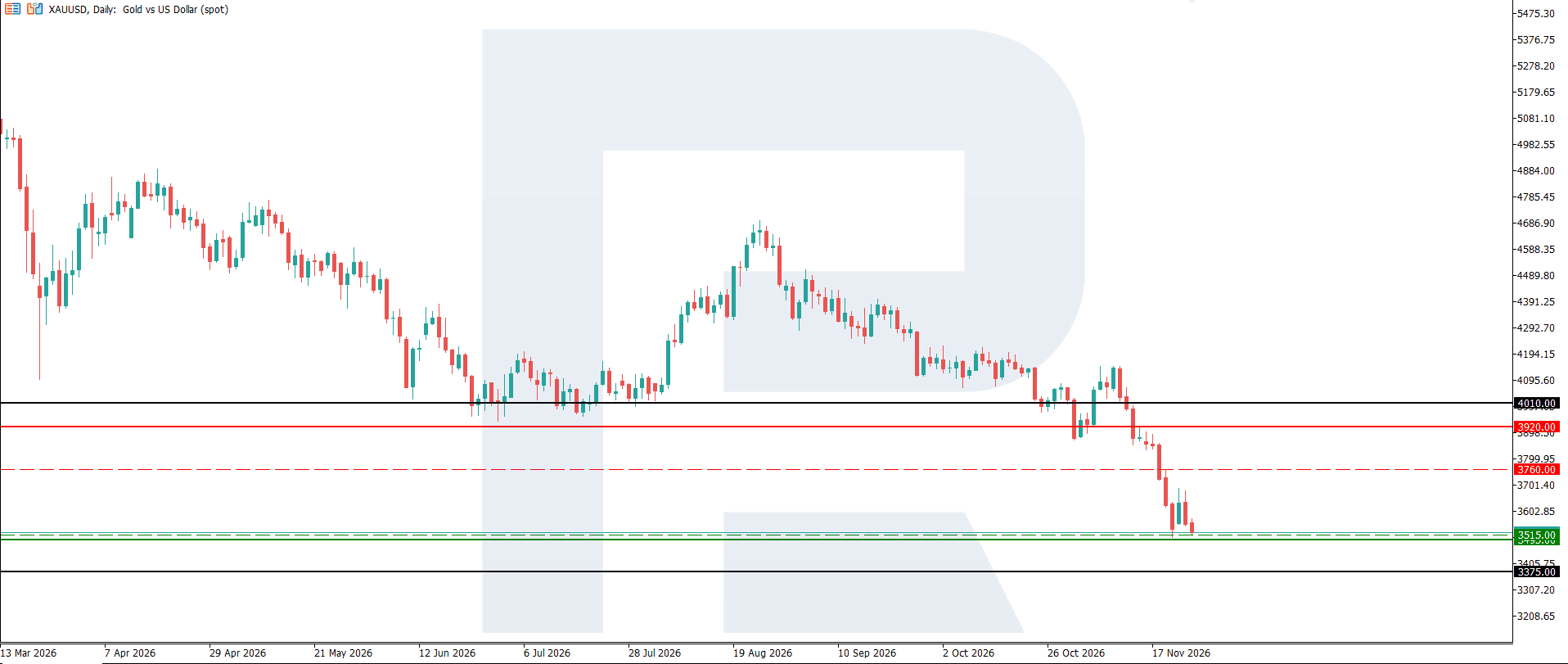
XAUUSD trading scenario for today
A breakout below a local support level, followed by consolidation below 3,515.00, would confirm the end of the current corrective recovery and create conditions for opening short positions.
Risk factors
The main risks to the bearish XAUUSD scenario are a potential slowdown in US inflation, a deterioration in macroeconomic indicators, and softer rhetoric from Federal Reserve officials, which could reduce expectations of further interest rate hikes. Additional support for gold could come from a weaker US dollar, declining US government bond yields, escalating geopolitical tensions, and increased demand from central banks. Furthermore, technically oversold conditions in gold and profit-taking on short positions increase the likelihood of a sharp upward correction.
Summary
The combination of fundamental and technical factors points to a predominantly bearish outlook for XAUUSD. The resilience of the US economy, elevated inflationary pressure, and the likelihood of further Federal Reserve monetary tightening set the stage for a continued decline in gold prices, with a potential test of the 3,400 USD level.
Editors’ picks


EURUSD forecast 2026–2027: technical analysis, price levels & predictions
The EURUSD outlook for 2026 and 2027: key levels on the daily chart, three trading scenarios and the policy gap between the Fed and the ECB that drives the pair.

Gold (XAUUSD) forecast 2026: technical analysis, price levels & predictions
Where gold could trade in 2026: key levels, three trading scenarios with entry triggers and the forecasts from J.P. Morgan, Deutsche Bank and Goldman Sachs.
Forecasts presented in this section only reflect the author’s private opinion and should not be considered as guidance for trading. RoboForex bears no responsibility for trading results based on trading recommendations described in these analytical reviews.