
Oracle stock forecast for 2026 after Q1 2027 financial year results
Oracle continues to accelerate OCI expansion and grow its RPO backlog. However, negative free cash flow, high capital expenditure, and the company’s debt burden continue to weigh on the business. As a result, the outlook for ORCL stock for the second half of 2026 suggests that the risk of further share price declines remains.
Oracle Corporation (NYSE: ORCL) delivered strong Q1 2027 financial year results, driven by cloud business growth. OCI revenue increased by 121% year-on-year, while RPO reached a record 664 billion USD, confirming a high volume of future contracted business. At the same time, non-GAAP operating margin stood at 42%, while free cash flow remained negative at –5.4 billion USD due to substantial investment in data centres and AI infrastructure.
For Q2 of the 2027 financial year, Oracle expects non-GAAP EPS of 1.85–1.93 USD, representing growth of 21–25% year-on-year in USD terms, excluding the one-off gain from the sale of its stake in Ampere in Q2 of the 2026 financial year. Compared with the reported Q2 2026 EPS of 2.26 USD without adjusting for this one-off factor, this would formally represent a decline of 14–18%.
For the full 2027 financial year, Oracle expects revenue of at least 90 billion USD, 34% higher than the 67.4 billion USD reported in the 2026 financial year, and non-GAAP EPS of 8.10 USD, representing growth of 19% from adjusted 2026 EPS of 6.83 USD. Compared with reported EPS of 7.63 USD for the 2026 financial year, including one-off investment gains, growth would be only around 6%.
This article analyses Oracle stock and reviews the company’s latest financial results. It focuses on the key drivers of its cloud business, fundamental analysis of ORCL, and the factors shaping the future performance of Oracle stock. It also provides technical analysis of ORCL, which forms the basis for the Oracle stock forecast for the second half of 2026.
About Oracle Corporation
Oracle Corporation is a US technology company founded in 1977 by Larry Ellison, Bob Miner, and Ed Oates. It was originally called Software Development Laboratories. Following several name changes, the company became Oracle Systems Corporation in 1982 and later Oracle Corporation.
Oracle develops database management systems, enterprise software, cloud applications, and computing infrastructure. The company’s flagship product is Oracle Database. Oracle also develops the Oracle Cloud Infrastructure (OCI) cloud platform, which competes with Amazon Web Services, Microsoft Azure, and Google Cloud.
Until 2020, Oracle was headquartered in Redwood City, California. The company then moved its headquarters to Austin, Texas.
On 12 March 1986, Oracle completed its initial public offering on the NASDAQ stock exchange under the ticker ORCL. Today, the company is one of the world’s largest providers of enterprise software and cloud solutions.
Oracle Corporation Q3 2025 financial results
On 10 March 2025, Oracle Corporation published its Q3 2025 financial results for the quarter ended 28 February 2025. The key figures are presented below:
- Revenue: 14.13 billion USD (+6%)
- Net income: 4.23 billion USD (+6%)
- Earnings per share: 1.47 USD (+4%)
- Operating margin: 44.00% (+23 bps)
Revenue by segment:
- Cloud services and license support: 11.00 billion USD (+10%)
- Cloud Revenue (IaaS plus SaaS): 6.20 billion USD (+23%)
- Cloud license and on-premise license: 1.12 billion USD (–10%)
- Hardware: 703.00 million USD (–7%)
- Services: 1.29 billion USD (–1%)
Oracle’s Q3 2025 financial results were mixed. Revenue reached 14.13 billion USD, compared with expectations of 14.40 billion USD, while adjusted earnings per share came in at 1.47 USD, compared with expectations of 1.49 USD. Cloud services and license support revenue rose 10% but still fell short of expectations.
Meanwhile, partnerships with OpenAI, Meta, and NVIDIA, data centre expansion, and participation in the Stargate project are expected to support growth in the cloud and AI businesses. Oracle expects revenue to increase by 15% in the 2026 financial year and plans to double its data centre capacity over the year. Another positive development was a 25% increase in the quarterly dividend to 0.50 USD per share.
Oracle Corporation Q4 2025 financial results
On 11 June 2025, Oracle Corporation published its Q4 2025 financial results for the quarter ended 31 May 2025. The key figures are presented below:
- Revenue: 15.90 billion USD (+11%)
- Net income: 3.42 billion USD (+9%)
- Earnings per share: 1.70 USD (+4%)
- Operating margin: 44.00% (–244 bps)
Revenue by segment:
- Cloud services and license support: 11.70 billion USD (+14%)
- Cloud Revenue (IaaS plus SaaS): 6.70 billion USD (+27%)
- Cloud license and on-premise license: 2.01 billion USD (+9%)
- Hardware: 850.00 million USD (–2%)
- Services: 1.35 billion USD (–2%)
Oracle’s Q4 2025 financial results showed a notable improvement compared with the previous quarter. In Q3, revenue and earnings per share fell short of expectations, while in Q4 revenue rose 11% to 15.9 billion USD and adjusted earnings per share reached 1.70 USD, exceeding analysts’ expectations. Oracle Cloud Infrastructure was the main growth driver, with revenue up 52% to 3 billion USD.
Further evidence of strengthening demand came from a 41% increase in remaining performance obligations (RPO) to 138 billion USD. For the 2026 financial year, Oracle expected cloud revenue to grow by more than 40%, OCI revenue by more than 70%, and total revenue to reach 67 billion USD, representing growth of 16–17%.
To meet demand, the company planned to invest 25 billion USD in expanding its cloud infrastructure. This was expected to strengthen Oracle’s competitive position against AWS, Microsoft Azure, and Google Cloud, while also increasing the company’s financial burden.
Following the report, Oracle shares rose by 14%. The market responded positively to accelerating cloud growth and higher RPO, although high debt levels and the stock’s high valuation remained the main risks.
Oracle Corporation Q1 2026 financial results
On 9 September 2025, Oracle Corporation published its Q1 2026 financial results for the quarter ended 31 August 2025. The key figures are presented below:
- Revenue: 14.93 billion USD (+12%)
- Net income (non-GAAP): 4.28 billion USD (+8%)
- Earnings per share (non-GAAP): 1.47 USD (+6%)
- Operating margin: 42.00% (–111 bps)
Revenue by segment:
- Cloud: 7.19 billion USD (+28%)
- Software: 5.72 billion USD (–1%)
- Hardware: 670 million USD (+2%)
- Services: 1.35 billion USD (+7%)
Oracle’s Q1 2026 financial results confirmed further improvement in the cloud business, although the overall results were mixed and fell slightly short of expectations. Revenue rose 12% year-on-year to 14.93 billion USD, non-GAAP operating income reached 6.24 billion USD, net income stood at 4.28 billion USD, and adjusted earnings per share increased by 6% to 1.47 USD.
The main improvement came from accelerating growth in the cloud business. Cloud revenue increased by 28% to 7.19 billion USD, accounting for nearly half of total revenue. Meanwhile, traditional software revenue declined to 5.72 billion USD. Remaining performance obligations (RPO) rose from 138 billion USD in Q4 to 455 billion USD, up 359% year-on-year, significantly improving the predictability of future revenue.
The main deterioration was in free cash flow, which fell to –5.88 billion USD over the trailing 12 months due to large-scale data centre construction. In the 2026 financial year, Oracle planned to invest around 35 billion USD to expand capacity.
For Q2, the company forecast revenue growth of 12–14%, cloud revenue growth of more than 30%, and earnings per share of 1.61–1.65 USD. Overall, the situation continued to improve in terms of demand for OCI and future revenue, although risks increased due to negative free cash flow and substantial capital expenditure.
Oracle Corporation Q2 2026 financial results
On 10 December 2025, Oracle Corporation published its Q2 2026 financial results for the quarter ended 30 November 2025. The key figures are presented below:
- Revenue: 16.06 billion USD (+14%)
- Net income (non-GAAP): 6.60 billion USD (+57%)
- Earnings per share (non-GAAP): 2.26 USD (+54%)
- Operating margin: 41.85% (–150 bps)
Revenue by segment:
- Cloud: 7.98 billion USD (+34%)
- Software: 5.88 billion USD (–3%)
- Hardware: 0.78 billion USD (+7%)
- Services: 1.43 billion USD (+7%)
Oracle’s Q2 2026 financial results showed further acceleration in the cloud business, but also a deterioration in cash flow. Revenue rose 14% year-on-year to 16.1 billion USD, falling slightly short of expectations. Non-GAAP operating income increased by 10% to 6.7 billion USD, while earnings per share reached 2.26 USD. However, a significant portion of the result came from a one-off gain of 2.7 billion USD from the sale of a stake in Ampere.
Cloud revenue rose 34% to 7.98 billion USD, accelerating from Q1. OCI revenue increased by 66–68% to 4.1 billion USD, while cloud applications revenue rose 11% to 3.9 billion USD. Remaining performance obligations (RPO) increased from 455 billion USD in Q1 to 523 billion USD, confirming strong demand for Oracle’s AI infrastructure.
Meanwhile, free cash flow over the trailing 12 months deteriorated from –5.88 billion USD to –13 billion USD due to investment in data centres. Debt exceeded 110 billion USD, while the full-year capital expenditure plan was raised from 35 billion USD to 50 billion USD. Capital returns were focused on dividends, while share repurchases remained minimal.
The full-year revenue forecast remained at 67 billion USD, but Q3 earnings-per-share guidance came in below expectations. Overall, the operating picture improved, driven by accelerating OCI growth and higher RPO. However, financial risks continued to increase due to negative free cash flow, rising debt, and record capital expenditure.
Oracle Corporation Q3 2026 financial results
On 10 March 2026, Oracle Corporation published its Q3 2026 financial results for the quarter ended 28 February 2026. The key figures are presented below:
- Revenue: 17.19 billion USD (+22%)
- Net income (non-GAAP): 5.22 billion USD (+23%)
- Earnings per share (non-GAAP): 1.79 USD (+21%)
- Operating margin: 42.92% (–92 bps)
Revenue by segment:
- Cloud: 8.91 billion USD (+44%)
- Software: 6.12 billion USD (+3%)
- Hardware: 0.71 billion USD (+2%)
- Services: 1.44 billion USD (+12%)
Oracle’s Q3 2026 financial results showed a notable operational improvement compared with Q2. Revenue growth accelerated from 14% to 22%, with revenue reaching 17.19 billion USD and exceeding expectations. Adjusted earnings per share also came in above expectations at 1.79 USD.
The cloud business remained the main growth driver. Cloud revenue growth accelerated from 34% to 44%, with revenue reaching 8.91 billion USD. OCI revenue rose 84% to 4.89 billion USD, compared with growth of 66–68% in the previous quarter. SaaS revenue increased by 13%, while multicloud database revenue surged 531%.
However, the financial burden continued to increase. Capital expenditure reached 48.3 billion USD, free cash flow deteriorated from around –13 billion USD to –24.7 billion USD, and debt rose to 134.6 billion USD.
For Q4, Oracle forecast revenue growth of 19–21% and earnings per share of 1.96–2.00 USD. The revenue forecast for the 2026 financial year remained at 67 billion USD, while the 2027 financial year guidance was raised to 90 billion USD. Overall, operating results and forecasts improved notably, although free cash flow moved even further into negative territory, while debt levels and capital expenditure continued to rise.
Oracle Corporation Q4 2026 financial results
On 10 June 2026, Oracle Corporation published its Q4 2026 financial results for the quarter ended 31 May 2026. The key figures are presented below:
- Revenue: 19.18 billion USD (+21%)
- Net income (non-GAAP): 6.23 billion USD (+26%)
- Earnings per share (non-GAAP): 2.11 USD (+24%)
- Operating margin: 44.80% (+54 bps)
Revenue by segment:
- Cloud: 9.91 billion USD (+47%)
- Software: 6.82 billion USD (–2%)
- Hardware: 0.92 billion USD (+9%)
- Services: 1.52 billion USD (+13%)
Oracle maintained strong momentum in Q4 2026. Revenue growth was broadly unchanged at 21%, compared with 22% in Q3, while adjusted earnings per share reached 2.11 USD, exceeding the company’s guidance of 1.96–2.00 USD.
The cloud business continued to accelerate. Cloud revenue growth increased from 44% to 47%, while Cloud Infrastructure revenue rose 93%, driven by demand for AI computing capacity. At the same time, traditional software revenue declined by 2%, reflecting customers’ shift to the cloud and Oracle’s increasing reliance on capital-intensive infrastructure.
Non-GAAP operating income reached 8.6 billion USD, while operating margin increased from 42.92% to 44.80%. Operating cash flow for the full year rose 54% to a record 32 billion USD. However, free cash flow over the trailing 12 months remained negative at –23.7 billion USD due to substantial investment in data centres.
Overall, the operating picture improved versus Q3, driven by accelerating cloud growth and stronger guidance. However, free cash flow recovered only marginally and remained the main unresolved issue.
Oracle Corporation Q1 2027 financial results
On 10 September 2026, Oracle Corporation published its Q1 2027 financial results for the quarter ended 31 August 2026. The key figures are presented below:
- Revenue: 19.35 billion USD (+30%)
- Net income (non-GAAP): 5.76 billion USD (+34%)
- Earnings per share (non-GAAP): 1.92 USD (+30%)
- Operating margin (non-GAAP): 42.13% (+35 bps)
Revenue by segment:
- Cloud: 11.61 billion USD (+62%)
- Software: 5.55 billion USD (–3%)
- Hardware: 0.77 billion USD (+15%)
- Services: 1.41 billion USD (+5%)
The Q1 results showed a notable improvement in Oracle’s business compared with the previous quarter. Total revenue growth accelerated from 21% to 30%, cloud revenue growth from 47% to 62%, and Oracle Cloud Infrastructure growth from 93% to 121%. The company exceeded its own revenue guidance, while earnings per share came in at the upper end of its guidance range. This indicates that the money invested in data centres is beginning to deliver more tangible results.
The cloud business generated 11.61 billion USD and accounted for 60% of Oracle’s total revenue for the first time. The main growth driver was OCI – infrastructure that customers rent for data storage, AI training, and complex computing workloads. OCI revenue increased to 7.39 billion USD. Cloud applications grew significantly more slowly, rising 10% to 4.22 billion USD.
As a result, Oracle is becoming increasingly dependent on the business of providing computing capacity. This business is growing rapidly but requires substantial spending on data centres, servers, and specialised AI chips. At the same time, traditional software revenue declined by 3% as customers are gradually shifting from on-premise software to cloud solutions.
Non-GAAP operating income rose 31% to 8.15 billion USD. Operating margin stood at 42.13%. The figure was slightly lower a year earlier but stood at 44.80% in Q4 2026. This means overall profit continues to grow, but the company is now earning slightly less per 100 USD of revenue than in the previous quarter. Remaining performance obligations (RPO) increased from 638 billion USD to 664 billion USD.
During the quarter, the company signed more than 30 billion USD in new AI infrastructure contracts, brought 850 MW of additional capacity online, and delivered more than 300,000 specialised chips to customers. This was almost three times the number delivered in Q4.
Operating cash flow rose 184% to 23.10 billion USD. At first glance, this is a very strong result. However, around 11.36 billion USD came from customer prepayments. In effect, customers provided Oracle with part of the funding for the required infrastructure in advance. This reduces the company’s financial burden but means almost half of operating cash flow came from prepayments.
Capital expenditure reached 28.50 billion USD, compared with 16.49 billion USD in the previous quarter. As a result, quarterly free cash flow deteriorated from –1.87 billion USD in Q4 2026 to –5.40 billion USD in Q1 2027. Over the trailing 12 months, negative FCF widened from –23.69 billion USD to –28.72 billion USD.
The debt position improved slightly. Debt declined from around 129.54 billion USD to 125.34 billion USD, while cash increased from 31.29 billion USD to 36.37 billion USD. However, positive free cash flow did not drive the debt reduction. Oracle raised 19.91 billion USD by issuing new shares and used part of the proceeds to repay debt.
For existing shareholders, issuing new shares dilutes their holdings. The number of shares outstanding increased by 3%, meaning Oracle’s future earnings are now spread across a larger number of shares. The company reduced its reliance on debt financing, but did so partly at shareholders’ expense.
For Q2 2027, Oracle forecasts total revenue growth of 30–34%, cloud revenue growth of 65–71%, and earnings per share of 1.85–1.93 USD. This suggests the cloud business will continue to accelerate, while earnings per share may remain around the Q1 level.
For the full 2027 financial year, the company maintained its revenue forecast of at least 90 billion USD and raised its earnings-per-share guidance from 8.05 USD to 8.10 USD. To meet this forecast, Oracle needs to keep bringing new data centres online quickly and convert signed contracts into actual revenue.
Overall, Oracle’s core business improved notably compared with Q4: total revenue, cloud revenue, and OCI growth accelerated, while the capacity already built began generating more revenue. However, the financial picture still looks weaker. Operating margin declined from the previous quarter, free cash flow deteriorated again, while the debt reduction was funded by new share issuance and customer prepayments.
Ultimately, the key question for an improved outlook for ORCL stock is whether rapid OCI growth can restore free cash flow before the high cost of infrastructure investment weighs more heavily on the company’s financial results.
Fundamental analysis of ORCL and key drivers of Oracle Corporation stock in 2026
In 2026, Oracle’s investment case is largely shaped by the development of its cloud business and substantial investment in AI infrastructure. Four key indicators can be used to assess the company’s prospects:
- OCI growth (Cloud Infrastructure revenue)
- Non-GAAP operating margin
- Free cash flow
- RPO (Remaining Performance Obligations)
OCI growth reflects demand for Oracle’s cloud infrastructure and is currently the main driver of the business. RPO reflects the volume of contracts already signed and provides an indication of future revenue. Non-GAAP operating margin shows whether the company can maintain high profitability while rapidly expanding its data centres. In contrast, FCF shows how costly this growth is for Oracle after capital expenditure.
The strongest scenario remains a combination of rapid OCI and RPO growth, a stable operating margin, and a gradual FCF recovery. A slowdown in OCI growth, accompanied by declining margins and a prolonged deterioration in cash flow, would be a more serious warning sign for Oracle’s investment case.
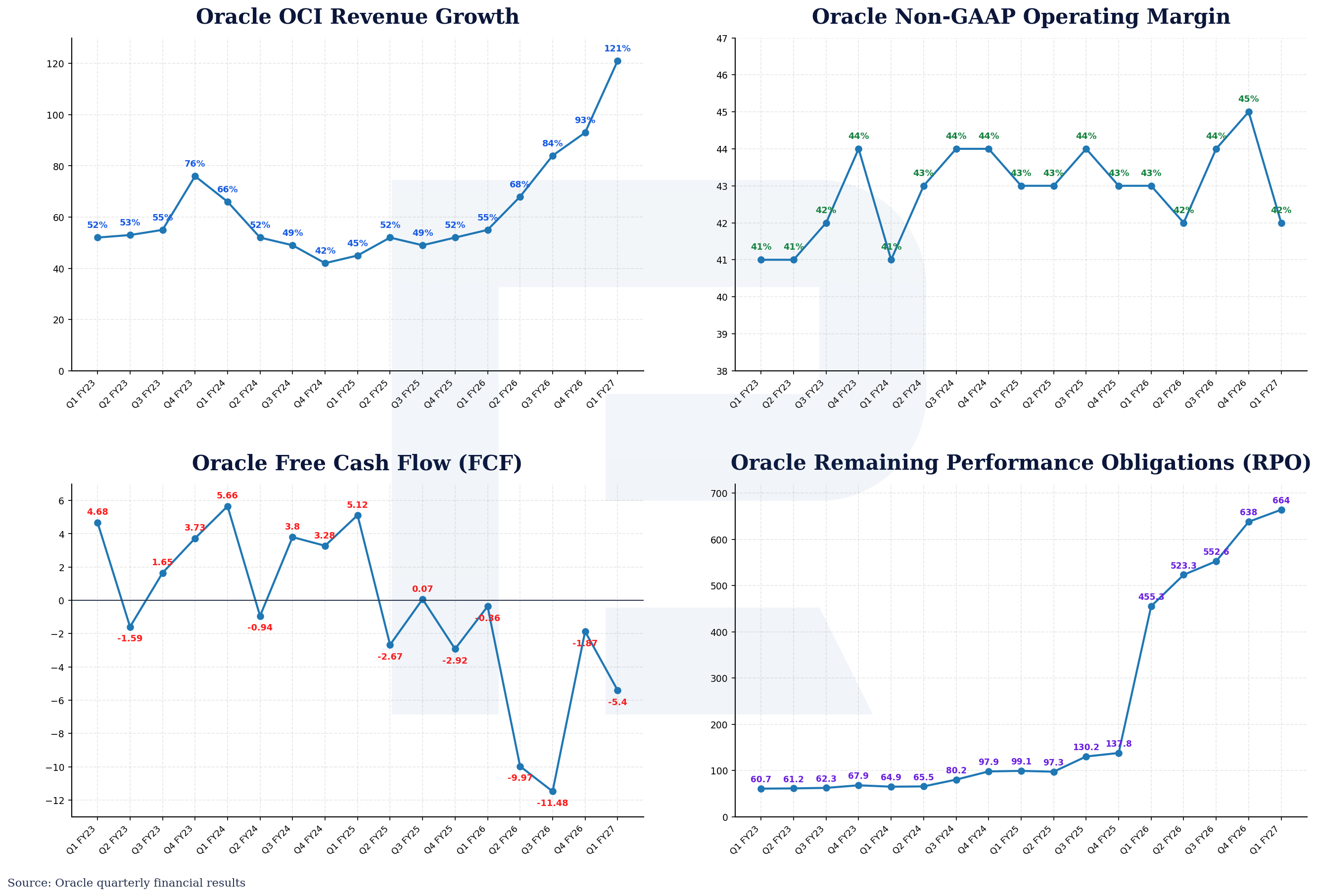
Fundamental analysis of ORCL shows a notable divergence between the company’s operating and cash flow metrics. On the one hand, OCI and RPO are growing at record rates, confirming strong demand for Oracle’s cloud infrastructure. On the other hand, capital expenditure remains extremely high, while free cash flow remains negative. The company’s ability to translate cloud growth into positive FCF will be a key factor in Oracle’s long-term stock performance.
To finance this investment programme, Oracle has relied more heavily on debt and equity financing, increasing its debt burden and raising the risk of shareholder dilution. Rising capital expenditure, negative FCF, and the need for external financing have become important factors weighing on the share price: Oracle stock has fallen by more than 55% from its 2025 high.
Therefore, buying Oracle stock under current conditions is a bet that record OCI and RPO growth will eventually restore FCF and justify the company’s massive infrastructure investment.
Fed policy remains an additional risk. If the central bank maintains a restrictive monetary policy by keeping interest rates high or raising them further, the cost of new financing and refinancing Oracle’s debt will remain high. Financial markets are already pricing in further Fed tightening amid persistent inflationary pressures. This factor is particularly important for Oracle given its high debt burden and the need to continue financing data centre construction. Under this scenario, negative FCF, high interest expenses, and the need for additional capital could continue to weigh on the company’s shares.
The situation could improve if OCI continues to grow rapidly while FCF recovers. A sustained improvement in free cash flow would be one of the clearest indications that Oracle’s large-scale investments are beginning to generate the required financial returns. However, there has not yet been a sustained recovery in FCF.
Analysts’ ratings of Oracle and stock forecast for 2026
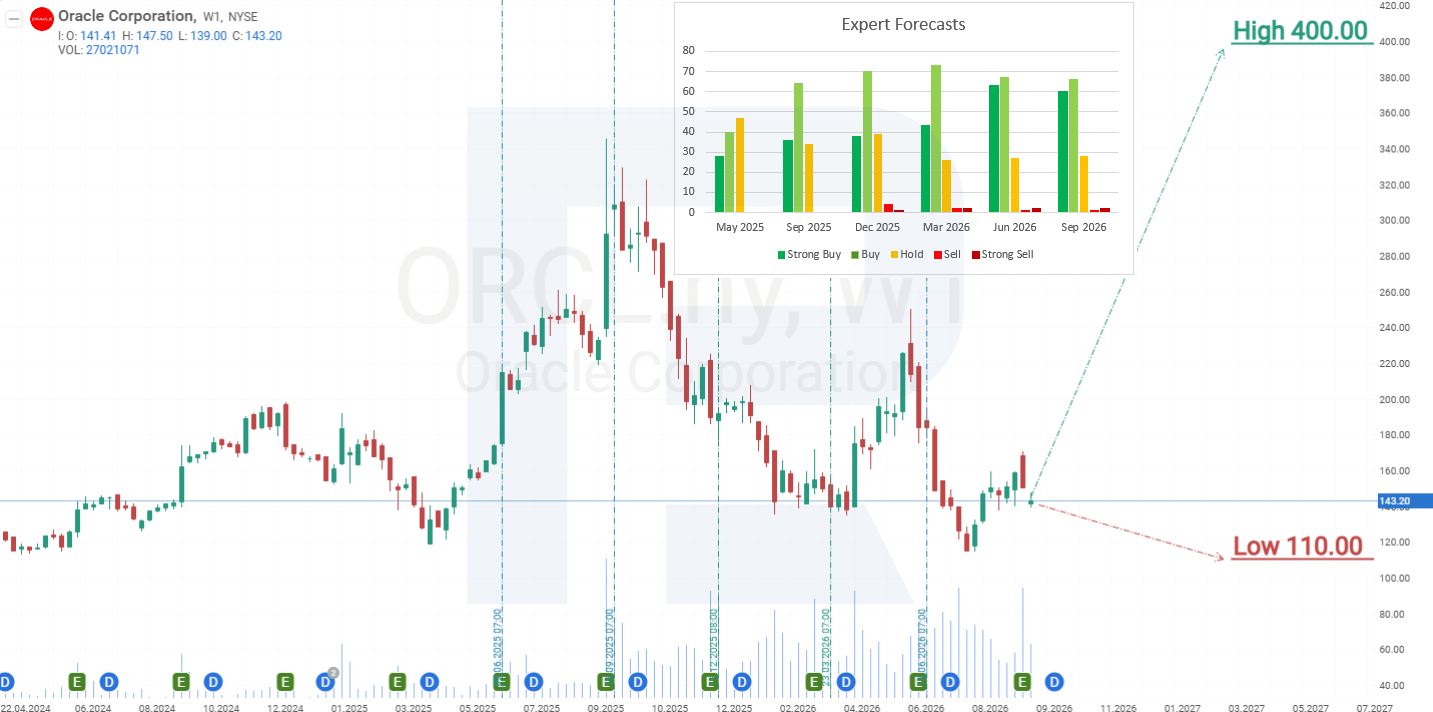
- Barchart: 33 of 44 analysts rated Oracle Corporation stock a Strong Buy, 1 a Buy, 9 a Hold, and 1 a Strong Sell. The highest price target is 400 USD, while the lowest is 110 USD.
- MarketBeat: 32 of 41 analysts rated the stock a Buy, 8 a Hold, and 1 a Sell. The highest price target is 400 USD, while the lowest is 145 USD.
- TipRanks: 25 of 29 analysts rated the stock a Buy and 4 a Hold. The highest price target is 400 USD, while the lowest is 145 USD.
- Stock Analysis: 27 of 43 analysts rated the stock a Strong Buy, 8 a Buy, 7 a Hold, and 1 a Strong Sell. The highest price target is 400 USD, while the lowest is 110 USD.
Analyst forecasts for Oracle stock in 2026 remain broadly positive. Buy recommendations predominate across most platforms, although the price-target range remains wide, at approximately 110–400 USD. This points to significant differences in analysts’ assessments of how quickly OCI growth and record RPO can offset Oracle’s negative free cash flow, high capital expenditure, and debt burden.
Overall, analysts’ outlook for Oracle stock remains notably more optimistic than ORCL’s current performance.
Technical analysis of ORCL and Oracle stock forecast for 2026
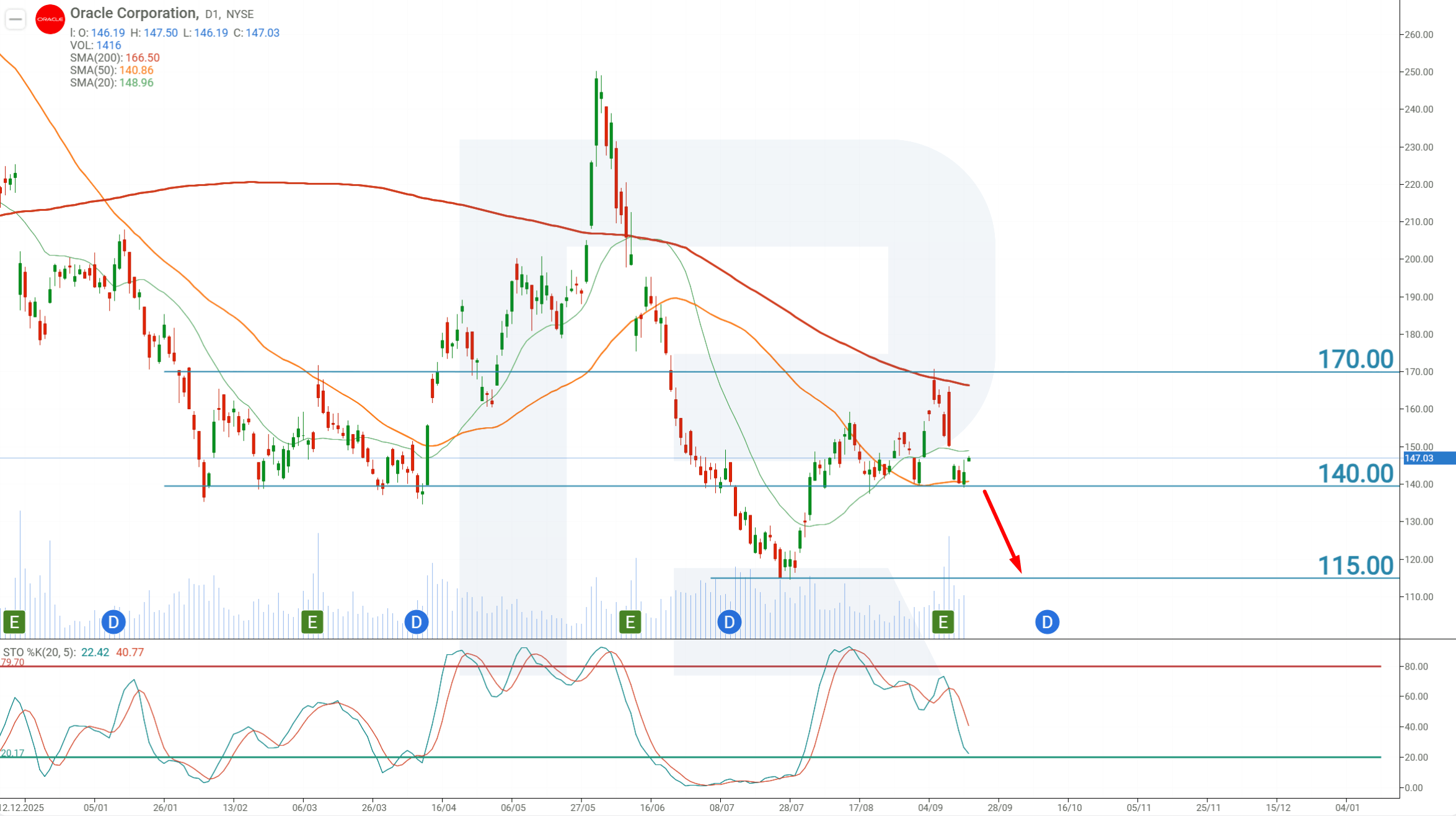
At the time of writing, ORCL stock is trading at 147 USD.
On the daily timeframe, ORCL stock is trading below the 200-period Moving Average, indicating that the downtrend remains dominant.
Fundamental analysis of ORCL also points to continued pressure on the company’s financial performance and no clear signs of a sustained recovery. An additional negative factor was the interest rate increase at the latest Fed meeting. Given Oracle’s high debt burden, this raises the cost of new financing and debt refinancing, which could increase pressure on Oracle stock.
Under the current conditions, the ORCL stock forecast for the second half of 2026 suggests that the risk of further declines remains. A break below the 140 USD support level would be the key technical signal. A sustained move below this level could open the way for a decline towards 115 USD.
Therefore, the ORCL stock trading idea is to place a Sell Stop order at 139 USD. Take Profit is set at 116 USD, with Stop Loss at 151 USD.
Sell Stop – 139.00
Take Profit – 116.00
Stop Loss – 151.00
Position management rule. Once the price moves 70% of the total target distance in the forecast direction, move the Stop Loss to the entry level. The protective order is then trailed behind the price, maintaining a distance of 10%. This continues until the position is closed at either Take Profit or Stop Loss, depending on which level is reached first.
Risks of investing in Oracle Corporation stock
Investing in Oracle Corporation’s shares is associated with several risks that could negatively affect the company’s revenues and impact its investors. Below are the main risks:
#.Intense competition in cloud computing: Oracle faces fierce competition from giants such as Alphabet Inc. (NASDAQ: GOOG), Amazon.com, Inc. (NASDAQ: AMZN), and Microsoft Corporation (NASDAQ: MSFT), which dominate the cloud technology market. If Oracle fails to implement innovations fully and offer competitive pricing, it may lose market share, thereby reducing its revenues.
#.Economic downturns: Oracle’s business model is enterprise-focused and reliant on corporate IT budgets. During recessions or economic slowdowns, companies may delay or reduce spending on software, cloud services, or hardware upgrades, which would directly impact Oracle’s revenues.
#.Limited infrastructure scalability: with rapidly growing demand for cloud services, particularly from AI-related projects, Oracle may face a shortage of computing capacity. Despite the announced data centre expansion plans and significant capital investment, the process of ramping up infrastructure takes time and resources. This may delay the execution of contracts and revenue recognition and even lead to client attrition to competitors with more scalable architectures. As a result, short-term revenue growth may be limited despite strong demand.
#.Infrastructure constraints and execution risks for AI projects: amid explosive demand for cloud and AI services, Oracle is aggressively expanding its data centre capacity, but the construction and commissioning of infrastructure take time and require substantial capital outlays. The company is already facing delays in certain AI-focused data centre projects, including those for major clients such as OpenAI. This creates risks of delayed contract execution, delayed revenue recognition, and a potential reallocation of some demand to competitors that can scale infrastructure more quickly.
#.Rising debt burden and credit risk: to finance AI investments, Oracle has issued tens of billions of USD in bonds in recent years, pushing total debt above 100 billion USD, while free cash flow has turned negative amid record CapEx. The company is becoming increasingly dependent on external financing, and bondholders require regular fixed payments, unlike shareholders, who may tolerate negative FCF in anticipation of future growth. Against this backdrop, the cost of default insurance for Oracle (CDS) has risen to its highest level since 2009, reflecting an elevated market perception of credit risk. If conditions in debt markets deteriorate, the company may be forced to cut back on CapEx, slowing the rollout of AI infrastructure, or raise capital on less favourable terms.
Forecasts presented in this section only reflect the author’s private opinion and should not be considered as guidance for trading. RoboForex bears no responsibility for trading results based on trading recommendations described in these analytical reviews.