
Palantir stock forecast: explosive business growth – outlook for PLTR shares in the second half of 2026
Palantir delivered one of the strongest quarterly results in its history. Revenue increased by 93% year-on-year, while its US commercial business grew by 149%. We examine the outlook for PLTR stock and the company's prospects for the second half of 2026.
Palantir Technologies Inc. (NASDAQ: PLTR) delivered strong Q2 2026 results, confirming the company's continued business acceleration. Revenue increased by 93% year-on-year to 1.94 billion USD. The primary growth driver remained the US commercial segment, where revenue rose by 149%. At the same time, revenue from the US government business increased by 90%, allowing the company to maintain strong momentum across its two key business segments.
Revenue growth was accompanied by improving profitability. Gross margin increased to 85%, while the GAAP operating margin reached 47%. Management once again raised its full-year guidance, forecasting revenue of 8.15–8.16 billion USD. Overall, the results show that Palantir continues to scale its Artificial Intelligence Platform (AIP), expand its commercial business, and improve operating efficiency simultaneously.
This article examines Palantir Technologies Inc., explains the company's revenue structure, reviews its quarterly financial results, provides a fundamental analysis of PLTR, presents analysts' forecasts for Palantir stock for 2026, analyses the performance of PLTR stock through technical analysis, and presents a forecast for Palantir Technologies stock for the second half of 2026.
About Palantir Technologies Inc.
Palantir Technologies was founded in 2003 by Peter Thiel, Alexander Karp, Joseph Lonsdale, Stephen Cohen, and Nathan Gеttings. The company went public on 30 September 2020 on the New York Stock Exchange under the PLTR ticker symbol.
Palantir specialises in developing software for big data analysis, including Gotham, designed for national security and intelligence agencies; Foundry, for the corporate sector; and Apollo, for deploying software releases. These products are available to both government and private clients, providing software solutions for data management and analysis, and emphasising privacy and security.
Palantir Technologies Inc. Q3 2024 financial results
Palantir Technologies released its Q3 2024 financial results on 4 November 2024. The key report highlights are outlined below:
- Revenue: 726.5 million USD (+30%)
- Net income: 149.3 million USD (+103%)
- Earnings per share: 0.06 USD (+100%)
Revenue by segment and region:
- US: 498.9 million USD (+45%)
- UK: 69.5 million USD (+10%)
- Other countries: 157.0 million USD (+21%)
- Government: 408.3 million USD (+33%)
- Commercial revenue: 317.5 million USD (+27%)
- US government revenue: 319.8 million USD (+39%)
- US commercial Revenue: 179.1 million USD (+34%)
The report indicates that the US government remains Palantir Technologies’ primary source of revenue, contributing nearly half of the company’s total revenue. Palantir forecasted revenue of 767.0–771.0 million USD in Q4 2024, representing a 5-6% increase compared to the previous quarter.
Palantir Technologies Inc. Q4 2024 financial results
On 3 February 2025, Palantir Technologies Inc. published its Q4 2024 financial results. The key figures are presented below:
- Revenue: 827.5 million USD (+36%)
- Net income: 76.9 million USD (-21%)
- Earnings per share: 0.03 USD (-25%)
Revenue by segment:
- Commercial revenue: 372.5 million USD (+31%)
- US government revenue: 343.0 million USD (+45%)
- US commercial revenue: 214.0 million USD (+64%)
Palantir CEO Alex Karp said the strong Q4 2024 results validated the company's strategy of driving widespread adoption of large language models. In his view, Palantir is only at the beginning of a multi-year growth cycle that the company has spent more than two decades preparing for.
For 2025, Palantir forecast revenue of 3.74–3.76 billion USD, representing growth of approximately 31%. US commercial revenue was expected to reach 1.07 billion USD, up 54% from 2024. Adjusted operating profit was forecast at 1.55–1.57 billion USD, while free cash flow was expected to range between 1.05 billion USD and 1.70 billion USD.
For Q1 2025, the company forecast revenue of 858–862 million USD and adjusted operating profit of 354–358 million USD. At the same time, potential reductions in the US defence budget remained a key risk, as more than 40% of Palantir's Q4 2024 revenue came from US government contracts.
Palantir Technologies Inc. Q1 2025 financial results
On 5 May 2025, Palantir Technologies Inc. published its Q1 2025 financial results for the quarter ended 31 March. The key figures are presented below:
- Revenue: 883.9 million USD (+39%)
- Net income: 214.0 million USD (+24%)
- Earnings per share (non-GAAP): 0.13 USD (+62%)
Revenue by segment:
- Commercial revenue: 396.8 million USD (+33%)
- Government revenue: 486.9 million USD (+45%)
- US government revenue: 373.0 million USD (+45%)
- US commercial revenue: 255.0 million USD (+71%)
Palantir's Q1 2025 results confirmed the company's strong business momentum. Revenue increased by 39% year-on-year, while the US commercial business grew by 71%. The number of customers rose by 39% year-on-year and by 8% compared with the previous quarter.
Further diversification was another important development. Palantir continued to expand its commercial business, gradually reducing its dependence on government contracts. Growth in the corporate customer base and an increasing number of large deals showed that the company's products were finding increasingly broad application beyond the government sector.
During the quarter, Palantir signed 139 deals worth more than 1 million USD, including 31 contracts valued at more than 10 million USD. Operating profit totalled 176 million USD, with an operating margin of 20%, while free cash flow reached 370 million USD.
Following these strong results, the company raised its 2025 revenue guidance to 3.89–3.90 billion USD. For Q2, Palantir forecast revenue of 934–938 million USD and operating profit of 401–405 million USD, expecting continued demand for its AIP platform and further expansion of its commercial business.
Palantir Technologies Inc. Q2 2025 financial results
On 4 August 2025, Palantir Technologies Inc. published its Q2 2025 financial results for the quarter ended 30 June. The key figures are presented below:
- Revenue: 1.00 billion USD (+48%)
- Net income: 326.72 million USD (+33%)
- Earnings per share (non-GAAP): 0.16 USD (+100%)
Revenue by segment:
- Commercial revenue: 450.7 million USD (+47%)
- Government revenue: 552.9 million USD (+49%)
- US government revenue: 426.1 million USD (+53%)
- US commercial revenue: 306.5 million USD (+93%)
Palantir delivered strong Q2 2025 results. Revenue reached 1.00 billion USD, up 48% year-on-year and 14% quarter-on-quarter. Growth was driven primarily by two business segments. Government revenue reached 553 million USD (+49% year-on-year), while commercial revenue totalled 451 million USD (+47% year-on-year). Geographically, the US remained the primary growth driver, generating 733 million USD in revenue (+68% year-on-year and +17% quarter-on-quarter). Revenue outside the US totalled 271 million USD, up 12% year-on-year.
Palantir's profitability improved. Gross margin reached approximately 80.8%, representing the proportion of revenue remaining after the direct costs of delivering its products. The GAAP operating margin rose to 27%, while the net profit margin reached 32.6%, indicating that the company generated substantial net profit relative to revenue. On a non-GAAP basis, which excludes certain non-operating items, the operating margin reached 46%. The improvement in margins was driven by operating leverage, with expenses growing more slowly than revenue.
Management raised its guidance for Q3 2025, forecasting revenue of 1.083–1.087 billion USD and adjusted operating profit of 493–497 million USD. For the full year, the company forecast revenue of 4.142–4.150 billion USD (approximately 45% year-on-year growth), adjusted operating profit of 1.912–1.920 billion USD, and adjusted free cash flow of 1.8–2.0 billion USD. Management also highlighted the continued acceleration of the US commercial business, which was expected to generate more than 1.302 billion USD in revenue during the year.
Palantir Technologies Inc. Q3 2025 financial results
On 3 November 2025, Palantir Technologies Inc. published its Q3 2025 financial results for the quarter ended 30 September. The key figures are presented below:
- Revenue: 1.18 billion USD (+63%)
- Net income (non-GAAP): 528.71 million USD (+119%)
- Earnings per share (non-GAAP): 0.21 USD (+110%)
Revenue by segment:
- Commercial revenue: 548.42 million USD (+73%)
- Government revenue: 632.68 million USD (+55%)
- US government revenue: 485.90 million USD (+52%)
- US commercial revenue: 396.70 million USD (+121%)
Palantir delivered a very strong Q3 2025 report, significantly exceeding market expectations. Revenue increased by 63% year-on-year, approximately 8% above the consensus forecast, while adjusted earnings per share (non-GAAP EPS) reached 0.21 USD, compared with market expectations of around 0.17 USD.
On a non-GAAP basis, the company was already operating like a mature, high-margin software business. Adjusted operating profit totalled 601 million USD, with an operating margin of 51%. Adjusted net income reached 529 million USD, while adjusted free cash flow amounted to 540 million USD, corresponding to a 46% margin. In other words, more than half of the company's revenue was converted into cash.
The business mix continued to shift towards the commercial segment. Commercial revenue increased by 73% year-on-year, while US commercial revenue rose by 121% to 397 million USD. By comparison, government revenue increased by 55% year-on-year. The US now accounted for approximately 75% of total revenue, while the number of large deals continued to grow, with 204 contracts worth more than 1 million USD signed during the quarter, including 53 valued at more than 10 million USD.
Management raised its 2025 guidance, forecasting revenue of 4.396–4.400 billion USD (approximately 53% year-on-year growth), adjusted operating profit of 2.151–2.155 billion USD, and adjusted free cash flow of 1.9–2.1 billion USD. For Q4 2025, the company expected revenue of approximately 1.33 billion USD and a further improvement in margins.
Palantir Technologies Inc. Q1 2026 financial results
On 4 May 2026, Palantir Technologies Inc. published its Q1 2026 financial results for the quarter ended 31 March. The key figures are presented below:
- Revenue: 1.63 billion USD (+85%)
- Net income (non-GAAP): 856.45 million USD (+156%)
- Earnings per share (non-GAAP): 0.33 USD (+154%)
Revenue by segment:
- Commercial revenue: 774.17 million USD (+95%)
- Government revenue: 858.41 million USD (+76%)
- US government revenue: 686.79 million USD (+84%)
- US commercial revenue: 594.79 million USD (+133%)
The primary growth driver in Q1 2026 was the continued acceleration of Palantir's US business. US revenue increased by 104% to 1.28 billion USD, accounting for almost 79% of the company's total quarterly revenue.
Revenue from the US commercial business increased by 133% to 595 million USD. The number of US commercial customers rose by 42% to 615, while the remaining deal value in this segment increased by 112% to 4.92 billion USD.
The US government business also delivered strong growth. Revenue increased by 84% to 687 million USD, supported by sustained demand from defence and other government agencies. Total government revenue reached 858 million USD, up 76% year-on-year.
Following the strong quarter, management raised its guidance for 2026. The company now expects:
- Revenue of 7.650–7.662 billion USD
- Annual revenue growth of approximately 71%
- US commercial revenue of more than 3.224 billion USD, representing growth of at least 120%
- Adjusted operating profit of 4.440–4.452 billion USD
- Adjusted free cash flow of 4.2–4.4 billion USD
Palantir Technologies Inc. Q2 2026 financial results
On 3 August 2026, Palantir Technologies Inc. published its Q2 2026 financial results for the quarter ended 30 June. The key figures are presented below:
- Revenue: 1.94 billion USD (+93%)
- Net income (non-GAAP): 1.05 billion USD (+159%)
- Earnings per share (non-GAAP): 0.41 USD (+156%)
Revenue by segment:
- Commercial revenue: 945.43 million USD (+110%)
- Government revenue: 990.03 million USD (+79%)
- US government revenue: 809 million USD (+90%)
- US commercial revenue: 764 million USD (+149%)
Palantir's Q2 2026 financial results confirmed that the company's business continued to accelerate. Revenue reached 1.94 billion USD, increasing by 93% year-on-year and 19% quarter-on-quarter. By comparison, revenue growth in Q1 was 85% year-on-year. Moreover, the result exceeded the upper end of Palantir's own guidance of 1.80 billion USD by 7.5%.
The US commercial business remained the primary growth driver. Revenue increased by 149% year-on-year and 28% quarter-on-quarter to 764 million USD. At the same time, the US government business also remained strong, with revenue increasing by 90% to 809 million USD. As a result, Palantir continues to benefit from two powerful growth drivers: corporate adoption of AIP and government programmes.
Diversification between the government and commercial businesses is particularly important. Total commercial revenue reached 945 million USD, more than doubling from 451 million USD a year earlier, while government revenue increased to 990 million USD from 553 million USD. As a result, the commercial segment now accounts for approximately 49% of quarterly revenue, up from 45% a year earlier. This shows that Palantir is not reducing its government business but is creating a more balanced revenue mix through significantly faster growth in its commercial operations.
Gross profit more than doubled to 1.64 billion USD, while the gross margin increased from 81% to 85%. GAAP operating profit reached 912 million USD, with an operating margin of 47%, while adjusted operating profit totalled 1.19 billion USD, with a margin of 62%. As a result, the Rule of 40 reached a record 155%, comprising 93% revenue growth and a 62% adjusted operating margin. Importantly, this rapid growth continues to be accompanied by improving profitability.
Cash flow also reflects the company's strong operating performance. Operating cash flow reached 1.22 billion USD, while adjusted free cash flow also totalled 1.22 billion USD, corresponding to a margin of approximately 63%. At the same time, the company ended the quarter with 9.2 billion USD in cash, cash equivalents, and short-term US Treasury securities, providing substantial liquidity to support future business growth.
One area that still warrants close attention is geographic concentration. Despite improving diversification between commercial and government customers, Palantir's dependence on the US market continues to increase. Revenue in the US grew by 115% to 1.57 billion USD and now accounts for 81% of total revenue, up from 73% a year earlier. Revenue outside the US increased at a much slower pace, rising by 34% to 362 million USD. As a result, one of the company's next key objectives will be to scale the success of AIP beyond the US market.
Management also raised its guidance significantly. Following Q1, Palantir had forecast annual revenue of 7.65–7.66 billion USD. This has now been raised to 8.15–8.16 billion USD, representing growth of approximately 82%. Guidance for US commercial revenue was raised from more than 3.22 billion USD to more than 3.42 billion USD, representing growth of at least 134%. Guidance for adjusted free cash flow was increased from 4.2–4.4 billion USD to 4.5–4.7 billion USD. For Q3, management forecast revenue of 2.16–2.164 billion USD and adjusted operating profit of 1.292–1.296 billion USD.
Q2 2026 can be regarded as one of Palantir's strongest quarterly results since the company went public. The key takeaway is the combination of 149% growth in the US commercial business, an almost even split between commercial and government revenue, an expansion in the GAAP operating margin to 47%, and strong cash generation. This indicates that AIP has moved beyond the stage of a promising technology to become a large-scale commercial business.
Key growth drivers for Palantir stock
When analysing Palantir stock as of August 2026, investors should focus on several key indicators. These provide insight into how successfully the company is scaling its AIP platform, maintaining strong growth in the US, expanding its international presence, and converting revenue growth into profit.
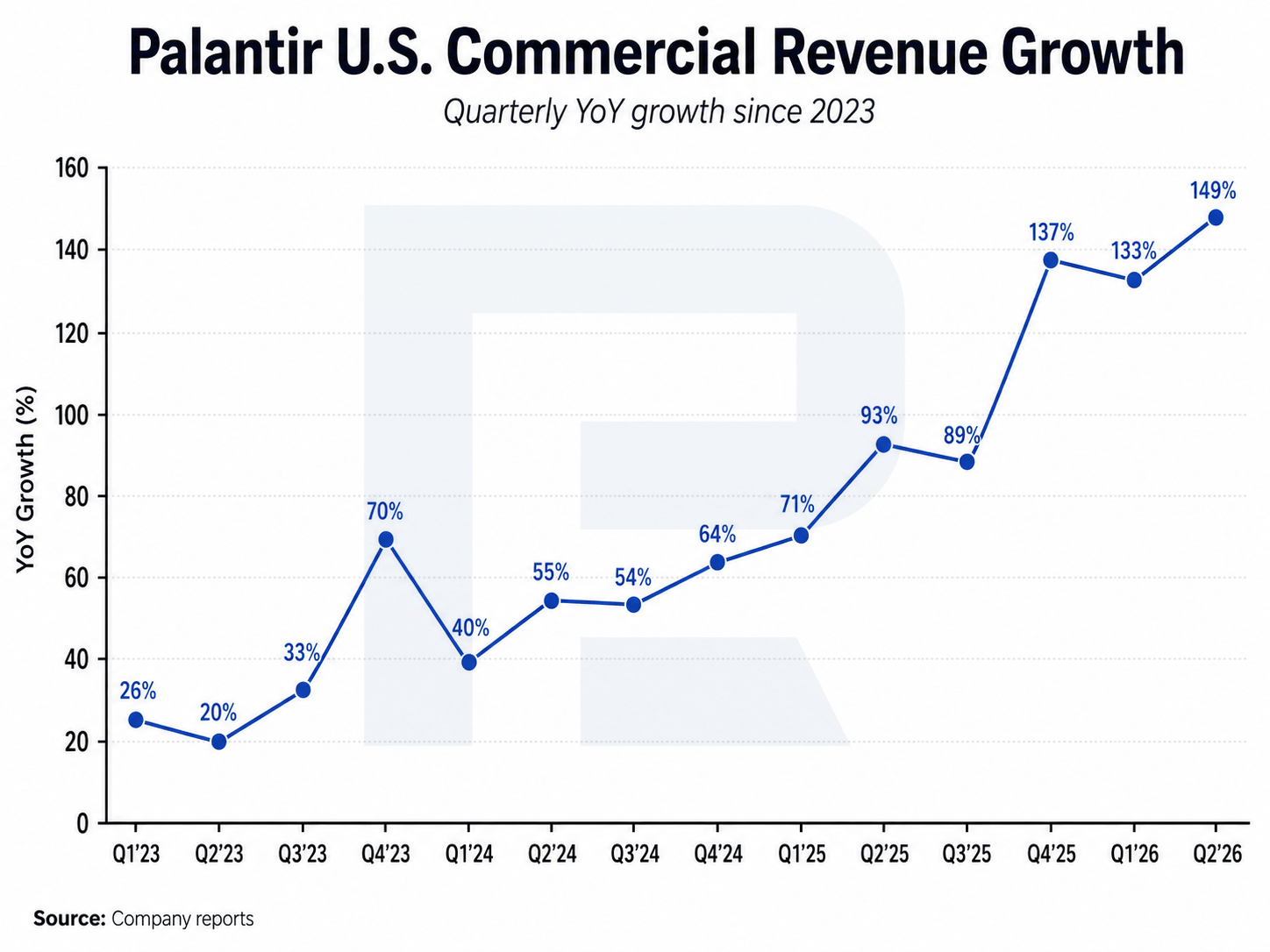
US commercial revenue growth. Growth in US commercial revenue remains the primary driver of Palantir stock. This metric best reflects the adoption of AIP among corporate customers and the company's ability to translate strong interest in artificial intelligence into revenue. Investors should assess whether the US commercial business continues to maintain its high growth rate. Following Q2 2026, Palantir continues to accelerate, confirming strong demand for its software solutions.
Sustained US commercial revenue growth of more than 100% would indicate that AIP continues to gain traction rapidly. Conversely, a sustained slowdown in this metric could become one of the earliest signs that the company's growth is beginning to moderate.
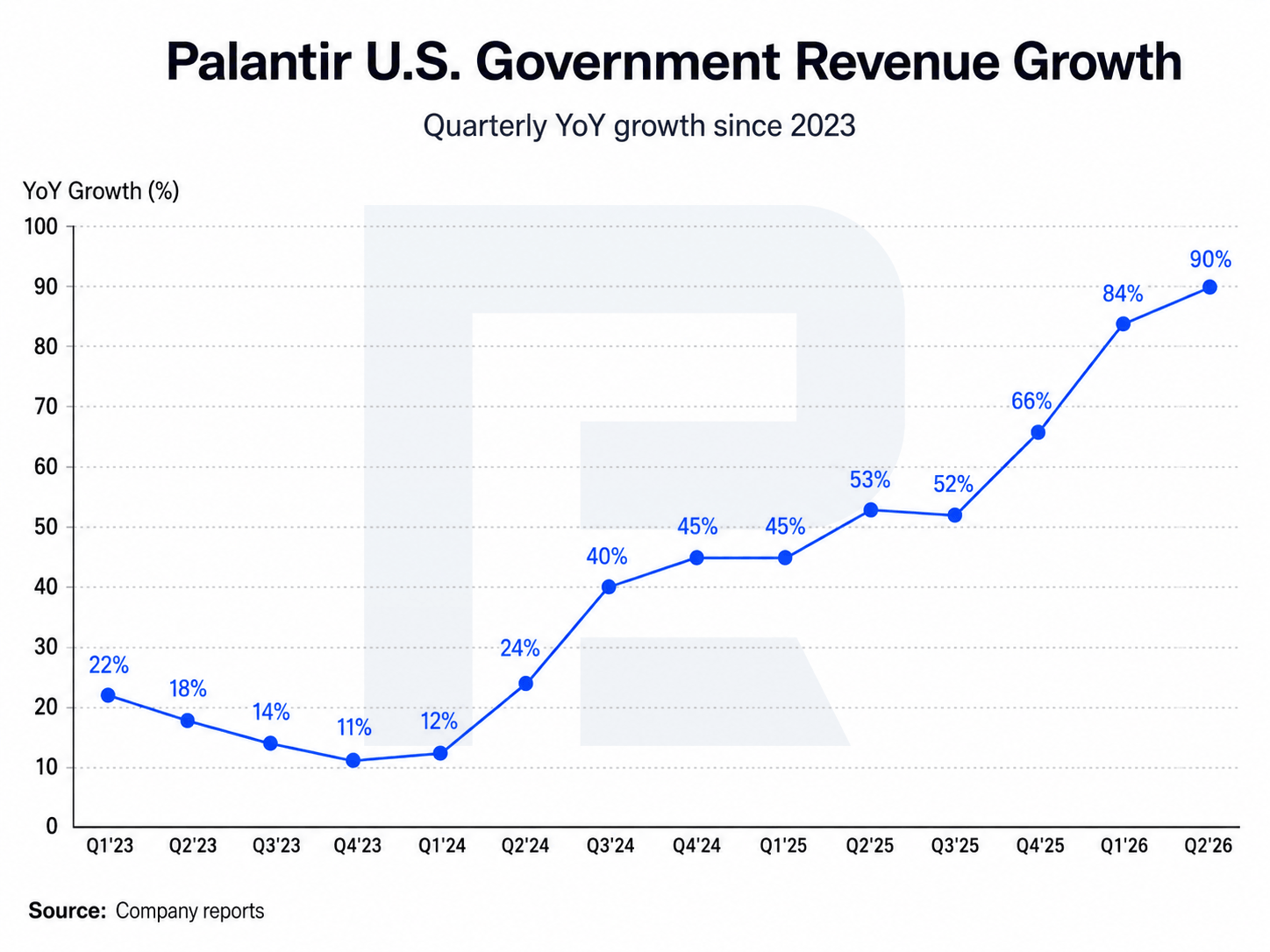
US government revenue growth. US government revenue remains an additional growth driver for Palantir. Government contracts provide the company with a large and stable source of revenue, while rising spending on defence, intelligence, and artificial intelligence creates additional growth opportunities.
In Q2 2026, US government revenue increased by 90% year-on-year and 18% quarter-on-quarter to 809 million USD.
As a result, Palantir continues to benefit from two powerful growth drivers: corporate customers and government clients.
After each earnings report, investors should assess whether US government revenue continues to grow strongly. Continued double-digit growth would support the company's overall expansion. In contrast, a simultaneous slowdown in both the commercial and government segments would represent a more significant negative signal for Palantir stock.
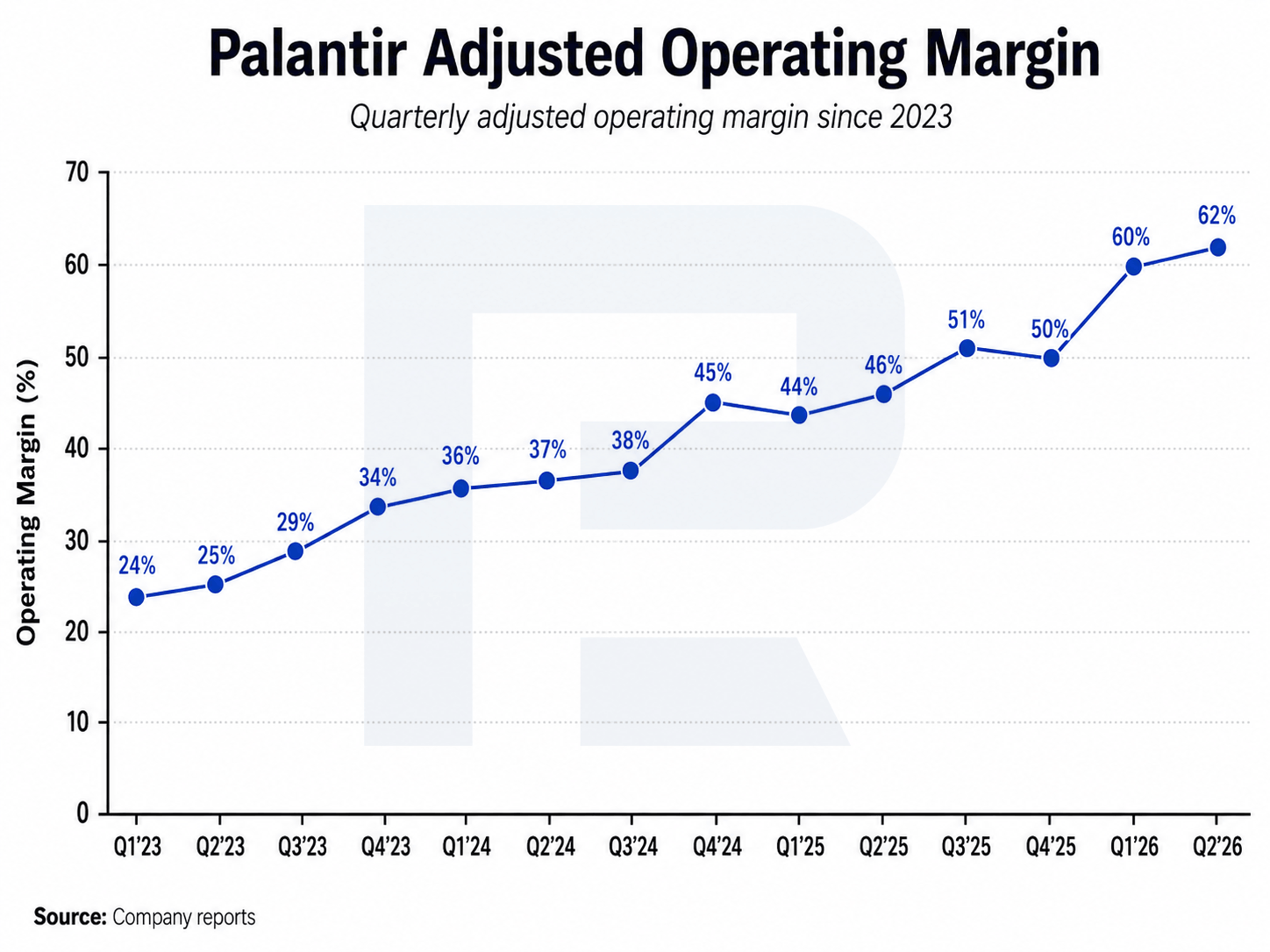
Operating margin. Palantir's high growth rate should be assessed alongside the company's profitability. Unlike many fast-growing technology companies, Palantir already demonstrates strong operating leverage.
In Q2 2026, adjusted operating profit reached 1.19 billion USD, while the adjusted operating margin increased to 62%, up from 60% in the previous quarter and 57% in Q4 2025.
Rising margins alongside accelerating business growth show that Palantir can scale AIP without a comparable increase in costs. However, if revenue continues to grow while the operating margin begins to decline, the quality of that growth will deteriorate.
Revenue growth outside the US. Another key indicator is growth in Palantir's revenue outside the US. The US market currently drives most of the company's growth, so international expansion shows how much potential remains for the business to scale further.
In Q2 2026, revenue outside the US totalled 362 million USD, increasing by 34% year-on-year. However, this growth was significantly slower than that of the company's US business, causing the share of international revenue to decline to 19% of total company revenue.
For Palantir's long-term investment case, it is important to assess whether the company can replicate the success of AIP in Europe, Asia, and other international markets.
If revenue growth outside the US begins to approach the pace of the company's US business, this would provide strong confirmation that AIP is evolving from a predominantly US product into a global enterprise platform. Conversely, weaker international growth would indicate that Palantir remains highly dependent on the US market.
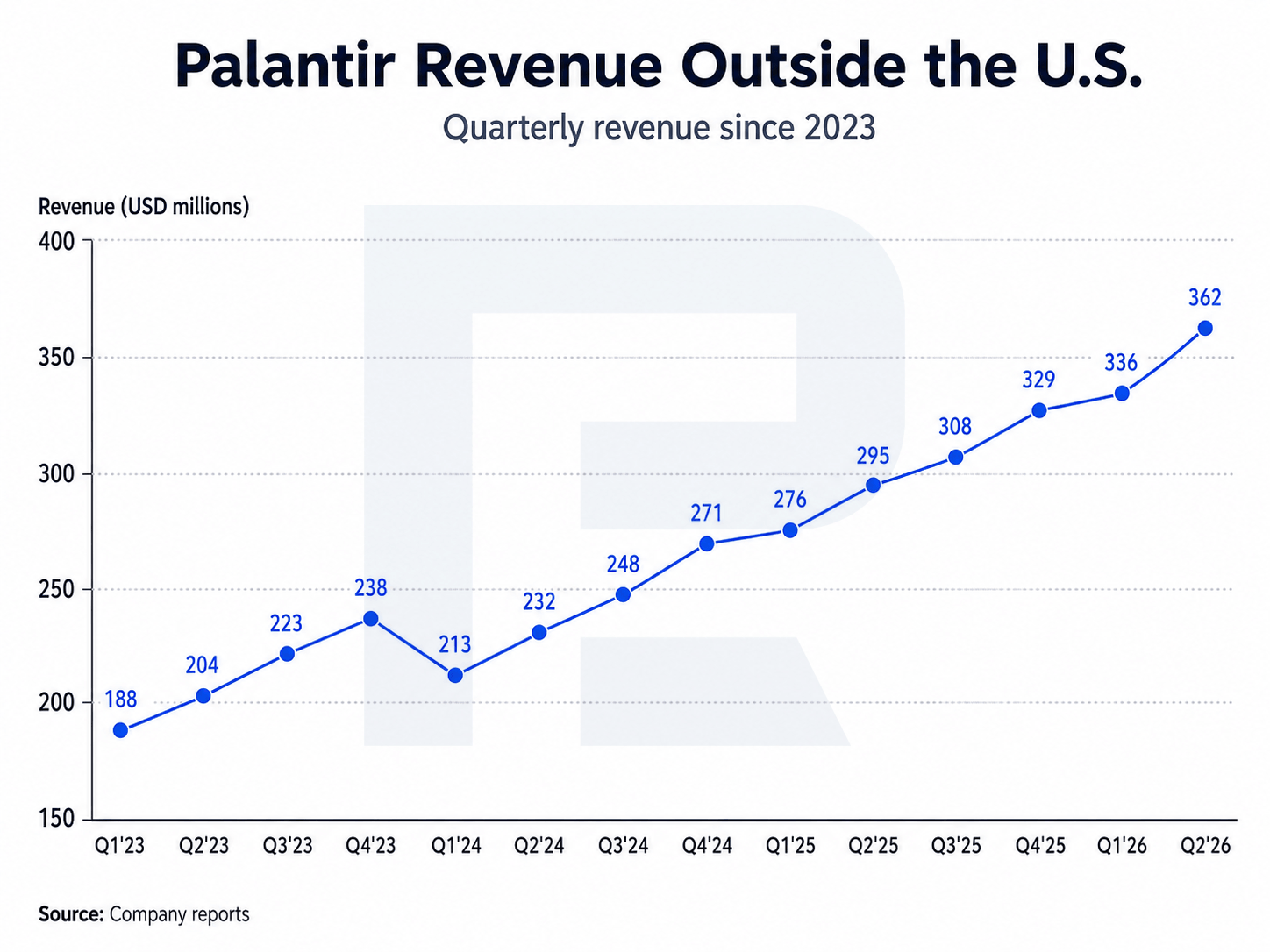
The four key indicators show a significant improvement in Palantir's fundamentals. US commercial revenue growth accelerated from 26% in Q1 2023 to 149% in Q2 2026, while US government revenue growth reached 90%. At the same time, this growth has been accompanied by a sharp improvement in profitability. The adjusted operating margin increased from 24% to 62%, confirming strong operating leverage and Palantir's ability to translate revenue growth into even faster profit growth.
The international business remains the weaker part of the company. Revenue outside the US increased from 188 million USD to 362 million USD; however, its growth continues to lag well behind that of the US business. If Palantir can accelerate its international expansion, this would provide an additional source of growth.
Overall, PLTR's fundamental drivers remain strong. The main risk is that, following such a sharp acceleration, the market will expect the company to sustain these very high growth rates. As a result, even a normalisation in growth could be viewed negatively by investors.
Expert forecasts for Palantir Technologies Inc.’s stock
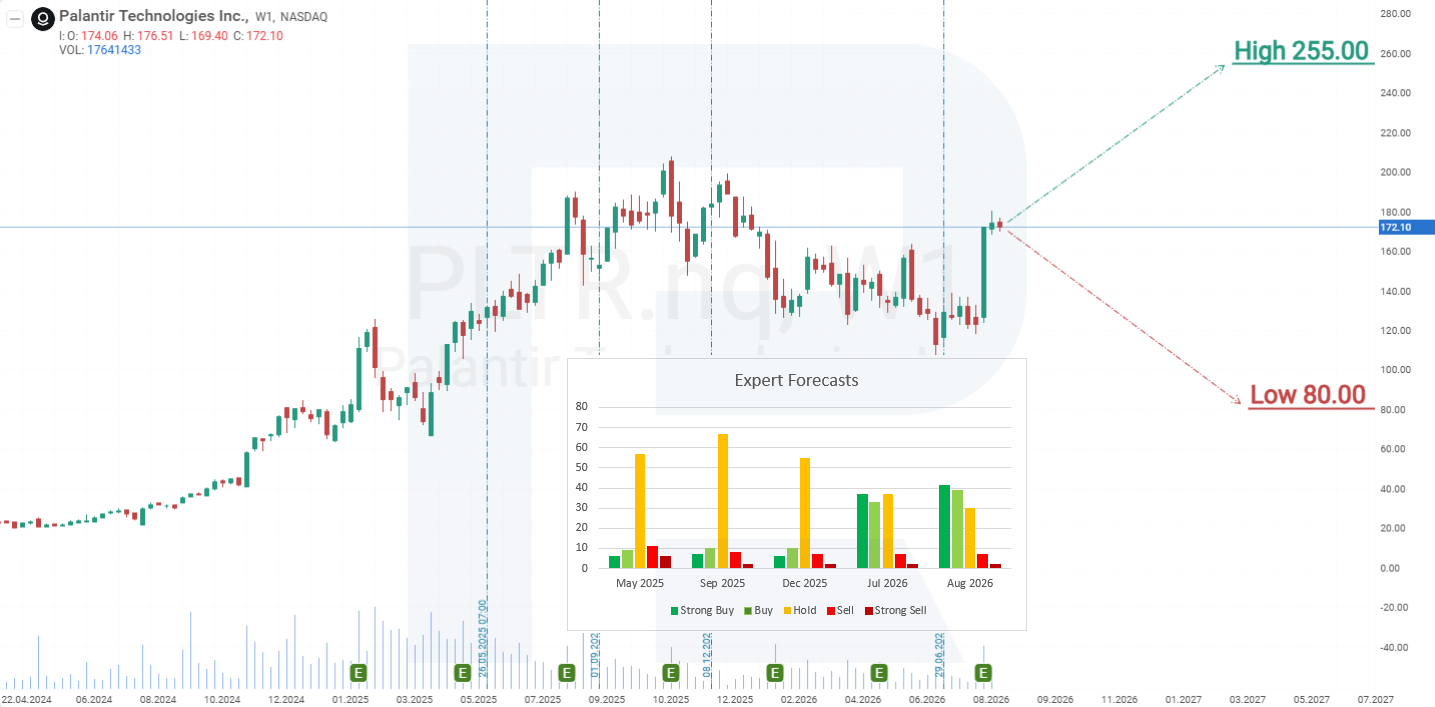
- Barchart: 21 of 29 analysts rate Palantir Technologies stock as Strong Buy, 6 as Hold, 1 as Sell, and 1 as Strong Sell. The highest price target is 255 USD, while the lowest is 80 USD.
- MarketBeat: 22 of 36 analysts rate the stock as Buy, 11 as Hold, and 3 as Sell. The highest price target is 255 USD, while the lowest is 80 USD.
- TipRanks: 16 of 22 analysts rate the stock as Buy, 4 as Hold, and 2 as Sell. The highest price target is 255 USD, while the lowest is 80 USD.
- Stock Analysis: 20 of 32 analysts rate Palantir Technologies stock as Strong Buy, 1 as Buy, 9 as Hold, 1 as Sell, and 1 as Strong Sell. The highest price target is 255 USD, while the lowest is 80 USD.
Analysts' forecasts for Palantir stock remain predominantly positive, although the range of estimates remains exceptionally wide. The majority of analysts recommend buying PLTR stock, while a notable proportion maintain a neutral or bearish view. The highest price target is 255 USD, and the lowest is 80 USD. This reflects considerable uncertainty regarding the company's fair value and highlights the stock's sensitivity to revenue growth, profitability, and continued demand for Palantir's AI solutions.
Palantir Technologies Inc. stock price forecast for 2026
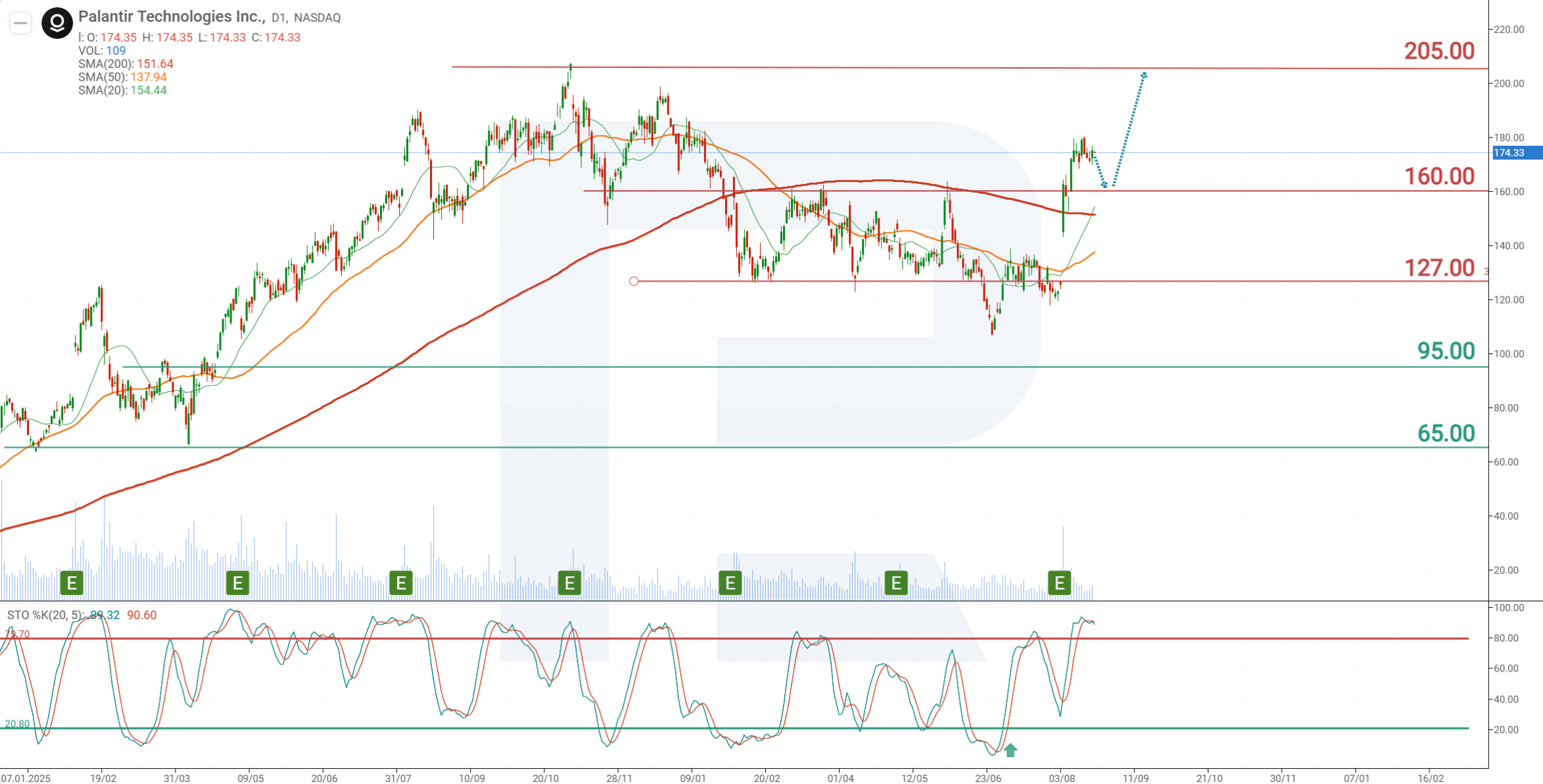
At the time of writing, PLTR stock is trading at around 175 USD.
On the weekly chart, Palantir Technologies stock has broken above the 200-period Moving Average and remains above it, signalling the emergence of a new long-term uptrend. At the same time, the Stochastic indicator is in overbought territory, increasing the likelihood of a short-term correction before the uptrend resumes. Based on the current Palantir Technologies stock performance, the following scenario outlines its potential movement in the second half of 2026.
The forecast for Palantir Technologies stock anticipates a test of support at 160 USD, followed by a rebound towards 205 USD. A break below the 200-period Moving Average at 150 USD would invalidate the bullish scenario for PLTR stock.
Accordingly, the trading strategy is to place a Buy Limit order at 160 USD, with a Take Profit target at 205 USD. A Stop Loss should be placed at 149 USD, below the 200-period Moving Average.
Position management: Once the stock has moved 8% in the projected direction, move the Stop Loss to the entry level. The protective stop should then be trailed 10% behind the price.
Risks of investing in Palantir Technologies Inc. stock
Investing in Palantir’s stock in 2026 involves certain risks that may impact the company’s earnings. Below are potential risks and factors that could negatively affect its revenue:
- Elevated valuation: despite the June sell-off, Palantir shares continue to trade at very high valuation multiples. If the company fails to deliver the growth needed to justify these valuations, investor sentiment could deteriorate, resulting in a sharp decline in the share price. Such a correction could occur if revenue growth falls short of the expected 25–30% per year.
- Reliance on government contracts: a sizeable portion of Palantir’s revenue comes from government clients, particularly US defence and intelligence agencies. Reductions in federal budgets, policy shifts under a new administration, or the non-renewal of key contracts could substantially impact revenue. Political instability or cuts in defence spending would heighten this risk.
- Commercial sector challenges: although Palantir’s Commercial revenue is growing, it still constitutes a smaller share of total revenue. The company struggles to scale due to elevated costs, making it less attractive to small and medium-sized enterprises. If the Commercial sector growth slows or fails to offset potential declines in its government revenue, overall revenue may suffer.
- Rising competition: Palantir faces competition from tech giants like Microsoft (NASDAQ: MSFT), which may integrate AI and analytics into broader offerings, as well as from specialised companies. If competitors offer cheaper or more affordable alternative solutions, Palantir risks losing its market share (especially in the commercial sector), which would negatively impact the company’s financial position.
- Regulatory and AI risks: tighter regulation of AI and data analytics, especially in the US and globally, could limit Palantir’s capabilities or increase compliance costs. Concerns over privacy or misuse of its tools (for example, in surveillance) could damage the company’s reputation, thereby deterring clients and reducing revenue.
- Share capital dilution due to stock compensation: Palantir actively uses company shares for compensation, reducing their value for shareholders. If this practice continues without corresponding revenue growth, it could undermine investor confidence and put pressure on the stock price, raising doubts about the stability of future revenue.
- Stock sales by insiders: in 2024, the company’s insiders, including CEO Alex Karp and co-founder Peter Thiel, actively sold significant portions of their personal holdings, with Thiel divesting a third of his stake during this period. In February 2025, it was announced that Karp had applied to sell an additional 1.00 billion worth of shares. Such insider activity may negatively impact the market price of the shares and investor sentiment.
All these factors reduce confidence in Palantir’s ability to maintain its projected growth trajectory and revenue streams in 2026, making investment in its stock highly risky.
Forecasts presented in this section only reflect the author’s private opinion and should not be considered as guidance for trading. RoboForex bears no responsibility for trading results based on trading recommendations described in these analytical reviews.