NVIDIA Turns One Deal Into Two Revenue Streams: What Firmus Means for NVDA Stock
NVIDIA has signed an agreement with Firmus to supply up to 170,000 AI chips for a major data centre in Indonesia. The deal widens NVIDIA's customer base, adds a stream of cloud computing income, and points to a new growth model for the company. The base-case forecast for NVDA stock sees a bounce off support at 195 USD and a move toward 280 USD.
In Brief
- NVIDIA signed a contract with Firmus to supply up to 170,000 AI chips.
- NVIDIA is entering the Indonesian market.
- The agreement gives NVIDIA access to young AI companies and other customers that cannot build large data centres on their own.
- NVIDIA broadens its customer base and opens a new source of recurring revenue.
- 46 out of 49 analysts rate NVDA stock as a Buy.
- NVDA could reach the upper channel line at 280 USD.
Trade Idea Parameters
Below are the specific parameters for the NVIDIA trade idea. The ticker for trading via RoboForex MobileTrader and MT5 on RoboForex is NVDA.
| Parameter | Value |
|---|---|
| Instrument | NVIDIA Corp (NASDAQ: NVDA) |
| Ticker in MobileTrader / MT5 | NVDA |
| Idea Date | June 30, 2026 |
| Time Horizon | 1–6 months |
| Direction | ↑ Buy (Long) |
| Entry Level (trigger) | 195 USD |
| Take Profit | 280 USD |
| Stop Loss | 164 USD |
| Position Size | No more than 3% of account · Medium risk |
Instant Access to Global Markets with RoboForex MobileTrader
NVIDIA and Firmus to Build a Large AI Data Centre in Asia
NVIDIA has signed a major agreement with Australian company Firmus Technologies, which plans to build one of the largest AI data centres in the Asia-Pacific region in Indonesia. The project will host up to 170,000 NVIDIA AI chips. Deliveries start in 2027 and continue into early 2028. The 360 MW data centre will be built on Batam Island, close to Singapore.
The main feature of the agreement lies in the structure of NVIDIA's income. The company earns revenue from selling the equipment, and then receives a share of the income from Firmus cloud services.
This way, NVIDIA broadens how it earns. Selling chips brings a large one-time payment during the construction phase, while the share of cloud income can create steady inflows over several years.
About Firmus Technologies
Firmus Technologies is an Australian company that builds and operates data centres for artificial intelligence workloads.
Firmus started out developing bitcoin mining sites, then moved into data centres and cloud computing. That shift came naturally, since both directions call for large amounts of electricity, efficient cooling, and a high density of computing hardware.
Firmus has worked with NVIDIA before. The chipmaker took part in earlier funding rounds for the company and became one of its investors.
The new agreement noticeably increases the scale of Firmus's business. The company gains access to 170,000 NVIDIA AI chips, its technologies, and support in finding customers.
Details of the NVIDIA and Firmus Agreement
NVIDIA and Firmus have signed a strategic agreement to provide computing capacity to AI developers, running through 2034. The core of the partnership will be a 360 MW site on Batam Island in Indonesia.
Firmus will buy NVIDIA equipment, install it at the site, and sell customers access to cloud computing. The main target audience will be companies building products around artificial intelligence, large enterprises, and independent software developers.
The agreement provides for the deployment of up to 170,000 NVIDIA AI chips across 2027 and 2028. Deliveries are set to include several platform generations:
- Grace Blackwell
- Vera Rubin
- Vera
The Firmus site in Batam will be built together with DayOne, a data centre operator headquartered in Singapore.
At the heart of the site will be NVIDIA DSX, a system for designing and managing large computing centres. It will be combined with Firmus's own development called HyperCube, a liquid-cooled computing site design created around NVIDIA's technical requirements.
Firmus expects to earn between 25 and 30 billion USD in the first six years after the site goes live. That estimate rests on customer commitments to buy future computing capacity.
NVIDIA will receive revenue from selling its equipment along with an agreed share of the income from the cloud services provided.
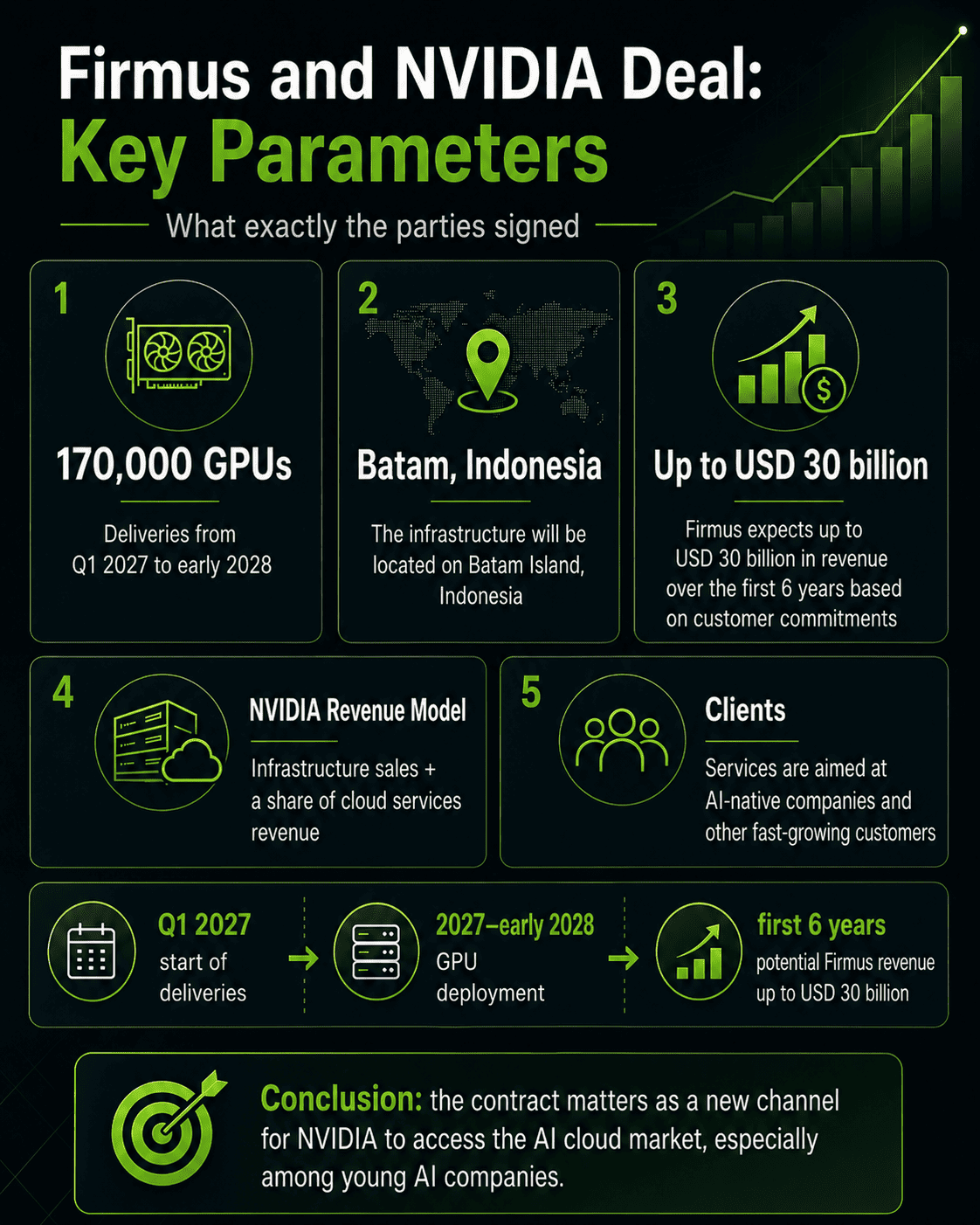
Below are the key parameters of the agreement between NVIDIA and Firmus:
Why the Firmus Deal Matters for NVIDIA
The Firmus deal expands NVIDIA's market beyond the largest technology companies. Today, most of the demand for accelerators comes from Microsoft, Amazon, Alphabet, Meta, and other large cloud operators. Firmus opens computing capacity to young AI companies, developers, and enterprises that cannot buy tens of thousands of AI chips and build their own data centres. Alongside that, the Firmus deal gives NVIDIA several more advantages:
- A new sales channel. Firmus pools demand from many customers, buys equipment in large batches, and then leases out computing capacity. This model helps NVIDIA sell more accelerators outside the largest cloud companies.
- Hardware revenue. NVIDIA can earn from supplying processors, networking equipment, and other components needed to run a data centre.
- A share of cloud revenue. On top of selling hardware, NVIDIA will receive a share of the income from Firmus cloud services. This lets the company keep earning after the systems are installed.
- Long-term demand across several product generations. Firmus plans to use Grace Blackwell, Vera Rubin, and Vera. The partnership runs through 2034, so NVIDIA can count on follow-on deliveries and hardware upgrades.
- A stronger position in Asia. The Batam site sits close to Singapore and can serve customers across Southeast Asia, Australia, and other fast-growing markets. That widens NVIDIA's sales geography.
- A model it can scale. If the project succeeds, NVIDIA can repeat this setup with other independent cloud operators.
The financial contribution of a single Firmus deal stays moderate relative to NVIDIA's scale. The main value of the deal lies in broadening the customer base, selling several hardware generations, and creating an added source of recurring revenue.
Open a Trading Account at RoboForex
Swap-free accounts, spreads from 0, and execution in 0.01 seconds.
Why the Firmus Deal Makes NVDA Stock More Attractive
NVIDIA's history has already shown several times that the company knows how to find new markets for its technologies.
During the crypto boom, NVIDIA graphics processors picked up extra demand from miners. After that market cooled, investors worried the company would lose an important source of growth, and the rise in NVDA slowed. The company then moved to the centre of artificial intelligence development, and its chips became the foundation for training and running large AI models, which acted as a catalyst for further gains in the share price.
The next concern appeared inside the AI market itself. A large part of the demand for NVIDIA accelerators sits with a small number of the biggest technology companies: Microsoft, Amazon, Alphabet, and Meta. These customers spend tens of billions of USD on equipment, and at the same time develop their own AI chips and aim to reduce their reliance on NVIDIA. The Firmus deal shows how NVIDIA can address that.
Firmus pools demand from young AI companies, developers, and corporate customers that need powerful computing but lack the funds to build their own data centres. That gives NVIDIA access to a broad customer base through one large partner. NVIDIA starts selling computing capacity through an independent cloud operator and lowers its reliance on a few of the biggest buyers.
The second important part of the agreement relates to the revenue model, under which NVIDIA receives a share of income from cloud services. This raises the economic value of every installed system and gradually adds recurring cloud income on top of hardware revenue.
For NVIDIA stock, this is a positive signal. The company is again widening the boundaries of its market and building a new channel to monetise its technology. Even if the largest cloud companies increase the use of their own chips, independent operators and young AI companies will keep needing the NVIDIA platform.
NVDA Analyst Ratings
As of July 2026, Barchart analyst ratings for NVDA stock show a strong tilt toward buying: 46 out of 49 tracked analysts rate NVDA as a Buy, 2 as Hold, and only 1 as a Sell.
Buy — 46
Hold — 2
Sell — 1
46 out of 49
recommend Buy (94%)
Hold
2 (4%)
Sell
1 (2%)
Average Target Price
301.92 USD
Maximum Target
500.00 USD
NVIDIA Stock Technical Analysis
On the weekly timeframe, NVDA trades above the 200-day Moving Average, which points to a continued uptrend. The price also stays within a rising channel and is testing the trendline around 195 USD, which now acts as support. The Stochastic indicator sits between the 20 and 80 levels, which raises the chance of a renewed move higher after the correction seen over the past seven weeks.
In the current setup, the optimal scenario is a bounce off support at 195 USD followed by a rise toward the upper channel line at 280 USD.
The Firmus deal, like the earlier RTX Spark story, belongs to the category of long-term investment ideas. So the 280 USD level is worth treating as the nearest target within the current move, rather than the final goal of long-term growth.
A break below support at 165 USD would cancel the bullish scenario, since the rising trendline would give way and the price could slide toward the 200-day Moving Average around 100 USD.
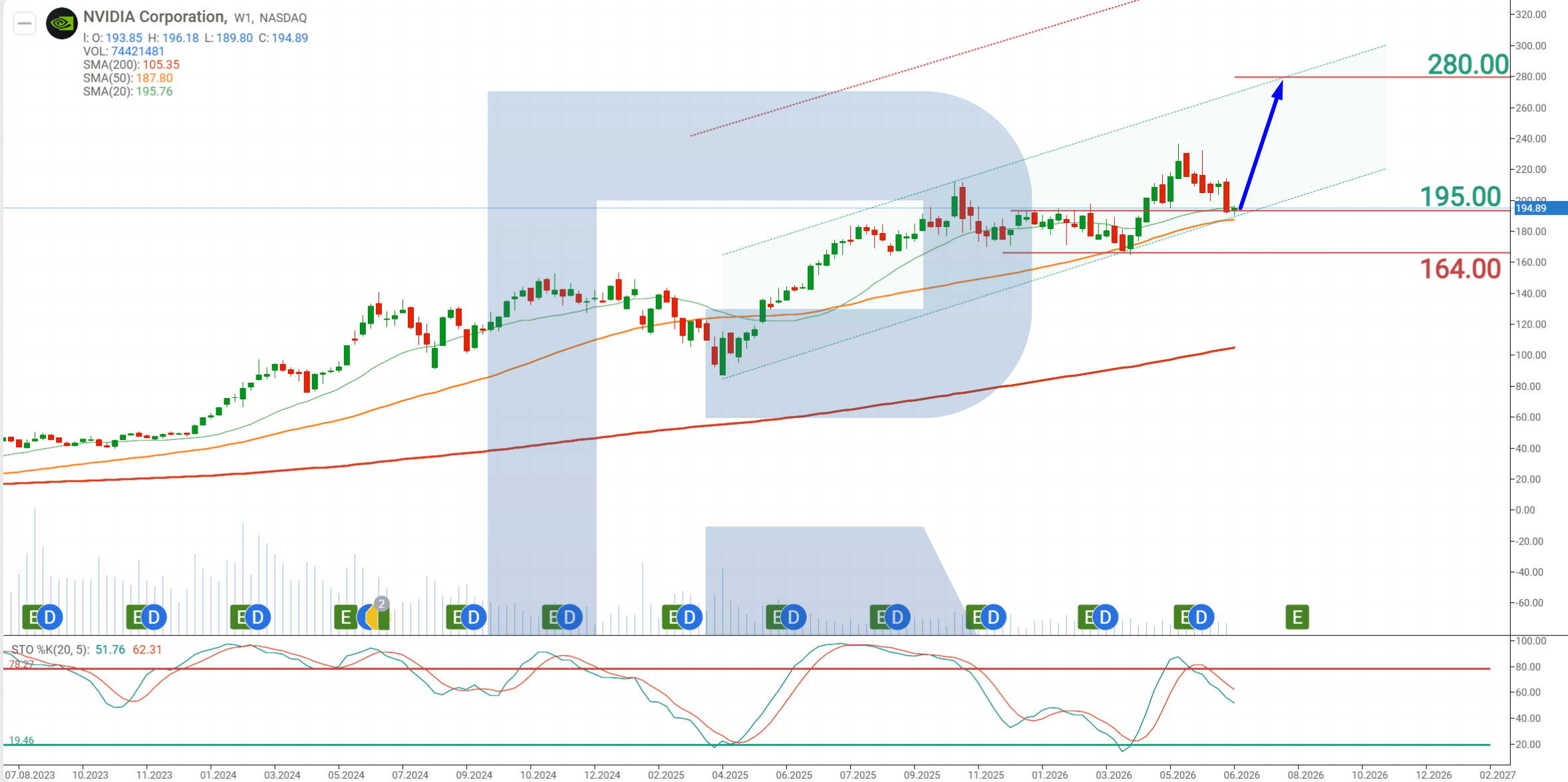
Based on the technical analysis, several conclusions can be drawn:
- The 200-day Moving Average (MA200) remains well below the current price, confirming the strength of the long-term uptrend.
- Stochastic sits between the 20 and 80 levels, which raises the chance that the correction ends and NVDA resumes its rise within the ascending channel.
- Buying on a bounce off support at 195 USD offers the best option in terms of the risk/reward balance.
- The upper channel line serves as the nearest target, rather than the goal of long-term growth.
Sample Trading Strategy for NVIDIA Stock
Below is a sample trading strategy for NVDA shares. This example is for educational purposes only and does not constitute investment advice. Investors should assess their own risk tolerance independently.
| Parameter | Value |
|---|---|
| Entry Point | Buy at 195 USD per share |
| Take Profit | 280 USD per share |
| Stop Loss | 164 USD (below support at 165 USD) |
| Risk / Reward Ratio | 1 : 2.7 |
| Position Size | No more than 3% of account |
Sample Calculation for 10 NVDA Shares
| Scenario | Calculation | Result |
|---|---|---|
| Buy 10 shares at 195 USD | 10 × 195 USD | 1,950 USD |
| If target reached (280 USD) | (280 − 195) × 10 | +850 USD (+43.6%) |
| If stop triggered (164 USD) | (195 − 164) × 10 | −310 USD (−15.9%) |
| Risk / Reward | 310 / 850 | 1 : 2.7 |
A risk/reward ratio of around 1:2.7 looks favourable for position trading. Keep in mind that markets are volatile: NVDA shares can move both for and against an open position.
Trade with RoboForex MobileTrader
Live charts, deposits and withdrawals, analytics and copy trading, all in one app.
Risks
Despite the strategic advantages of the agreement, carrying it out involves a number of financial and operational risks for NVIDIA:
- Firmus funding risk. Building a 360 MW site and buying a large number of accelerators will require significant capital. If Firmus cannot raise funding on acceptable terms, NVIDIA's delivery schedule could be cut back or pushed out.
- Losses on investments and credit support. NVIDIA is an investor in Firmus and takes part in a financial support model. If the partner runs into trouble, the company could face losses on its holdings, guarantees, or other related commitments.
- Construction and launch delays. The project depends on the availability of electricity, cooling systems, network infrastructure, and the timely completion of construction work. Delays could push back NVIDIA's revenue recognition and reduce the overall economic return of the agreement.
- Pressure on margins. To support the project, NVIDIA may offer special terms, discounts, or financial incentives. This would increase sales volume, though it could lower the contract's profitability compared with regular deliveries to the largest cloud companies.
- Competition from other cloud platforms. Firmus will have to compete with Microsoft Azure, Amazon Web Services, Google Cloud, Oracle Cloud, CoreWeave, and Nebius. Lower prices or better terms from rivals could slow customer acquisition and reduce the utilisation of NVIDIA equipment.
Should You Buy NVIDIA Stock on This News?
The Firmus deal confirms strong demand for NVIDIA accelerators and shows that the AI hardware market is gradually moving beyond the largest technology companies. The contract could bring NVIDIA several billion USD in revenue from equipment supplies, followed by added income from Firmus cloud services. For a company of this scale, the financial effect stays limited, though the structure of the deal looks far more interesting than a one-time sale of chips.
The main value of the agreement lies in the ability to scale this model. If NVIDIA signs similar deals with other independent operators, the company can grow the share of recurring cloud income, expand its customer base, and reduce its reliance on a few of the largest buyers. In that case, the new direction becomes an added long-term driver for NVIDIA's business and its stock.
* The information in this article reflects the personal opinions of the authors. It should not be construed as trading advice or a call to action. The authors and RoboForex bear no responsibility for trading results based on the recommendations and reviews contained in this material. Past performance is not a guarantee of future results. Trading stocks and CFDs involves a high risk of capital loss.
× ![]()