Apple CXMT Memory Chips Could Lift AAPL Stock to 383 USD
Apple CXMT memory chips are now in testing, and that one supply chain change sits at the centre of this AAPL stock forecast. Memory prices are rising fast enough to squeeze the gross margin on every iPhone and Mac the company builds. Apple's own guidance for the September quarter came in below what the market expected, and the share price fell more than 7% after it was published. A breakout above resistance at 317 USD is the level that turns this story into a trade.
Apple CXMT memory chips are now in testing, and that one supply chain change sits at the centre of this AAPL stock forecast. Memory prices are rising fast enough to squeeze the gross margin on every iPhone and Mac the company builds. Apple's own guidance for the September quarter came in below what the market expected, and the share price fell more than 7% after it was published. A breakout above resistance at 317 USD is the level that turns this story into a trade.
In Brief
- Rising memory prices are putting pressure on Apple's gross margin.
- Apple is testing DRAM memory from China's CXMT for the iPhone and the MacBook.
- AAPL shares fell after a record June quarter because the guidance for the next one disappointed the market.
- A second memory supplier could ease cost pressure and strengthen Apple's hand in talks with Samsung Electronics, SK Hynix and Micron.
- The trade idea for AAPL is a buy order on a breakout above resistance at 317 USD, with a target at 383 USD.
Trade Idea Parameters
Below are the specific parameters for the Apple trade idea. The ticker for trading via RoboForex MobileTrader and MT5 on RoboForex is AAPL.
| Parameter | Value |
|---|---|
| Instrument | Apple Inc (NASDAQ: AAPL) |
| Ticker in MobileTrader / MT5 | AAPL |
| Idea Date | August 10, 2026 |
| Time Horizon | 1 to 6 months |
| Direction | ↑ Buy (Long) |
| Entry Level (trigger) | 318.00 USD |
| Take Profit | 383.00 USD |
| Stop Loss | 279.00 USD |
| Position Size | No more than 3% of account · Medium risk |
Instant Access to Global Markets with RoboForex MobileTrader
How CXMT Could Lower the Cost of Apple Devices
Apple is facing a new pressure point on profitability. The sharp rise in memory prices increases the build cost of every iPhone and Mac, and that feeds straight through to the gross margin. The company is looking for ways to reduce its dependence on the three suppliers that dominate the market.
On 9 August 2026 it became known that Apple is testing DRAM memory from ChangXin Memory Technologies for several product lines, including the iPhone and the MacBook. Apple has also held preliminary talks about using CXMT components in devices sold inside China.
Bringing in a new supplier would increase the volume of memory Apple can get hold of and strengthen its position in negotiations with Samsung Electronics, SK Hynix and Micron. It also creates a political exposure, because the technology dispute between the United States and China makes any Chinese component a sensitive choice for an American company.
The timing matters. Apple closed the third quarter of its 2026 financial year with record sales and profit, and investors looked straight past those results to the guidance. Apple warned about rising memory costs, limited component supply and slower revenue growth in the following quarter, and AAPL sold off on the news.
Why Apple Turned to CXMT Memory
Samsung Electronics, SK Hynix and Micron remain the main DRAM suppliers worldwide. The fast build-out of data centres for artificial intelligence has driven a sharp increase in demand for memory, above all for high-bandwidth HBM. Manufacturers are shifting capacity toward the most profitable product for AI servers, which leaves less ordinary memory available for smartphones, personal computers and other consumer electronics.
Apple feels this more than most because of the volume of iPhone, Mac and iPad units it builds. Apple's chief executive has warned that memory prices have risen far enough that the company has had to raise the price of some of its products. Apple held that increase back from customers for as long as the economics allowed. Cost control has been high on the agenda since the change of chief executive in April 2026.
Widening the supplier list is the direct response. Apple is testing CXMT parts in the iPhone and the MacBook, and is looking at Chinese memory first for devices intended for the local market. The company also hopes for political backing from the White House before it goes further with a Chinese manufacturer. A fourth supplier would give Apple several things at once:
- more available memory volume at a moment when supply is tight
- sharper price competition between suppliers
- additional room in purchase talks with Micron, Samsung Electronics and SK Hynix
- lower build cost on devices sold inside China
Apple's problem has two halves: getting enough memory at all, and paying an acceptable price for it. Even a limited CXMT presence in the chain helps with both.
Apple’s Q3 2026 Results Beat Expectations
Apple closed the third quarter of its 2026 financial year, which ended on 27 June, with the best June-quarter figures in its history. Revenue grew 16% year on year, and the installed base of active devices reached another all-time high.
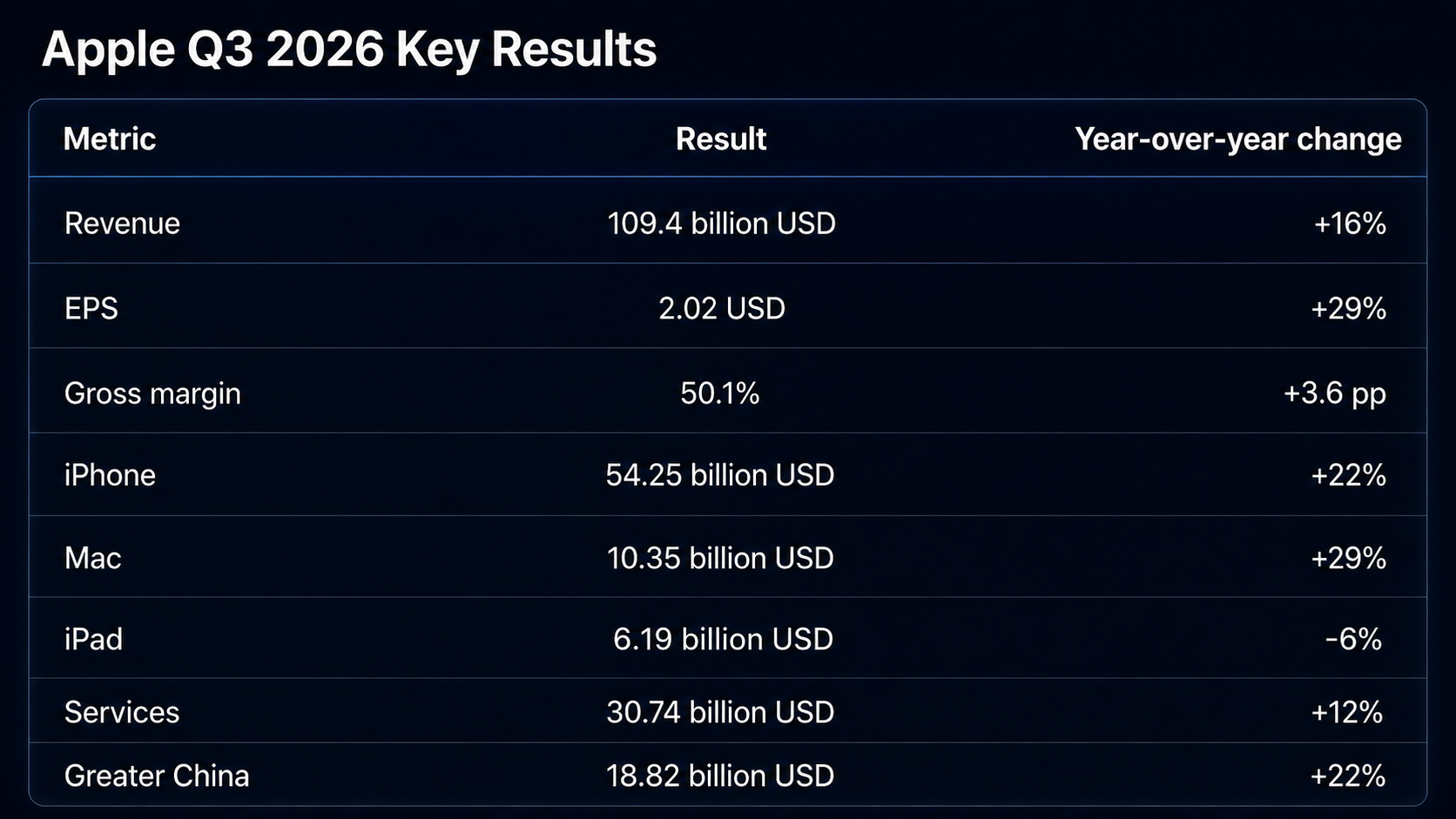
The quarter itself was strong on every measure Apple reports. Sales of the main devices kept growing and the active installed base set a record. The problem sat entirely in the outlook for the quarter that follows.
Why AAPL Shares Fell After a Record Quarter
Management expects revenue in the September quarter, Q4 of the 2026 financial year, to grow 9 to 11% year on year. Wall Street had been looking for 12%. iPhone sales growth is guided above 10%, against an analyst expectation of around 17.6%. Gross margin is guided at 47 to 48%.
Apple's September-quarter guidance against market expectations, growth year on year
Revenue growth, June quarter (reported)
16%
Revenue growth, September quarter (Apple guidance)
9 to 11%
Revenue growth, September quarter (Wall Street estimate)
12%
iPhone sales growth, September quarter (Apple guidance)
above 10%
iPhone sales growth, September quarter (analyst estimate)
17.6%
1 to 3 points below the market estimate on total revenue growth
7.6 points below the analyst estimate on iPhone growth, at the floor of the guided range
Set against the 16% revenue growth of the June quarter, the September outlook is a visible slowdown. Build cost is the second source of concern. Apple is already absorbing more expensive memory, and management warned that prices could keep climbing. Strong demand from the AI industry pushes manufacturers to send more capacity toward memory for data centres, leaving fewer components for phones and computers.
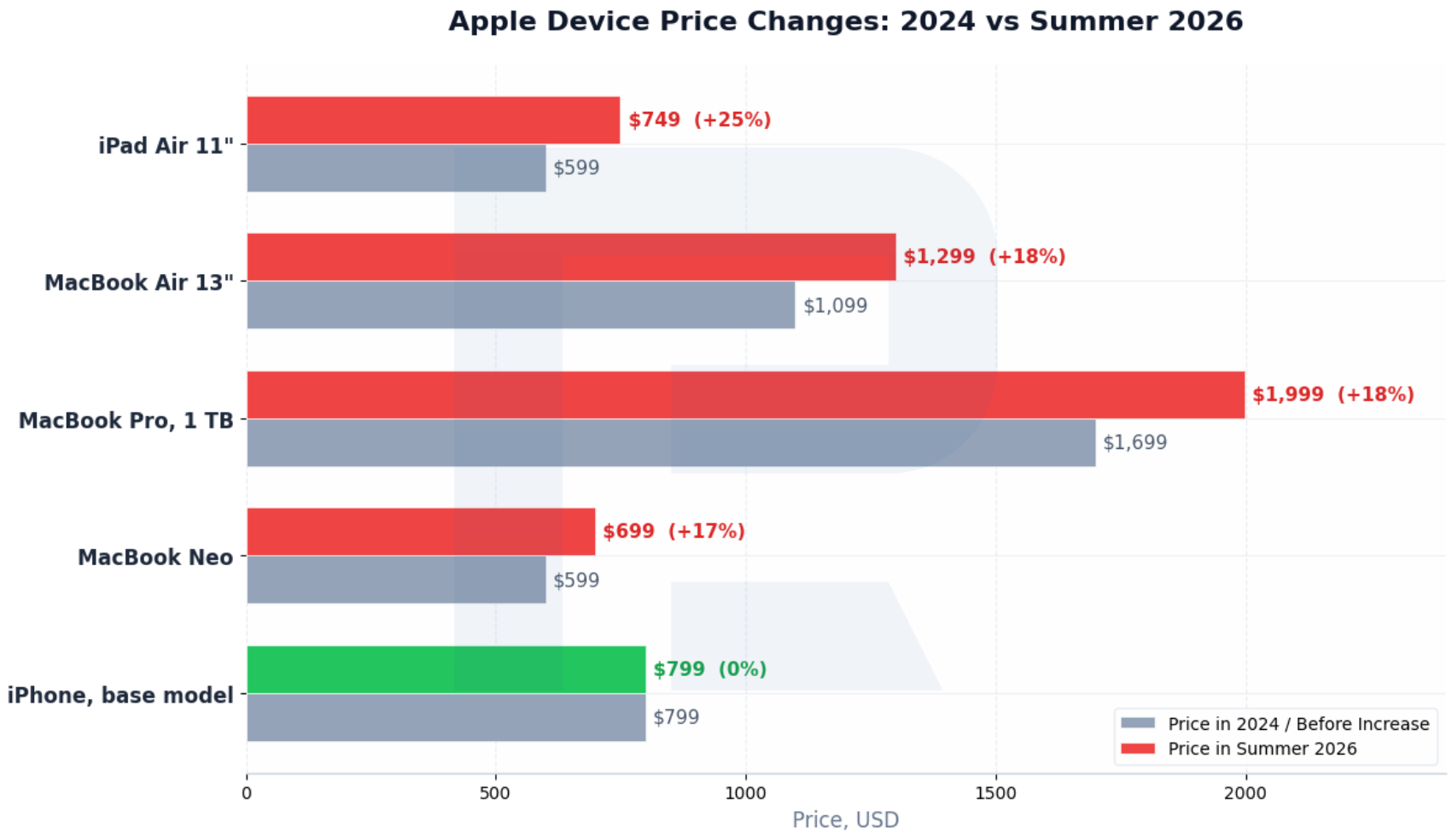
Supply limits on other semiconductor components make it harder still. Apple described significant supply problems and a limited ability to raise production quickly. Management stressed that the constraint sits in component availability while demand for Apple devices stays healthy. The market weighed the outlook more heavily than the record quarter, and AAPL fell more than 7% after the guidance was published. Investors started pricing in the chance that high build costs and supply limits hold back profit for several quarters.
CXMT memory is what could change that view. A new supplier reduces the shortage and eases the pressure on memory prices, which climbed sharply once AI demand took hold.
Open a Trading Account at RoboForex
Swap-free accounts, spreads from 0, and execution in 0.01 seconds.
AAPL Analyst Ratings
As of August 2026, Barchart analyst ratings for Apple Inc lean toward buying the stock. Of the 42 analysts tracked, 24 rate AAPL a Buy, 15 a Hold, and only 3 a Sell.
Buy: 24
Hold: 15
Sell: 3
24 out of 42
recommend Buy (57%)
Hold
15 (36%)
Sell
3 (7%)
Average Target Price
323.19 USD
Minimum Target
235.00 USD
Maximum Target
400.00 USD
The average target price is 323.19 USD, the most optimistic forecast reaches 400.00 USD, and the lowest target sits at 235.00 USD. That spread of 165 USD between the extremes shows how much uncertainty surrounds Apple's growth rate and the effect of higher component costs on profitability. The weight of Buy recommendations shows that most analysts keep a positive view on Apple over the long run despite the pressure on gross margin.
Worth noting for this idea: the 383 USD target used below comes from chart geometry, and it sits 18.5% above the analyst average. It is closer to the most bullish forecast on the street than to the consensus.
AAPL Stock: Technical Picture
On the daily timeframe, AAPL trades above its 200-period Moving Average. This is one of the most widely watched lines in stock analysis, and while the price holds above it the long-term uptrend is treated as intact. The Stochastic indicator has reached oversold territory, which suggests the correction that started after the Q3 2026 report may be close to finished.
A breakout above resistance at 317 USD is the signal that the rise is resuming inside that uptrend. The trade idea therefore places a Buy Stop order at 318 USD, one dollar above the level, so the position only opens if the market confirms the move.
Market participants tend to act ahead of the numbers. If Apple can put CXMT parts into its devices, that lowers build cost and strengthens the company's position with its existing memory suppliers at the same time. Better purchasing terms would support device sales and, more importantly, help Apple hold its margin. The effect can also last: even once memory prices normalise, sharper competition between suppliers and a more diversified chain keep working in Apple's favour. Investors may start pricing that in long before it shows up in a quarterly report, and a break of 317 USD is one of the first places that demand would become visible.
The upside target is 383 USD. Until July 2026 AAPL traded inside a rising channel, then broke above its upper boundary and held there. After that kind of break, a move equal to the width of the channel is the standard projection, and that measurement puts the target at 383 USD.
The stop-loss goes at 279 USD, below support at 280 USD. A break of that support would almost coincide with a break of the 200-period Moving Average from above, which would point to a deeper correction or a change of trend from up to down.
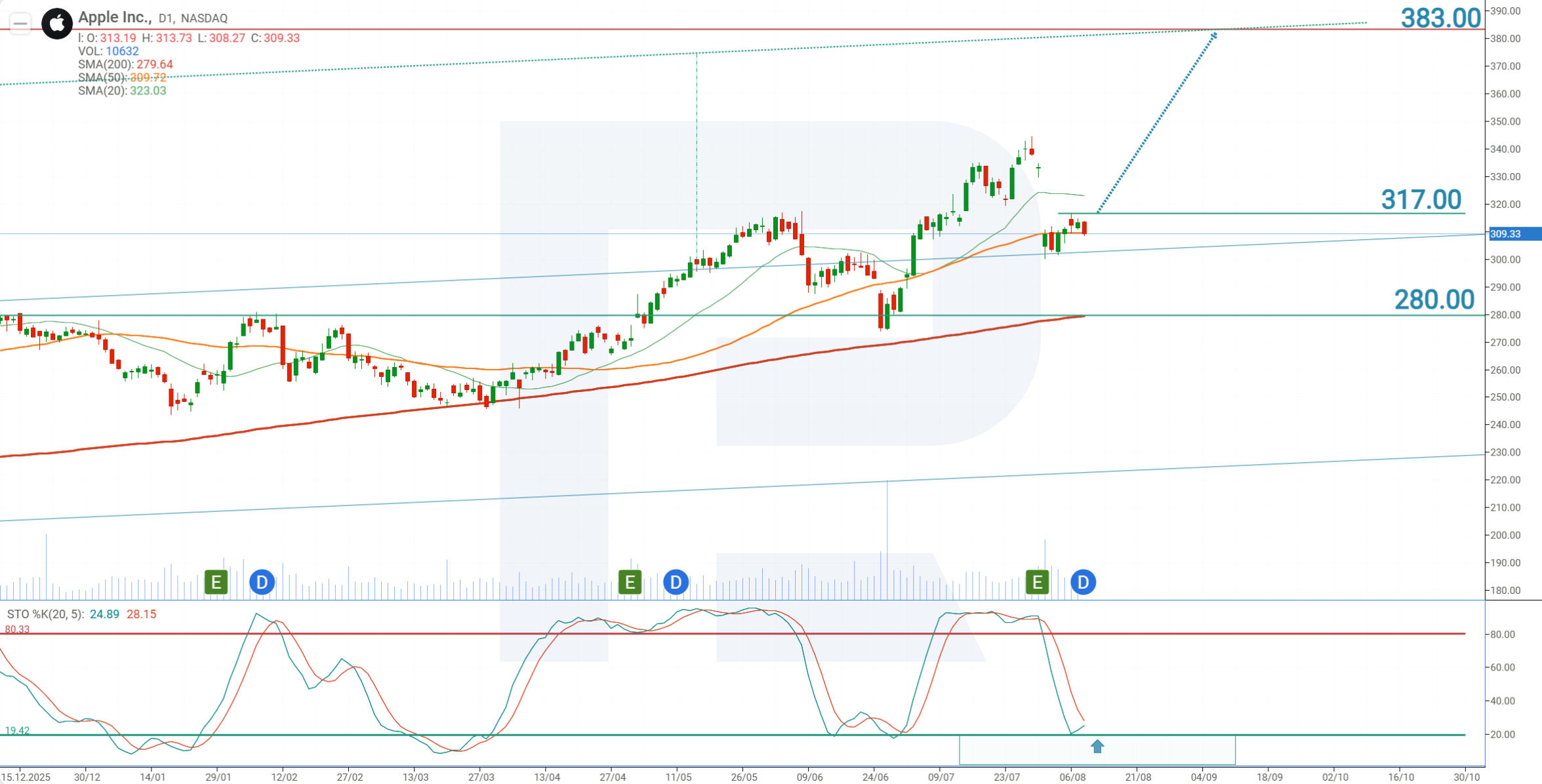
- The 200-day Moving Average (MA200) sits below the price, which confirms the long-term uptrend is still in place.
- Stochastic has reached oversold territory, a sign that the correction may be ending.
- A breakout above resistance at 317 USD serves as the signal for the rise to resume inside the uptrend.
- The trade idea is to buy the stock at 318 USD, once resistance at 317 USD has been broken.
- The main upside target is 383 USD, measured from the width of the broken channel.
Sample Trading Strategy for AAPL Shares
Below is a sample trading strategy for AAPL shares. This example is for educational purposes only and does not constitute investment advice. Investors should assess their own risk tolerance independently.
| Parameter | Value |
|---|---|
| Entry Point | Buy on a breakout above resistance at 317.00 USD, order at 318.00 USD |
| Take Profit | Channel-width target at 383.00 USD |
| Stop Loss | 279.00 USD, below support at 280.00 USD |
| Risk / Reward Ratio | 1 : 1.6 |
| Position Size | No more than 3% of account |
Sample Calculation for 10 AAPL Shares
| Scenario | Calculation | Result |
|---|---|---|
| Buy 10 shares at 318.00 USD | 10 × 318.00 USD | 3,180 USD |
| If target reached (383.00 USD) | (383.00 − 318.00) × 10 | +650 USD (+20.4%) |
| If stop triggered (279.00 USD) | (318.00 − 279.00) × 10 | −390 USD (−12.3%) |
| Risk / Reward | 390 / 650 | 1 : 1.6 |
A risk/reward ratio of 1:1.6 sits in the acceptable range for position trading. Keep in mind that markets are volatile: AAPL shares can move both for and against an open position.
When This Idea Stops Being Valid
Two conditions end it.
- The trigger never fires. If AAPL does not trade above 317 USD, the Buy Stop at 318 USD is never filled and there is no position to manage. The idea expires unused at the end of the 1 to 6 month horizon.
- Support at 280 USD breaks. The stop-loss at 279 USD sits just under that level. A daily close below it would come close to a break of the 200-period Moving Average from above, and both signals together point to a deeper correction or a change of trend from up to down. At that point the case for a rise to 383 USD no longer holds and the idea is closed.
One more condition sits outside the chart. If Washington blocks the CXMT arrangement, or Apple drops the testing programme, the reason the market would re-rate the stock disappears even while the price is still above 317 USD.
Trade with RoboForex MobileTrader
Live charts, deposits and withdrawals, analytics and copy trading, all in one app.
Political Limits on Apple’s CXMT Plan
The main obstacle for Apple is political. Using CXMT components is a sensitive matter for an American company while the technology dispute between the United States and China continues. According to The Wall Street Journal, Apple would like White House approval before it widens the arrangement. Current restrictions also limit how far American companies can transfer technology to CXMT or order custom-designed parts from it.
That is why CXMT memory is being considered first for products sold inside China. The approach lets Apple do three things at once:
- diversify supply
- reduce cost in one of its largest markets
- keep political exposure contained
It also means CXMT cannot yet replace Samsung, SK Hynix or Micron across Apple's global production. Deeper reliance on Chinese components creates an exposure of its own. If relations between Washington and Beijing worsen, restrictions could tighten after Apple has already rebuilt part of its supply chain around them.
Should You Buy Apple Stock on This News?
Apple's interest in CXMT memory shows that component costs have become a factor capable of moving margins over the next few quarters. An extra supplier increases the volume of memory available, reduces dependence on Samsung Electronics, SK Hynix and Micron, and strengthens Apple's position when purchase prices are negotiated. The arrangement stays politically sensitive and cannot yet be treated as a full answer to the memory shortage.
For investors the question is whether Apple can hold its gross margin while build costs rise and components stay tight. If the company diversifies its chain and eases that pressure, the market may start pricing in better results before they appear in a filing. The 383 USD target is worth weighing against the 323.19 USD analyst average before acting on it.
For traders, the actionable level is 317 USD: a confirmed breakout activates the long scenario toward 383 USD, while a break of support at 280 USD cancels the setup and points to a deeper correction.
FAQ
What triggers this AAPL trade idea?
A breakout above resistance at 317 USD. The idea uses a Buy Stop order at 318 USD, so the position opens only after the market confirms the move above the level.
Why would CXMT memory matter for Apple's share price?
Memory is one of the costs squeezing Apple's gross margin right now. A fourth supplier increases the volume Apple can buy and gives it more room in price talks with Samsung Electronics, SK Hynix and Micron. Investors tend to price that kind of change in before it reaches the financial statements.
Where does the 383 USD target come from?
From the width of the rising channel that AAPL broke above in July 2026. After a channel break, a move equal to the channel width is the standard projection. The target is well above the 323.19 USD analyst average, which is worth weighing before acting on it.
When does this AAPL idea stop being valid?
On a break of support at 280 USD. The stop-loss sits just under it at 279 USD, and that level almost coincides with the 200-period Moving Average, so a close below both points to a deeper correction or a change of trend from up to down.
How can I trade Apple shares at RoboForex?
Apple trades under the ticker AAPL in MobileTrader and MT5. Both platforms support pending orders, which is what this idea needs, since the entry is a Buy Stop above the current market.
* The information in this article reflects the personal opinions of the authors. It should not be construed as trading advice or a call to action. The authors and RoboForex bear no responsibility for trading results based on the recommendations and reviews contained in this material. Past performance is not a guarantee of future results. Trading stocks and CFDs involves a high risk of capital loss.