How Do Interest Rates Work? Their Effect on the Economy and Markets
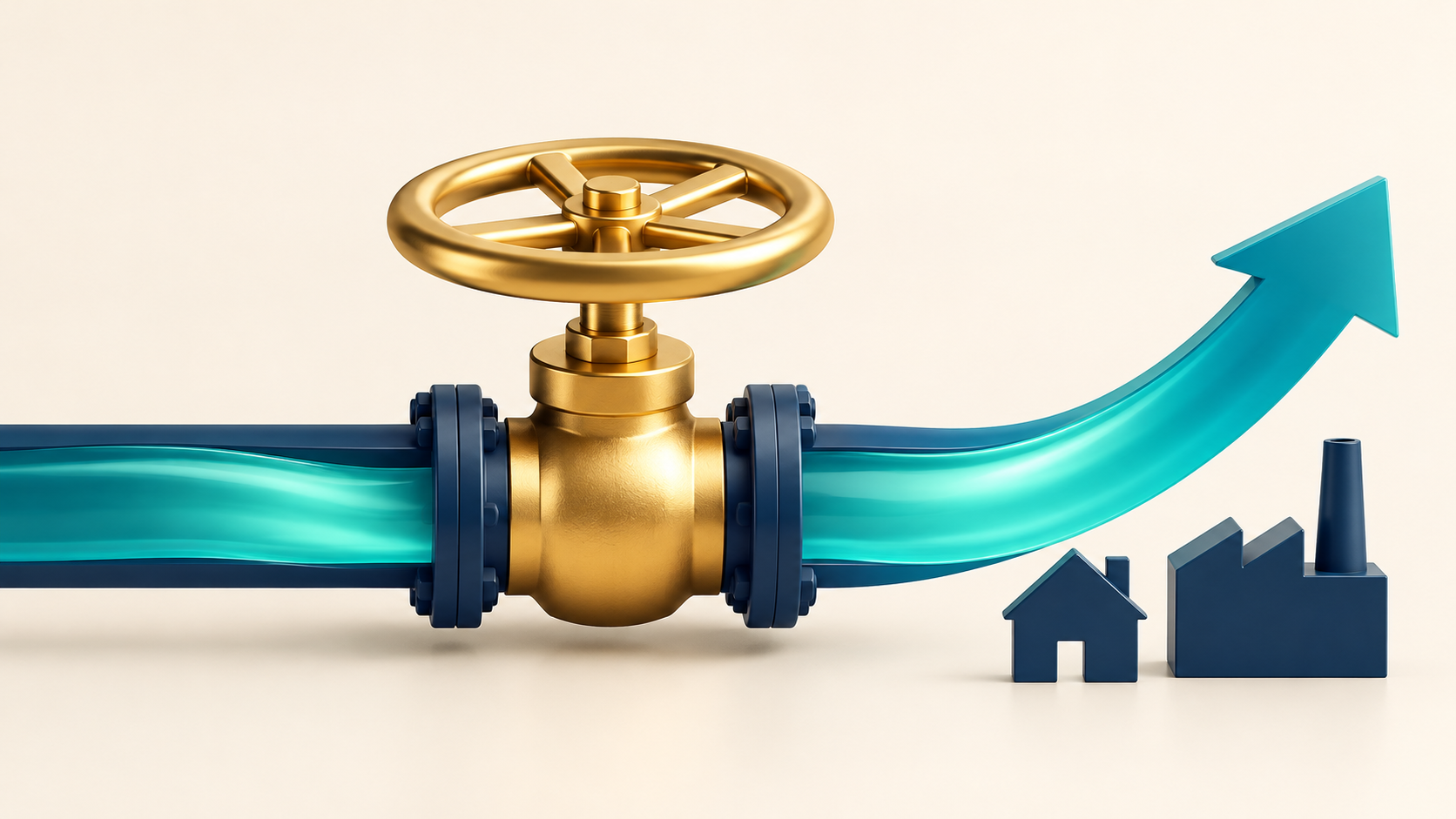
How do interest rates work? A central bank sets a policy rate that becomes the base price of money. Banks pass it on to loans and savings, borrowing and spending adjust, and prices follow with a delay. Markets trade the gap between a decision and what they expected, which is what this guide teaches you to read.
TL;DR
- Find the policy rate of the central bank behind your currency, and note the forecast and the previous value in the economic calendar before each decision.
- Judge the decision against what markets already expected: a surprise moves prices, a fully expected change often does not.
- After the release, read the statement and the press conference, then trade only according to your plan.
This guide follows a rate decision from the central bank to your trading screen: who sets the rate, how it reaches the economy and inflation, what it does to currencies, stocks, bonds and gold, and a five-step routine for reading a decision.
What Are Interest Rates and Who Sets Them?
An interest rate is the price of using money for a period of time: the percentage a borrower pays a lender, or the return a saver earns. In every major economy a central bank sets the benchmark rate that other rates follow.
Policy Rate vs Market Rates
- Policy rate. The official rate set by a central bank. Commercial banks borrow from the central bank or deposit money with it at this rate, so it is the base cost of money in the economy.
- Market rates. The rates banks charge businesses and households on mortgages, consumer loans and cards. They usually sit above the policy rate, because they add the bank's margin and a premium for the risk that a borrower does not repay.
Which Central Banks Set the Main Currency Rates
Each central bank below sets the rate for the currency it issues. The official name of the rate and the mechanics differ by country.
| Central bank | Official name of the rate | Currency |
|---|---|---|
| Federal Reserve (Fed) | Federal funds rate (target range) | US dollar (USD) |
| European Central Bank (ECB) | Deposit facility rate | Euro (EUR) |
| Bank of England (BoE) | Bank Rate | British pound (GBP) |
| Bank of Japan (BoJ) | Policy interest rate | Japanese yen (JPY) |
| Reserve Bank of Australia (RBA) | Cash rate target | Australian dollar (AUD) |
A decision by one of these banks is the event that matters for the currency in the last column. Levels change at every meeting, so check the current figure in the economic calendar.
How Do Interest Rates Work? From the Central Bank to Your Wallet
A rate decision reaches the economy in four links. The central bank decides, the interbank market reprices, commercial banks change their offers, and households and companies change how much they borrow, spend and save. Each link takes time, so the full effect arrives with a delay.
1
Central bank decision
The monetary policy committee raises, cuts or holds the policy rate, weighing inflation, the labour market and growth within its mandate.
2
Interbank market
Short-term market rates and the funding costs of banks move first, and the change then spreads to other parts of the financial market.
3
Commercial banks
Banks adjust rates on mortgages, loans, cards and deposits for businesses and households.
4
Spending and saving
People and companies change how much they borrow, spend and save, which shifts total demand in the economy.
Meeting day Several quarters later
How Do Interest Rates Affect the Economy?
Higher interest rates slow borrowing, spending and inflation, and lower rates speed them up. Rates change the price of borrowing, the reward for saving and the expectations of businesses and households, and these effects build up gradually, so a decision can shape activity and inflation some time after the meeting.
When Rates Fall: Cheaper Credit Lifts Spending
Lower rates make loans cheaper. Companies find more projects worth financing, and households can afford larger purchases such as housing and cars. Savings deposits pay less, which encourages spending. Together these effects support retail sales, production and GDP.
When Rates Rise: Higher Costs Cool Prices
Higher rates make borrowing more expensive and saving more rewarding. Companies postpone investment, and households limit big purchases and move money into deposits. Demand cools, price pressure eases and an overheating economy slows down.
How Do Interest Rates Affect Inflation?
Interest rates are the main tool central banks use to steer inflation. When inflation runs above the target, a central bank can raise the rate to tighten financial conditions, cut excess demand and ease price pressure. Many large economies aim for inflation of around 2%, although targets and methods differ by country.
The effect arrives with a lag. A change in the rate can take several quarters or longer to show up in prices, so central banks act on forecasts of inflation and growth.
Inflation data therefore feeds into the next rate decision and into what traders expect from it. Our guides explain how price changes are measured: CPI in Forex Trading: What It Is and How It Moves Prices and What Is PPI in Forex: Producer Price Index for Traders.
Instant Access to Global Markets with RoboForex MobileTrader
Everything you need for trading in one app: stocks, indices, metals, oil, currencies.
How Do Interest Rates Move Markets?
A rate rise tends to strengthen the currency and weigh on stocks, bonds and gold, and a rate cut tends to do the opposite. The size of the move depends on the surprise: prices react most when the decision, or the tone of the central bank, differs from what traders expected.
| Asset | When rates rise | When rates fall | Why |
|---|---|---|---|
| Currencies | The currency tends to strengthen | The currency tends to weaken | Higher returns can attract demand for assets in that currency. |
| Stocks | Prices tend to fall | Prices tend to rise | Higher rates raise financing costs and the cost of capital, which lowers what investors pay for companies. |
| Bonds | Prices of existing bonds usually fall | Prices of existing bonds usually rise | Bond yields (the return a bond pays relative to its price) and prices move in opposite directions. |
| Gold (XAU/USD) | Often under pressure | Often supported | Gold pays no interest, so higher rates raise the cost of holding it. |
| Stock indices (US 500) | The index tends to fall | The index tends to rise | The same drivers as for stocks, applied to a whole index. |
These are tendencies. A move that was already priced in can produce the opposite reaction, as the next section shows.
Currencies
A currency tends to gain when its rate rises relative to the rates of other countries, because a higher return draws investors. The gap between two economies' rates, and how it is expected to change, is one of the main drivers of a pair such as EUR/USD or USD/JPY.
Stocks and Stock Indices
Higher rates raise the cost of financing for companies and lower the value investors place on future profits, so stocks tend to weaken when rates rise and tend to gain when they fall. An index such as US 500 reflects the same effect across a whole market.
Bonds
A bond that pays a fixed 3% becomes less attractive when new bonds pay 4%, so its price falls until its return matches the market. When rates fall, the opposite happens. This is why bond prices and yields move in opposite directions.
Gold (XAU/USD)
Gold pays no interest, so higher rates raise the cost of holding it and often weigh on its price. The link is looser than it looks: central bank purchases and geopolitics also move gold.
Why Do Markets Move Before a Rate Decision Is Announced?
Traders price in what they expect. A move is priced in when expectations about it are already reflected in the current price, so by the time a decision is published, much of the expected change has happened. This is why a currency can fall after a rate rise: the reaction depends on the gap between the result and the expectation.
Example: The Fed Decision of 16 September 2026
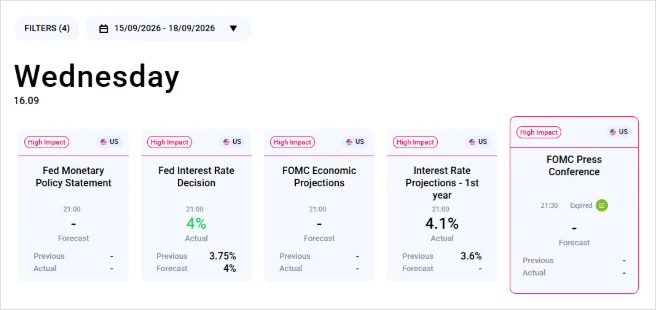
Before the Fed meeting of 16 September 2026, markets expected a 25 basis point (0.25 percentage point) rise, taking the top of the target range from 3.75% to 4.00%. The move was close to fully priced. Traders who expect a rise often buy the currency in advance, so the price of the US dollar already carried much of the expected change when the decision arrived.
The calendar in Real-Time Market Insights in your Members Area shows the decision of that day with the previous rate, the forecast and the actual rate. The forecast was 4%, the same as the result, so the decision matched the expectation.
Compare three possible results with that expectation, the first of which is what happened:
Below the expectation
3.75%
No change
Expected
4.00%
25 basis points up
Above the expectation
4.25%
50 basis points up
Values show the top of the Fed's target range.
| Result | Against the expectation | What often happens to the dollar |
|---|---|---|
| A 25 basis point rise, to 4.00% | Matches it | There is little new information. Some traders take profits, a pattern known as "buy the rumour, sell the fact", so the dollar can weaken. |
| A 50 basis point rise, to 4.25% | Above it | A surprise. Prices adjust to a faster path of rate rises, and the dollar often jumps. |
| No change, at 3.75% | Below it | A surprise in the other direction. The dollar often falls. |
These are typical patterns. Markets do not always react this way.
The first reaction is not final. The statement and the press conference can reverse it, which the next section turns into a routine.
How to Read a Rate Decision in Five Steps
Use the same routine for every central bank. It takes the expectation, the result and the signals about the future in that order.
- Check the expectation. Before the decision, note the current rate, the forecast and the previous value in the economic calendar. The forecast shows which result is already in prices.
- Compare the result with the forecast. A result that differs from the forecast, or comes with unexpected signals about future policy, can cause a sharp first move.
- Read the statement. Look at how the central bank describes inflation, jobs and growth. A statement pointing to rates staying high for longer tends to support the currency, while one pointing to faster rate cuts tends to weigh on it.
- Follow the press conference. The chair's answers to questions can change the first reaction when they add new signals about future policy.
- Follow your trading plan. Volatility is high at the moment of release. Trade only according to a plan and a risk limit you set in advance.
Follow Rate Decisions With RoboForex
RoboForex tools cover the whole routine, from the calendar to the order.
- Economic calendar. Lists scheduled releases and central bank decisions with previous and forecast values, so step 1 takes a minute.
- Market Analysis. Articles that put economic events and price levels in context.
- RoboForex MobileTrader. Quotes and trading in a mobile app and a Telegram bot.
- Trading account. Demo and live accounts, so you can practise reading decisions before risking capital.
- MetaTrader 5. A platform for market analysis and managing positions, with a Strategy Tester for testing strategies and Expert Advisors on historical data. Versions for desktop, mobile and web.
Conclusion
Interest rates reach prices through the cost of borrowing, inflation and expectations, and markets react to the gap between a decision and the forecast. Before the next central bank meeting, open the economic calendar, write down the current rate, the forecast and the previous value, and judge the result against that forecast.
FAQ
What are interest rates in simple terms?
An interest rate is the price of using money: the percentage a borrower pays a lender, or the return a saver earns over a period of time.
Who sets interest rates?
In each major economy a central bank sets the benchmark policy rate: the Fed in the US, the ECB in the euro area, the Bank of England in the UK, the Bank of Japan in Japan and the Reserve Bank of Australia in Australia. Commercial banks then set their own lending and deposit rates around it.
How do interest rates affect the economy?
Higher rates make borrowing more expensive and saving more rewarding, which cools demand and price pressure. Lower rates do the opposite and support spending and investment. The effect builds up over several quarters.
Why do central banks raise rates when inflation is high?
A higher rate makes loans costlier and saving more attractive, which cuts excess demand and eases price pressure. Because the effect is delayed, central banks act on forecasts of inflation and growth.
How do interest rates affect stocks?
Higher rates raise financing costs and the cost of capital, so stocks tend to fall when rates rise and tend to gain when they fall. A change that markets already expected can leave prices little changed.
How do interest rates affect currencies?
A currency tends to strengthen when its rate rises relative to other countries' rates and to weaken when it falls, because the return on assets in that currency changes. If a rise was fully expected, the currency can fall after the announcement.
Do rising rates push gold down?
Often, because gold pays no interest and higher rates raise the cost of holding it. The link is looser than it looks: central bank purchases and geopolitics also move gold.
Where can I see the next rate decision?
In the RoboForex economic calendar, which lists scheduled central bank decisions with previous and forecast values. Whether rates go down next depends on inflation and jobs data, which the calendar also lists.
- CPI in Forex Trading: What It Is and How It Moves Prices: how consumer inflation is measured and why a CPI release can change rate expectations.
- What Is PPI in Forex: Producer Price Index for Traders: price pressure at the producer level and how traders read it.
- What Is an Economic Calendar and Why Every Trader Should Use It: how forecast, previous and actual values work in the calendar.
- US Dollar Index (DXY): What It Is and How to Use It in Forex: how the dollar's strength against a basket of major currencies is measured.
Any information provided in articles on this website is based solely on the personal opinions of the authors. These articles should not be construed as trading recommendations or a call to action. The authors and RoboForex accept no responsibility for the results of any trades made on the basis of these recommendations and reviews. Past performance is not indicative of future results. Trading stocks and CFDs involves a high risk of capital loss.