Market Week Ahead (September 28 – October 2): RBA Rate Decision and US Jobs Set the Tone

The new trading week brings several large macro stories at once. The RBA rate decision on Tuesday comes as inflation risks in Australia widen again, the US releases Core PCE and its September jobs report, and Japan publishes its quarterly Tankan survey. China's September PMIs and the flash eurozone inflation reading complete the calendar.
The US releases carry extra weight after the Fed's first rate rise in three years. Steady inflation and a strong labour market would support expectations of further tightening, while weak data would give the market grounds to expect a pause. This issue covers AUD/USD, EUR/USD, USD/JPY and the US 500.
In Brief
- RBA Interest Rate Decision (Tuesday, September 29): the RBA rate decision is expected to lift the cash rate from 4.35% to 4.60%, so the guidance on further moves matters most.
- US Core PCE and final Q2 GDP (Wednesday, September 30): core inflation is forecast at 0.3% month on month after 0.2%.
- Japan Tankan Large Manufacturers Index (Thursday, October 1): seen at 23 after 22, a read on big business confidence.
- US Non-Farm Payrolls and Unemployment Rate (Friday, October 2): 90,000 new jobs expected after 162,000, with unemployment at 4.1%.
Where the Market Stands Going Into the Week
After the Fed's September rate rise, the market's question is whether the tightening cycle continues. Core PCE on Wednesday and Non-Farm Payrolls on Friday give the two answers the Fed watches most closely: how fast prices are rising and how strong the labour market is.
Australia adds its own story. The RBA holds its cash rate at 4.35%, but inflation risks are growing again, and Governor Michele Bullock said last week that some of them are starting to materialise. Market expectations have moved clearly toward a 25 basis point rise, so for AUD/USD the signal about the path ahead counts as much as the RBA rate decision itself.
Going into the week, the dollar is strong. AUD/USD has pulled back sharply from its September highs near 0.7220 to around 0.7025, and EUR/USD has fallen from the August area of 1.1710 to about 1.1390. Both pairs sit at their lower Bollinger bands with the stochastic deep in oversold. USD/JPY has recovered from its September low near 153.00, while the US 500 holds its medium-term rising structure at around 7748.
Key Events of the Week
| Date | Event | Instruments | Importance |
|---|---|---|---|
| Tue, Sep 29 | RBA Interest Rate Decision | AUD/USD, Australian bonds, Australian stocks | ●●● High |
| Wed, Sep 30 | US Core PCE Price Index and final Q2 GDP | EUR/USD, USD Index, US Treasuries | ●●● High |
| Thu, Oct 1 | Japan Tankan Large Manufacturers Index | USD/JPY, Japanese government bonds, Nikkei 225 | ●● Medium |
| Fri, Oct 2 | US Non-Farm Payrolls and Unemployment Rate | US 500, US Treasuries, USD Index | ●●● High |
Instant Access to Global Markets with RoboForex MobileTrader
Everything you need for successful trading in one app: currencies, metals, oil, stocks, indices.
29
Sep
Cash Rate, Consensus
4.60%
Current
4.35%
Why It Matters
The RBA comes to this meeting after a pause in August, and the inflation picture has become less comfortable since then. The cash rate stands at 4.35%, the central bank points to the risk of price pressure staying high, and most major Australian banks expect a 25 basis point rise to 4.60%. Because much of that move is already in expectations, a rise alone may not be enough for a strong reaction in the Australian dollar. The tone matters more: whether the RBA leaves the door open to further rises or presents the September step as a sufficient adjustment.
Market Reaction
A rise to 4.60% with firm guidance would support the Australian dollar and bring buyers back into AUD/USD. A hold at 4.35%, or a cautious signal about further rises, would bring a sharper drop in the currency, since the market already prices in tightening.
Market Sentiment
On the chart, AUD/USD has corrected sharply from its September highs near 0.7220 and trades around 0.7025. Price has reached the lower Bollinger band and the stochastic has dropped deep into oversold, so the room for a technical bounce is growing. MACD keeps falling and has moved below its signal line, so until a reversal signal appears, short-term momentum stays with sellers. The 0.7000 to 0.7010 area becomes the key zone for buyers after the fast decline. If it holds and the RBA sounds firm, a recovery toward 0.7115 could follow. A move below 0.6970 would break the rebound scenario.
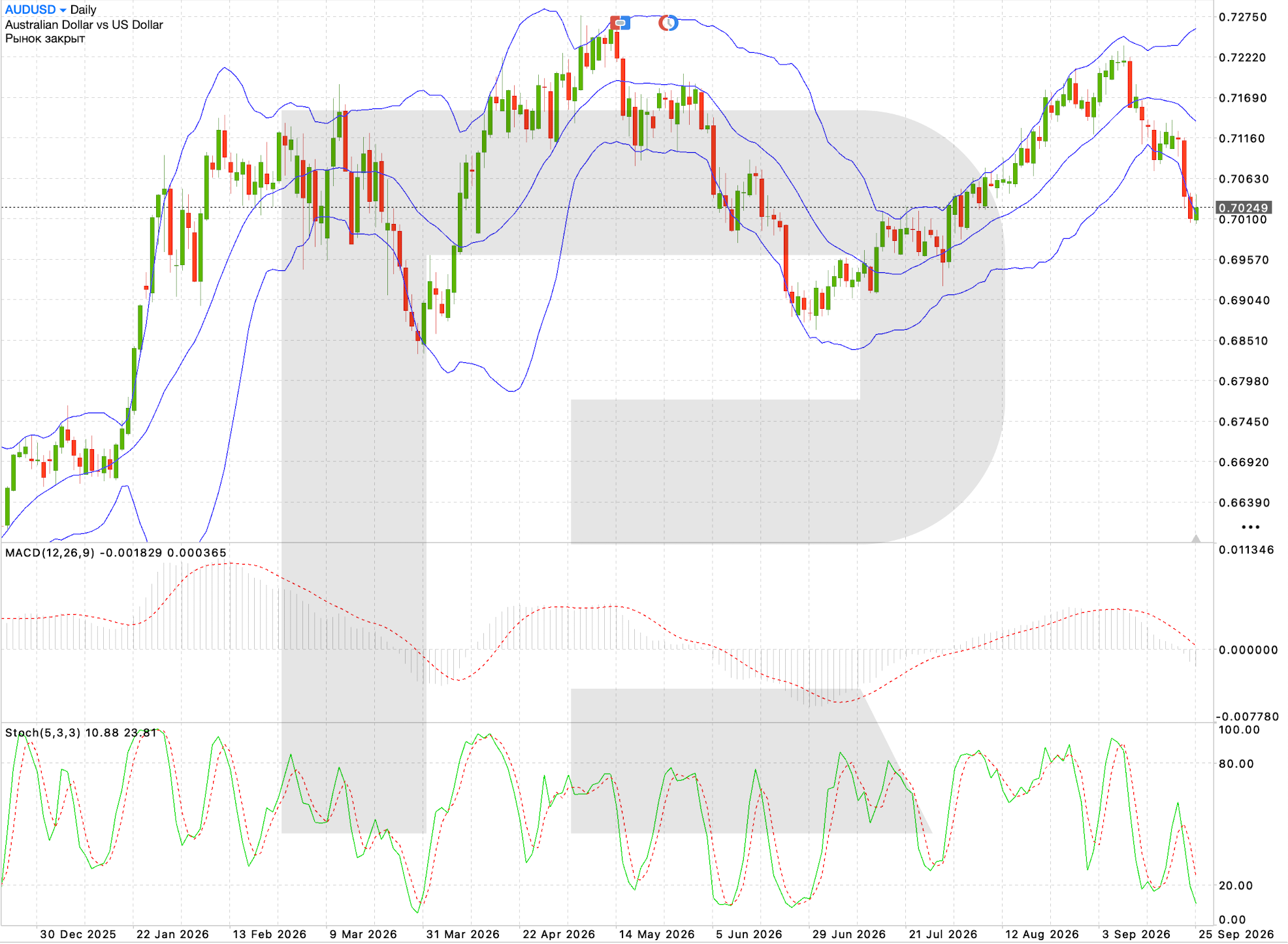
Key Levels and Trade Parameters — AUD/USD
| Parameter | Value |
|---|---|
| Resistance | 0.7115 |
| Support | 0.7010 / 0.6970 |
| Entry, Buy Limit | 0.7010 |
| Stop loss | 0.6970 |
| Take profit | 0.7115 |
| Risk to reward | 1:2.6 |
30
Sep
Core PCE, Forecast (m/m)
0.3%
Previous
0.2%
Why It Matters
Core PCE is one of the Fed's main inflation gauges. It rose 0.2% month on month in July, and the market expects it to speed up to 0.3% in August. After the Fed's change of course, the question is how likely the tightening cycle is to continue. Household income and spending data and the final estimate of US GDP for the second quarter arrive at the same time, which gives a fairly complete picture of the US economy. The second estimate showed annualised growth of 1.5%.
Market Reaction
Core PCE above 0.3% would strengthen the case for further Fed tightening and add pressure on EUR/USD. A reading below expectations would weaken the dollar and could trigger a corrective bounce in the pair after its sharp September decline.
Market Sentiment
EUR/USD is under clear pressure. The pair has fallen from the August area of 1.1710 to around 1.1390 and has reached the lower Bollinger band. MACD stays negative and confirms the downward impulse, but the stochastic is already deep in oversold, which raises the chance of a correction higher, though it would run against the main short-term move. Key support lies at 1.1324 to 1.1365. While it holds, the oversold reading leaves room for a recovery to 1.1485 and then to 1.1545. A close below 1.1324 would signal the decline continuing.
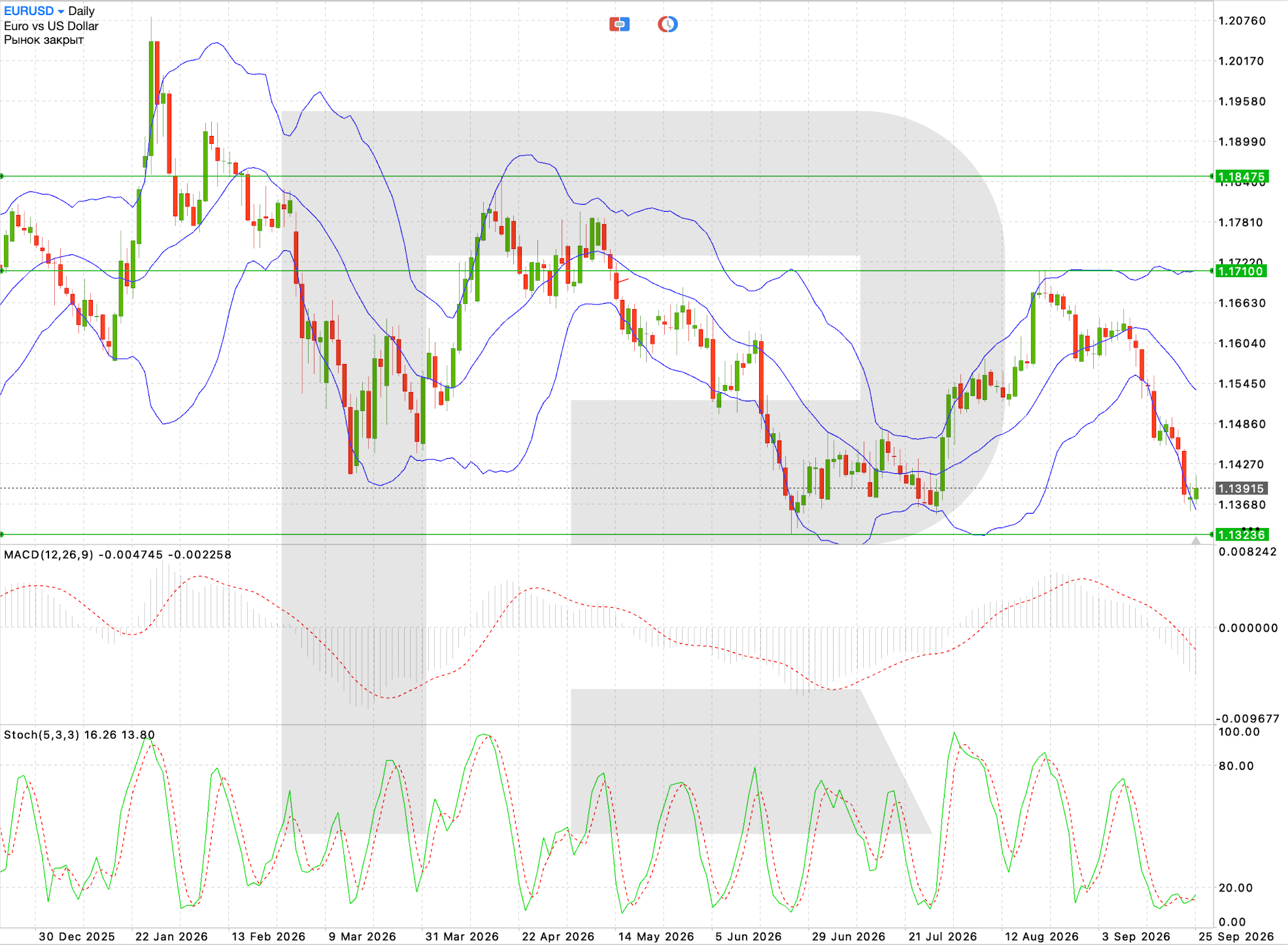
Key Levels and Trade Parameters — EUR/USD
| Parameter | Value |
|---|---|
| Resistance | 1.1485 / 1.1545 |
| Support | 1.1365 / 1.1324 |
| Entry, Buy Limit | 1.1365 |
| Stop loss | 1.1315 |
| Take profit | 1.1485 |
| Risk to reward | 1:2.4 |
1
Oct
Tankan Large Manufacturers, Forecast
23
Previous
22
Why It Matters
The Bank of Japan's Tankan is one of the most complete quarterly reads on the mood of large Japanese companies. A rise from 22 to 23 would show that the corporate sector stays resilient and add to the case for further policy normalisation by the Bank of Japan. The release carries extra weight after months of heavy swings in the yen. USD/JPY fell sharply from its July peak near 164.00, recovered to 160.00 and then dropped again, so any sign of strength in Japan's economy would quickly turn attention back to the gap between Fed and Bank of Japan policy.
Market Reaction
A Tankan above forecast would support the yen and send USD/JPY back toward its lower technical targets. A weak report would ease the pressure on the Bank of Japan to tighten further and help the dollar win back part of its recent losses.
Market Sentiment
USD/JPY has recovered from its September low near 153.00, but the rise stalled around 159.00, where major resistance meets the falling trendline, and the pair has since slipped back to about 157.30. MACD stays below zero, though the negative impulse has lost much of its strength. The stochastic is turning down from overbought. This combination makes 159.00 to 160.00 the key area: without a break above it, the dollar's recovery still looks corrective. A failed attempt to hold above 159.00 would open a return to 156.60. A break higher would cancel the scenario and open the way to 160.20 and 161.10.
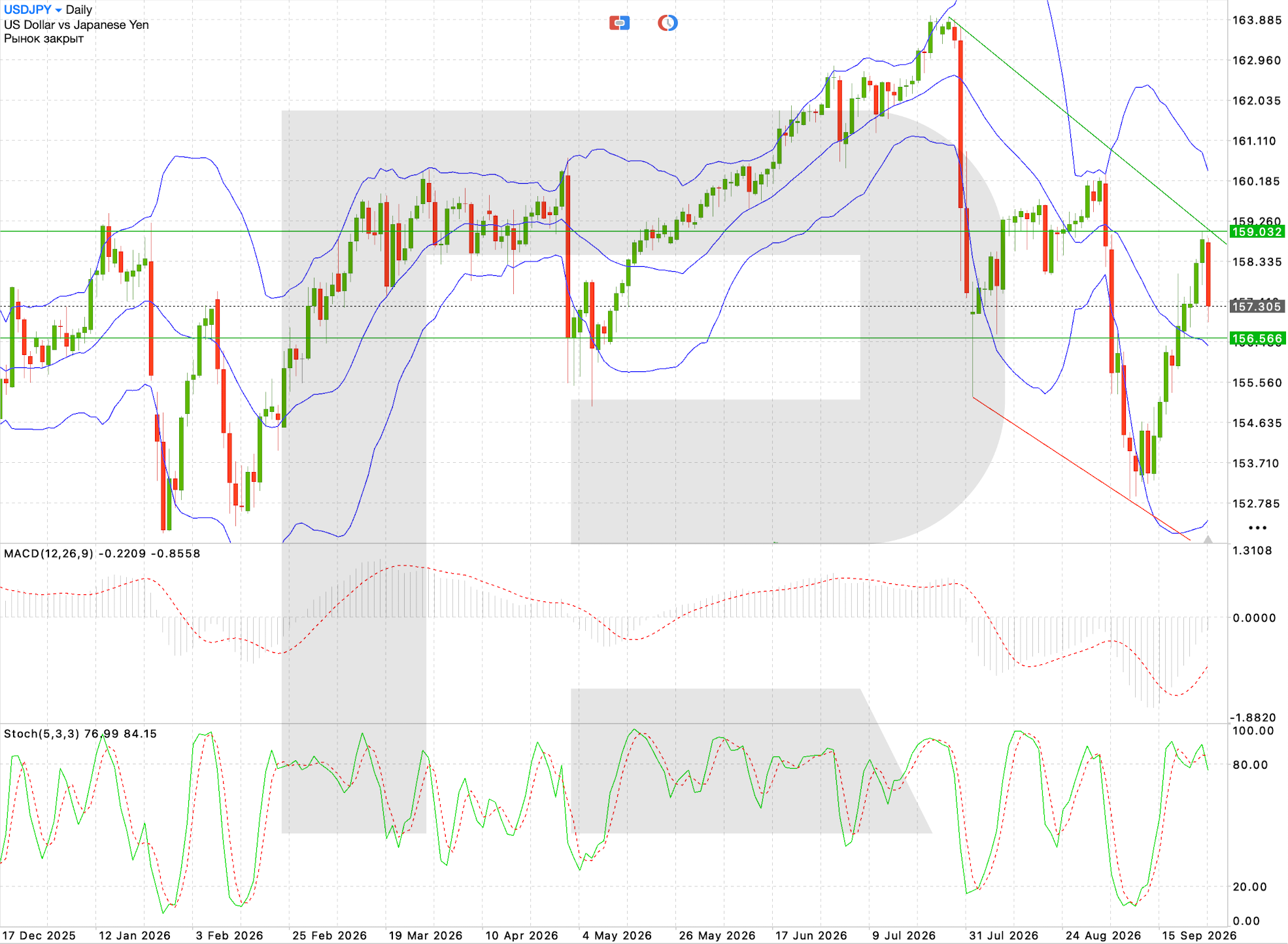
Key Levels and Trade Parameters — USD/JPY
| Parameter | Value |
|---|---|
| Resistance | 159.00 / 160.20 |
| Support | 156.60 |
| Entry, Sell Limit | 158.80 |
| Stop loss | 159.70 |
| Take profit | 156.60 |
| Risk to reward | 1:2.4 |
2
Oct
Non-Farm Payrolls, Forecast
+90K
Previous
+162K
Unemployment Rate, Forecast
4.1%
Previous
4.1%
Why It Matters
The end of the week is the main test for Fed expectations. After 162,000 new jobs in August, we expect job growth to slow sharply to 90,000 in September, with unemployment holding at 4.1%. For the Fed, the combination of inflation and the labour market is what counts. A high Core PCE on Wednesday and strong payrolls on Friday would give two arguments for another rate rise. Weak hiring would put the need for fast further tightening in doubt.
Market Reaction
Strong payrolls with stable or lower unemployment would lift bond yields and add pressure on US stocks through expectations of tighter Fed policy. Weak job growth could support the US 500 at first as rate expectations ease, though very weak figures would shift the market's attention from monetary policy to risks for economic growth.
Market Sentiment
The US 500 keeps its medium-term rising structure and holds above trendline support despite visible volatility in September. The index has recovered to 7748 and is again close to the top of its range, but the stochastic has turned down after overbought, a sign that short-term momentum is weakening. MACD stays positive, so the pullbacks still look like consolidation inside a wider uptrend. The 7570 to 7690 area remains the key support zone for the current structure. If it holds, the index could retest its highs and move toward 7930. A break of the rising trendline would clearly weaken the technical picture.
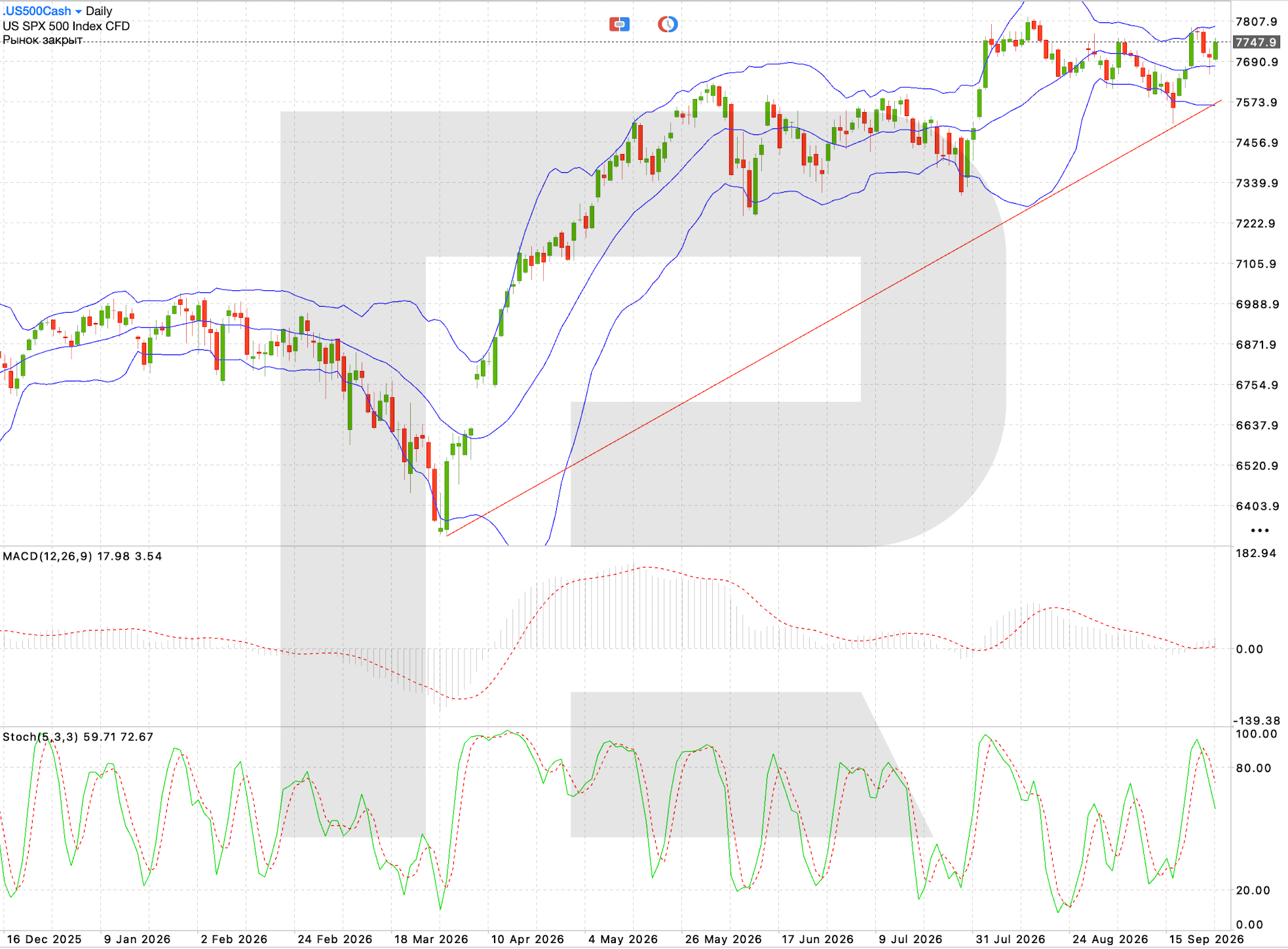
Key Levels and Trade Parameters — US 500
| Parameter | Value |
|---|---|
| Resistance | 7930 |
| Support | 7690 / 7570 |
| Entry, Buy Limit | 7690 |
| Stop loss | 7570 |
| Take profit | 7930 |
| Risk to reward | 1:2.0 |
What Else to Watch
China publishes two manufacturing PMIs this week. The official NBS Manufacturing PMI is expected at 50.0 after 49.8, and the RatingDog Manufacturing PMI is forecast unchanged at 51.5. A return of the official index to the line between growth and contraction matters most for the Australian dollar, other commodity currencies and metals. On Friday, the flash eurozone inflation reading for September is due, with consumer prices expected at 3.4%.
Track the forecast and the actual figures for each release, since the gap between consensus and the outcome is what tends to move prices the most. Learn more about how to read the economic calendar and trade the news.
Conclusion
The week tests the Fed's next step and the RBA's resolve. On Tuesday, a rise to 4.60% with firm guidance would help AUD/USD hold 0.7010 and recover toward 0.7115, while a hold or a cautious tone would take the pair below 0.6970. Core PCE on Wednesday then sets the dollar's direction: a soft reading gives EUR/USD room to bounce from 1.1365 toward 1.1485.
Thursday's Tankan decides whether USD/JPY turns lower from the 159.00 resistance toward 156.60. Non-Farm Payrolls on Friday close the week: as long as the US 500 holds 7570 to 7690, a retest of its highs toward 7930 stays in play.
Any information provided in articles on this website is based solely on the personal opinions of the authors. These articles should not be construed as trading recommendations or a call to action. The authors and RoboForex accept no responsibility for the results of any trades made on the basis of these recommendations and reviews. Past performance is not indicative of future results. Trading stocks and CFDs involves a high risk of capital loss.