FOMC Meaning: What the Fed's Committee Decides and How It Moves Markets
FOMC meaning: the Federal Open Market Committee is the group inside the US Federal Reserve that sets the direction of US interest rates. It meets eight times a year and ends each meeting with a decision, a statement and a press conference. Those events move the US dollar, gold and US stock indices.
TL;DR
- Copy the FOMC dates from the table below, and note the forecast and the previous rate in the economic calendar before each meeting.
- On meeting day read the policy statement first, then the projections, which are the participants' forecasts for rates and the economy (four meetings a year), then the press conference.
- Judge the reaction against what markets expected, and trade only according to your plan.
This guide explains what the FOMC is, who votes, when it meets, what each part of a meeting day tells you, and how to read a decision for the dollar, gold and the US 500.
What Does FOMC Mean?
FOMC stands for Federal Open Market Committee. It is the monetary policymaking body of the Federal Reserve System, the central bank of the United States. The Committee reviews economic and financial conditions and decides the stance of monetary policy, which usually means raising, cutting or holding short-term interest rates.
The Fed is the whole central bank. The FOMC is the committee inside it that votes on rates, so a headline about a Fed rate decision is a headline about an FOMC vote.
Who Votes on the FOMC?
The FOMC has twelve voting members: the seven members of the Board of Governors, the president of the Federal Reserve Bank of New York, who is a permanent voting member, and four of the other eleven Reserve Bank presidents, who take turns on a rotating basis. The chair of the Board of Governors chairs the Committee. All Reserve Bank presidents attend the meetings and join the discussion, including those who do not vote that year.
How Many FOMC Meetings Are There in a Year?
The FOMC holds eight regularly scheduled meetings a year, about six weeks apart. It can also meet between scheduled dates when conditions require. Meetings last two days, and the decision is announced at the end of the second day.
FOMC Meeting Schedule for 2026 and 2027
| Meeting | 2026 | 2027 | Summary of Economic Projections |
|---|---|---|---|
| January | 27 to 28 | 26 to 27 | No |
| March | 17 to 18 | 16 to 17 | Yes |
| April | 28 to 29 | 27 to 28 | No |
| June | 16 to 17 | 8 to 9 | Yes |
| July | 28 to 29 | 27 to 28 | No |
| September | 15 to 16 | 14 to 15 | Yes |
| October | 27 to 28 | 26 to 27 | No |
| December | 8 to 9 | 7 to 8 | Yes |
Source: Federal Reserve FOMC calendar, checked on 8 October 2026. Each date is tentative until confirmed at the meeting before it.
What Happens on FOMC Meeting Day?
A meeting produces up to four pieces of information. The first three arrive on decision day, and the fourth follows three weeks later.
1
Decision day
Policy statement
Issued after every regular meeting. It gives the rate decision, the Committee's view of the economy and its signals for the next steps.
2
Decision day
Projections and dot plot
At four meetings a year (March, June, September, December) all participants, including presidents who do not vote that year, publish the Summary of Economic Projections, with forecasts for growth, unemployment, inflation and the policy rate. The dot plot shows where each participant expects the policy rate to be at the end of each year, one dot per person.
3
Decision day
Press conference
The chair explains the decision after each meeting and answers questions, which can change the first market reaction.
4
Three weeks later
Minutes
A full record of the discussion, published three weeks after the meeting.
How Does an FOMC Decision Move Markets?
An FOMC decision moves markets through the US interest rate and through expectations about its next steps. The US dollar is the most direct market, because the Fed sets the interest rate on the dollar itself, and gold and stock indices respond to the same change in rate expectations.
| Market | Signal of higher rates | Signal of lower rates | Why |
|---|---|---|---|
| US dollar (pairs such as EUR/USD) | The dollar tends to strengthen | The dollar tends to weaken | A higher US rate raises the return on dollar assets. |
| Gold (XAU/USD) | Often under pressure | Often supported | Gold pays no interest, so higher rates raise the cost of holding it. |
| Stock indices (US 500) | The index tends to fall | The index tends to rise | Higher rates raise financing costs and lower what investors pay for future profits. |
These are typical patterns. Markets do not always react this way.
The size of the move depends on the surprise. A decision that matches the forecast can leave prices little changed, while a result or a tone that differs from the forecast can start a sharp move.
Instant Access to Global Markets with RoboForex MobileTrader
Everything you need for trading in one app: stocks, indices, metals, oil, currencies.
How to Read an FOMC Decision in Five Steps
Use the same routine at every meeting. It starts before the release and ends with your plan.
- Prepare before the meeting. Copy the date from the table, then note the current rate, the forecast and the previous value in the economic calendar.
- Read the statement against the last one. Most of the text repeats the previous statement, so the changed words show what is new about inflation, jobs and the next steps.
- Check the projections at the four projection meetings. Compare the projected rate path with the previous projections. A higher path points to fewer rate cuts or more rate rises, and a lower path points to the opposite.
- Follow the press conference. Listen to how the chair describes the next meeting and which data the decision depends on.
- Follow your trading plan. Volatility can rise sharply at the moment of release. Trade only according to a plan and a risk limit you set in advance, and read the minutes three weeks later to see what the Committee discussed.
Worked Example: How a Surprise Rate Decision Played Out
Every central bank decision works the same way, so here is the routine from the previous section on a past case: the Reserve Bank of New Zealand on 7 August 2019. The market expected a cut of 0.25 percentage points. The bank cut by 0.5 points.
Before the Decision: The Plan
Before the release, the trader checks the expectation and the chart. NZD/USD traded in a narrow range between support (a level where the price had stopped falling before) at 0.6515 and resistance (a level where it had stopped rising) at 0.6555. On the hourly H1 chart the range formed a symmetrical triangle, and the daily chart showed a downtrend. A cut larger than forecast would be bad news for the New Zealand dollar, so the plan was to sell on a break of the lower border. A Sell Stop order, a pending order that sells when the price falls to a set level, was placed at 0.6510, with a stop above the nearest level.

After the Decision: The Reaction
The cut of 0.5 points against a forecast of 0.25 was a surprise. NZD/USD fell through 0.6510, the pending order triggered, and the pair reached the 0.6400 area about two hours after the release. In a fast move like this a position can open a few points below the order price, a gap known as slippage.

The order of work is the lesson: the expectation first, the plan before the release, and the reaction judged against the forecast. Trading the news carries significant risk, and a position can close at a loss as well as at a profit.
Follow the FOMC With RoboForex
RoboForex tools cover the whole routine, from the calendar to the order.
- Economic calendar. Lists scheduled releases and central bank decisions with previous and forecast values, so step 1 is quick.
- Market Analysis. Articles that put economic events and price levels in context.
- RoboForex MobileTrader. Quotes and trading in a mobile app and a Telegram bot.
- Trading account. Demo and live accounts, so you can practise reading decisions before risking capital.
- MetaTrader 5. A platform for market analysis and managing positions, with a Strategy Tester for testing strategies and Expert Advisors on historical data. Versions for desktop, mobile and web.
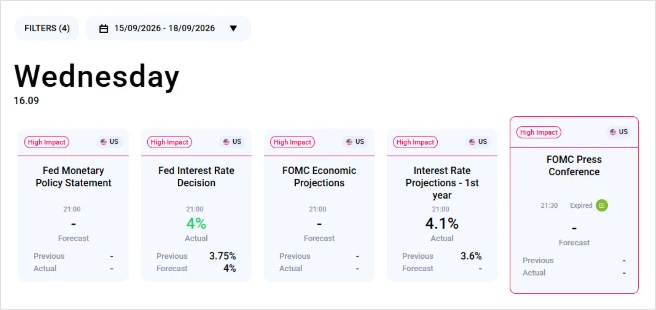
On decision day the calendar puts the whole sequence in one place. For the Fed decision of 16 September 2026, Real-Time Market Insights in your Members Area shows the previous rate, the forecast and the actual rate next to the projections and the press conference.
Conclusion
The FOMC meets eight times a year, and each meeting gives you a decision, a statement and a press conference to read against what markets expected. Before the next meeting, copy its date from the table, open the economic calendar and write down the forecast and the previous rate.
FAQ
What does FOMC stand for?
FOMC stands for Federal Open Market Committee. It is the monetary policymaking body of the Federal Reserve System, the central bank of the United States.
What does FOMC mean in trading?
For traders, the FOMC means the eight meetings a year when the Fed decides on US interest rates. The decision, the policy statement and the press conference are events that move the US dollar, gold and US stock indices.
How many FOMC meetings are there per year?
The FOMC holds eight regularly scheduled meetings a year, about six weeks apart. It can also hold unscheduled meetings when conditions require.
When is the next FOMC meeting?
The remaining 2026 meetings are on 27 to 28 October and 8 to 9 December. In 2027 the Committee meets on 26 to 27 January, 16 to 17 March, 27 to 28 April, 8 to 9 June, 27 to 28 July, 14 to 15 September, 26 to 27 October and 7 to 8 December. Each date is tentative until confirmed at the meeting before it. The RoboForex economic calendar shows the date and time of each decision.
Who votes at the FOMC?
Twelve members vote: the seven members of the Board of Governors, the president of the New York Fed, who is a permanent voting member, and four of the other Reserve Bank presidents on a rotating basis.
What is the dot plot?
The dot plot is a chart in the Fed's Summary of Economic Projections, published at four meetings a year. Each dot marks where one participant expects the policy rate to be at the end of a year.
What are the FOMC minutes?
The minutes are a full record of the Committee's discussion at a meeting. They are published three weeks after the decision.
Does the FOMC affect gold?
Often, because gold pays no interest and a signal of higher US rates raises the cost of holding it. The link is looser than it looks: central bank purchases and geopolitics also move gold.
- CPI in Forex Trading: What It Is and How It Moves Prices: the inflation data that feeds into every FOMC decision.
- What Is an Economic Calendar and Why Every Trader Should Use It: how forecast, previous and actual values work.
- US Dollar Index (DXY): What It Is and How to Use It in Forex: how the dollar's strength against a basket of major currencies is measured.
Any information provided in articles on this website is based solely on the personal opinions of the authors. These articles should not be construed as trading recommendations or a call to action. The authors and RoboForex accept no responsibility for the results of any trades made on the basis of these recommendations and reviews. Past performance is not indicative of future results. Trading stocks and CFDs involves a high risk of capital loss.