Trading Strategies That Were a Revolution: Three Strategies of Linda Raschke
Linda Raschke is an American trader known for short-term strategies that trade false breakouts and the end of pullbacks. Three of them are covered here: the 80-20 strategy, which trades the day after a strong one-sided candle; the Turtle Soup strategy, which fades a false break of the 20-day range; and the Anti system, which uses a fast Stochastic to join the trend after a correction. None of them needs more than one indicator.
TL;DR
- For the 80-20 strategy, find a D1 candle whose body is 80% or more of its range, then trade the return after the price overshoots its close by 20 points.
- For the Turtle Soup strategy, wait for a break of the 20-day high or low and sell or buy when the price comes back inside the range.
- For the Anti system, set Stochastic to 7, 10, 3 and enter when the fast line hooks back in the direction of the slow line; keep the stop behind the signal candle.
It is generally accepted that there are much fewer women in trading than men, but this does not mean at all that their influence on the trading establishment is a bit less. In this series of posts we will introduce you to the bright representatives of financial markets, whose activities have not gone unnoticed. And the first one will be Linda Raschke.
Who Is Linda Raschke?
Linda Bradford Raschke is a famous and talented trader. She was born in the USA in 1959. She has been trading for over 35 years. For the start, she used to help her father when she was young. Then, she worked at the exchange. And in 1992, she founded her own company LBR Group. In 1993, she extended her horizons and started managing investor money. In 2002, she founded a hedge fund that, according to Barclays Hedge, became the 17th out of 450 active funds.
Mostly, Linda Raschke traded S&P 500 futures and successfully applied her own trading systems on the currency and commodity markets. As a rule, her positions are short-term, no more than 10-15 minutes. A position holding for up to several weeks is more of an exclusion. She used to carry out 3-4 trades a day.
In 2015, she finished her career as an active trader and took up delivering lectures and organizing workshops for analysts and market makers.
Linda Raschke is the author of several books, such as:
- "Street Smarts. High Probability Short-Term Trading Strategies" (co-authored by L.Connors)
- "Trading Sardines"
The table sums up the three Linda Raschke strategies described below.
| Strategy | Type | Timeframe | Entry condition | Stop |
|---|---|---|---|---|
| 80-20 | Intraday reversal on a false breakout | D1 for the signal candle, H1 for the entry | The price goes 20 points or more beyond the close of the momentum candle and returns; target 50% of the candle, exit by the end of the day | Beyond the extreme of the false move |
| Turtle Soup | Reversal on a false break of the 20-day range | D1 for the range, H1 for the entry; held 2-3 days | A 20-day high or low is broken no earlier than 3 days after it formed, and the price returns 10 points inside the range | Beyond the new extreme, then a trailing stop of 50-70 points |
| Anti | Trend continuation after a pullback | Almost any | Stochastic 7, 10, 3: the fast line hooks back in the direction of the slow line, and both move the same way | Under the low or above the high of the signal candle; exit by the end of the day |
Trade on the Go With RoboForex MobileTrader
A portable trading workstation on your phone, on Android and iOS.
The 80-20 Trading Strategy
This Raschke's strategy does not require any indicator; it is short-term, intraday, based on the idea of the false breakaway of a range.
At the basis of this strategy lies the formation of a specific intraday candlestick. Particularly, a candlestick with a long body and short shadows. If the body takes up 80% or more of the candlestick, while the shadows constitute 20% or less, such a candlestick is considered to signal next day trades. Raschke noticed that, in such a case, a reversal of the market is highly probable the next day. Such a candlestick was named momentum candlestick.
After the momentum candlestick has formed, the next couple of days we should wait for the price to escape the limits of the closing price of the momentum candlestick for 20 points, and on the return of the price to the closing level open an order with a profit of 50% of the whole length of the momentum candlestick. The return will be to at least the center of the momentum candlestick.
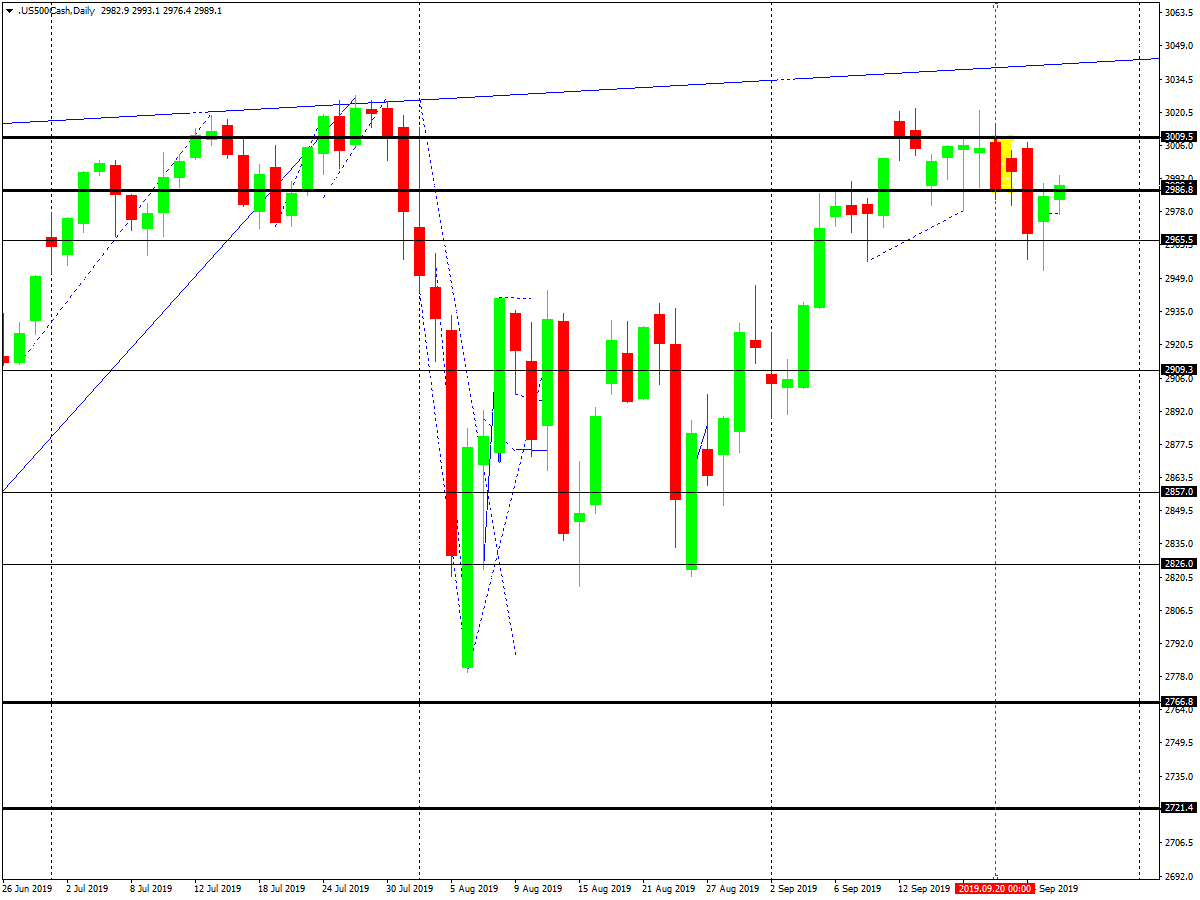
The system is obviously simple. It may equally be used by beginners and professionals. Let us have a look at an example: a D1 of the US 500. The candlestick of September 20th, 2019 looks interesting, complying with all the requirements of the system.
After the momentum candlestick has formed, we should move to H1. In Pic 2 you can see all the possibilities of using this system.
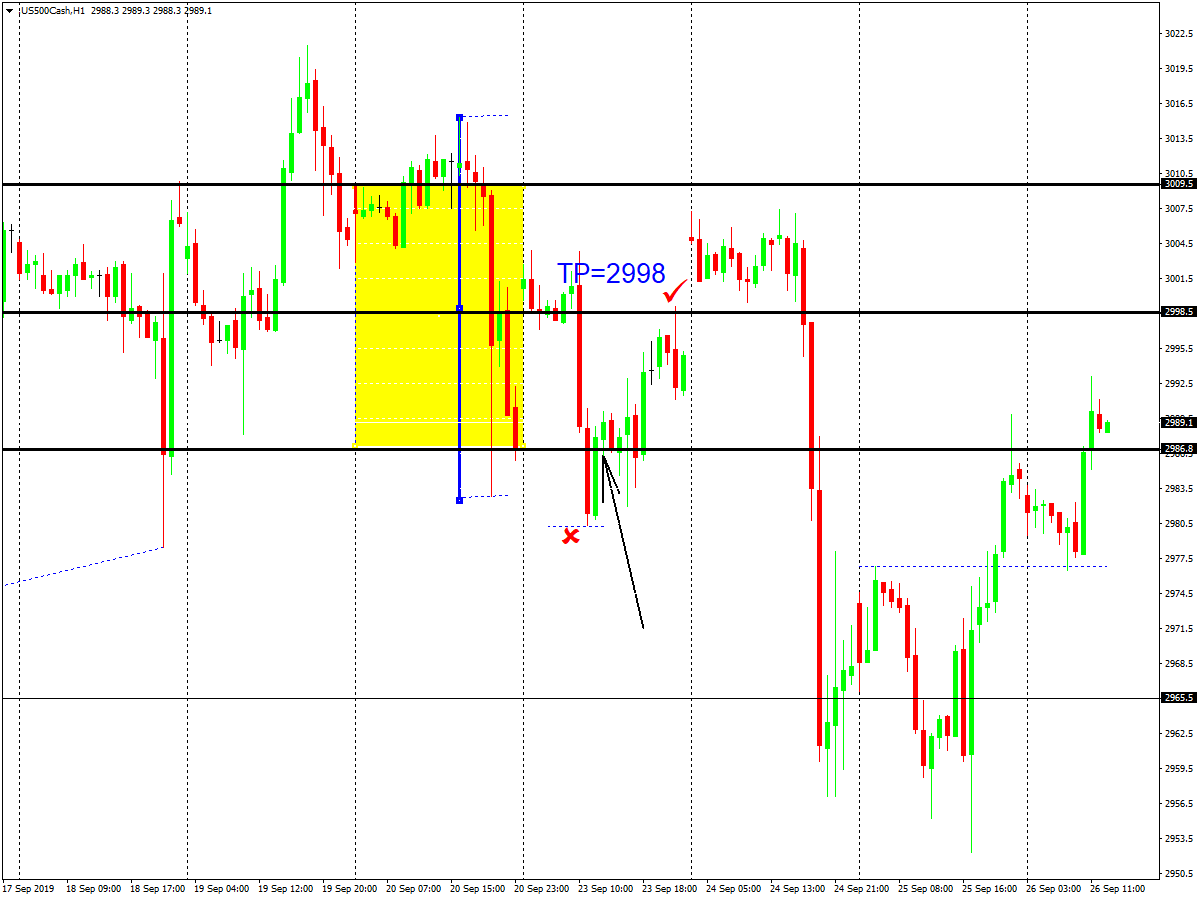
The market is breaking through the range in question top-down, declines for over 20 points and returns inside the borders of the range.
Right after the return you can start buying. The profit is right in the middle of the range. If the Take Profit is not triggered, the order is closed manually at the end of the session, at, say 23:59, a minute before the market closes. The signal in this strategy is valid for only a day. The 80-20 strategy is applicable to Forex as well.
Let us discuss another example of the USD/CAD on September 13th, 2019.
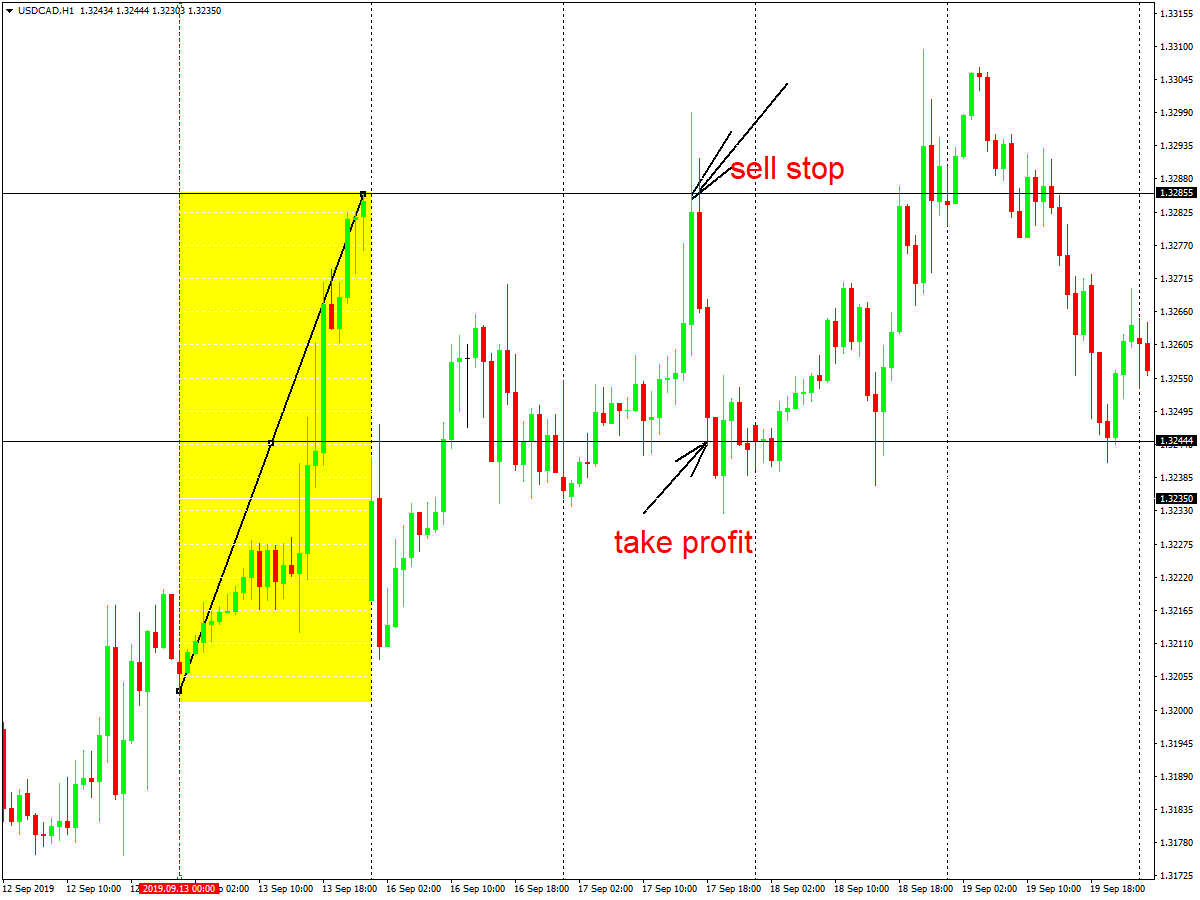
The condition is met on the second day after the appearance of the momentum candlestick. The market goes more than 20 points above the closing price of the momentum candlestick, and on the reversal, we can place a Sell Stop. You receive a profit after 2-3 hours of trading. The Stop Loss must be placed above the maximum at the moment of the order being triggered.
The Turtle Soup Strategy
This strategy is mid-term or long-term, requiring no indicator. The position is held for 2-3 days. The key element of the strategy is the 20-day price range.
The calculation starts any day of the market analysis. The strategy is based on the false breakaway of the range. The work starts when the minimum or the maximum of the range is broken through no earlier than 3 days after the price reached this maximum or minimum. Upon the price returning to the range, an order heading inside the range is open. In other words, when the minimum is broken through, a buy order is open if the price enters the range starting 10 points from the minimum of the initial range. In case the maximum is broken away, a sell order is open from the maximum -10 points from the maximal price of the range.
The order is followed by a trailing stop for 50-70 points.
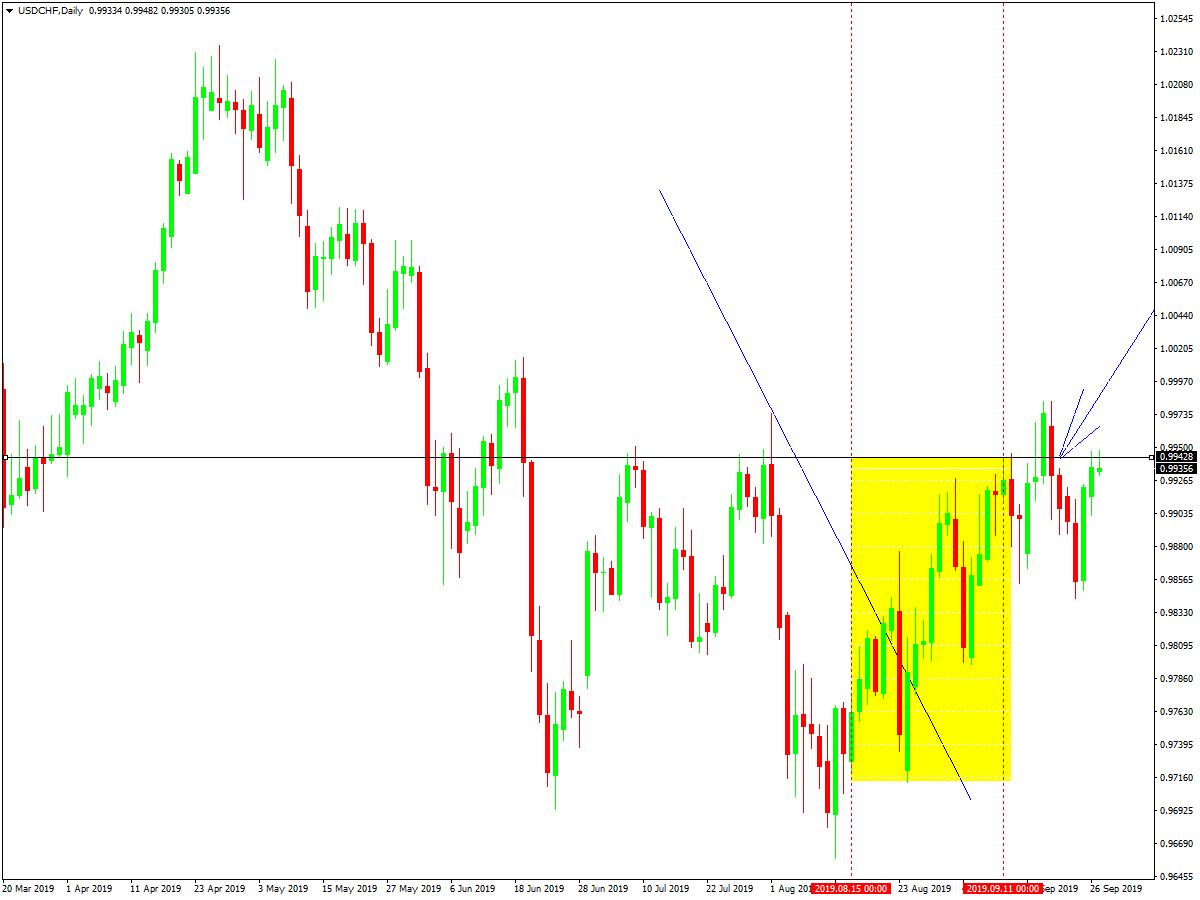
Among the last 20-day ranges, the most successful one was, perhaps, the one on the USD/CHF pair.
We move to H1 and launch the period separators.
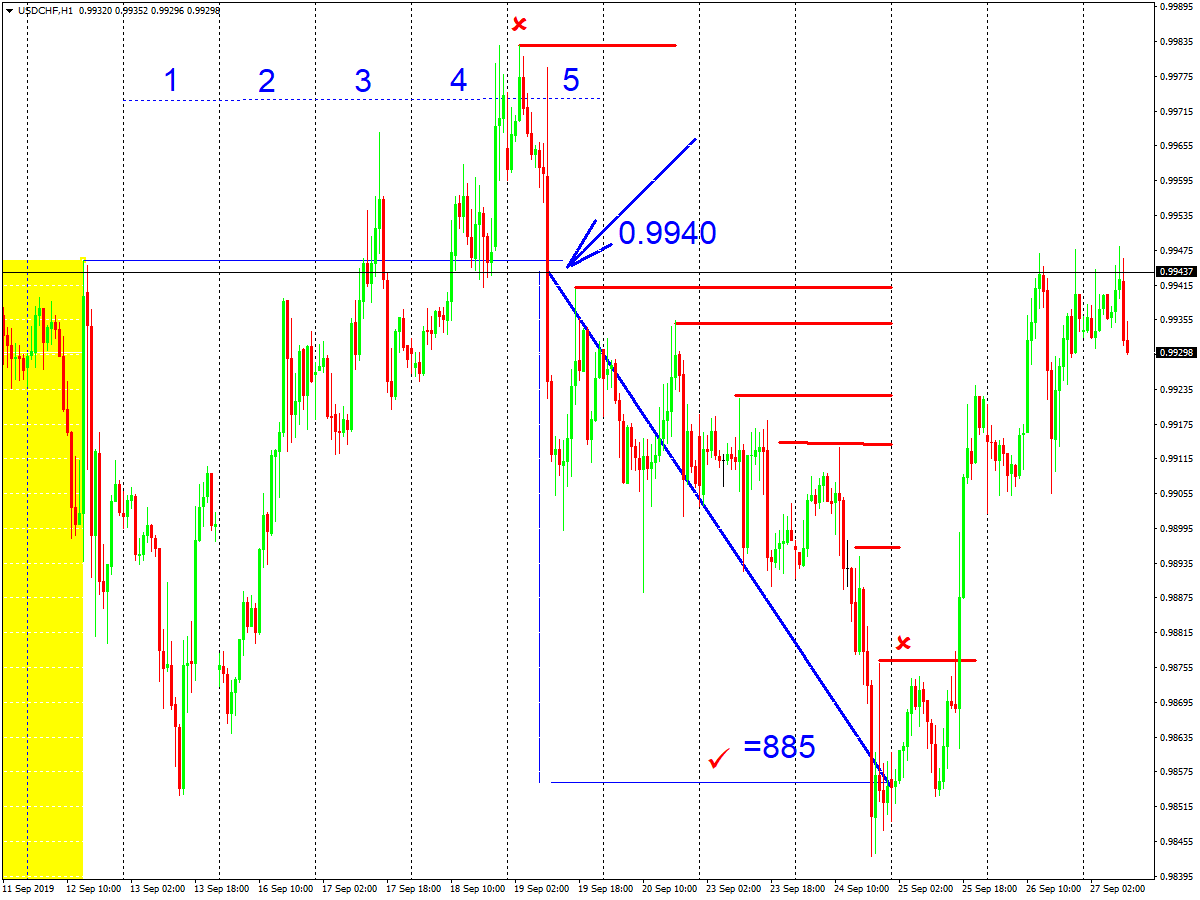
In the picture, we can clearly see the market break through the maximum of the 20-days range and return to the range 4 days later. The condition of 3+ days is fulfilled. We open a sell order from 0.9940. We put an SL above the new maximum that has formed at the moment of the trade.
We remain in the trade for 2-3 days. At the end of the third day, we can get a profit of 885 points. Or, we can visually follow the transition of the SL to the specified maximums of the correction. Or, we can choose a trailing stop for 50 points. However, in this case, the profit will be reduced.
Start Trading Now
Forex, stocks, indices and gold on MetaTrader 4 and MetaTrader 5, from a free demo account to a live one.
The Anti Trading System
The main idea of this one is trading the trend after the completion of a correction. The particularity of the system is the use of the Stochastic Oscillator for defining the end of the pullback and the continuation of the main trend.
The Stochastic parameters are 7.10.3. The trend direction is in accordance with the slow line of the oscillator, while the quick line signals the end of the pullback. The trade is entered when both lines move in the same direction. What deserves the most attention is the hook under the slow line. The order is held strictly one day, with a TP placed at the end of the day and an SL under the minimum/maximum of the signal candlestick.
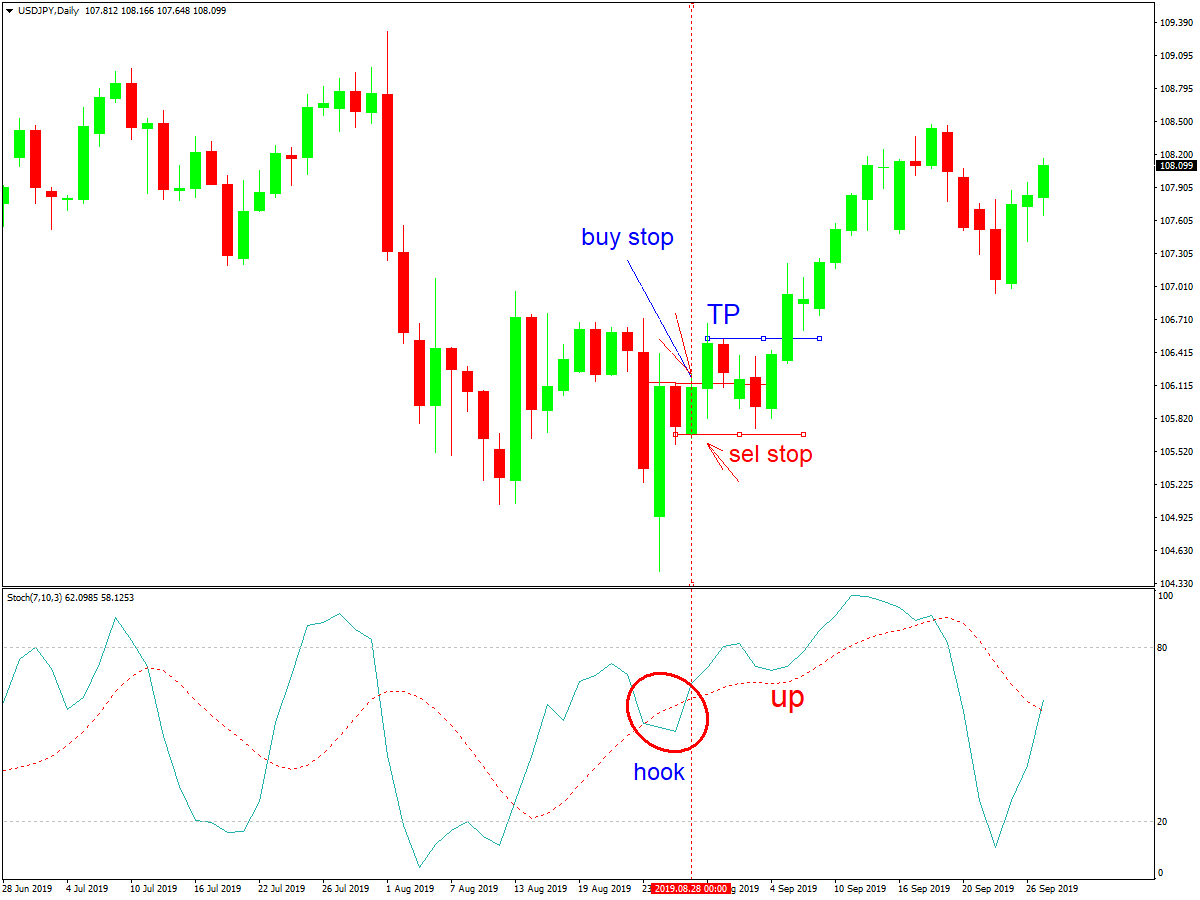
Entry and Exit Rules
The Anti system works in four steps:
- Read the trend. The slow line of Stochastic 7, 10, 3 sets the direction: if it rises, look only for buys; if it falls, only for sells.
- Wait for the pullback. The fast line moves against the slow one, down in an uptrend or up in a downtrend, and approaches it. This is the correction.
- Catch the hook. When the fast line turns back in the direction of the slow line without crossing it, both lines move the same way again. The candle on which this happens is the signal candle. Enter when the price breaks its high for a buy or its low for a sell.
- Exit the same day. Place the stop loss under the low of the signal candle for a buy, above its high for a sell, and close the trade by the end of the day if it is still open.
A hook in the direction of the higher timeframe trend gives the cleanest signal. If the fast line crosses the slow one instead of hooking, the pullback may be turning into a reversal, and the Anti system skips the trade.
This strategy is suitable for almost any timeframe if all the rules are followed.
Summary
In this article, we have discussed the three easiest strategies by Linda Raschke that have influenced the whole market significantly, stimulating many traders to develop new breakaway strategies for D1 as well as session, week, month or year timeframes. These three strategies are suitable for beginners and professionals equally. It is worth mentioning that, regardless of how easy they look, these strategies require much care with SLs. Raschke's work is an example of long-time devotedness to trading. With lots of other systems available, she has invented her own unique methods and shared them generously.
Good results take more than reading the rules and opening an account: they need strict compliance with the rules, good money- and risk management. No matter how great her strategies are, Linda Raschke has experienced serious losses, too. However, after them, she demonstrated even better results. That is why she gives us such an amazing example to follow.
FAQ
Who is Linda Raschke?
An American trader, born in 1959, who traded for over 35 years, mostly S&P 500 futures, and ran her own firm and a hedge fund. She is known for short-term strategies such as the 80-20, the Turtle Soup and the Anti, and for the book Street Smarts, written with Laurence Connors.
What is the 80-20 trading strategy?
A short-term strategy by Linda Raschke. It starts from a daily candle whose body takes 80% or more of its range. If the price then goes 20 points or more beyond that close and returns, a trade opens back toward the middle of the candle and closes by the end of the day.
What is the Turtle Soup strategy?
A Linda Raschke strategy that trades a false break of the 20-day high or low. When the price breaks the range no earlier than 3 days after the last extreme and comes back inside, a trade opens in the direction of the return and is held for 2-3 days with a trailing stop.
What Stochastic settings does the Anti system use?
7, 10, 3. The slow line shows the trend, and the entry comes when the fast line hooks back in the direction of the slow one after a pullback.
Are Linda Raschke's strategies suitable for beginners?
The article considers them suitable for beginners and professionals alike, because the rules are simple and need little or no indicators. They still demand strict stop losses and risk management, so test them on a demo account first.
Any information provided in articles on this website is based solely on the personal opinions of the authors. These articles should not be construed as trading recommendations or a call to action. The authors and RoboForex accept no responsibility for the results of any trades made on the basis of these recommendations and reviews. Past performance is not indicative of future results. Trading stocks and CFDs involves a high risk of capital loss.