
Brent is plunging: when will the sell-off end?
The Brent price fell to 78.22 USD on Thursday. The market continues to strip the geopolitical premium out of the quotes. More details are in our analysis for 18 June 2026.
Brent forecast: key takeaways
- The Brent price is plunging: the US and Iran have signed an agreement
- The IEA expects weak oil demand in 2027
- Brent forecast for 18 June 2026: 77.60
Fundamental analysis
Brent crude fell below 79 USD per barrel on Thursday, continuing its decline towards the lows seen since early March. Pressure on the market increased after reports that the US and Iran had signed an interim peace agreement in electronic form.
According to US sources, the memorandum has already entered into force. However, it remains unclear whether Iran has started practical steps towards fully reopening the Strait of Hormuz and restoring shipping through the key energy route.
According to preliminary information, the agreement provides for a rapid resumption of traffic through the strait and the removal of restrictions on Iranian oil exports. At the same time, talks on Iran’s nuclear programme and possible additional economic support measures will continue separately.
Market participants are also closely monitoring the actions of shipping companies, many of which had previously almost stopped transit through the Strait of Hormuz amid mutual restrictions imposed by the US and Iran.
Additional pressure on the quotes is coming from the forecast of the International Energy Agency (IEA). The organisation expects global oil supply to rise by 8 million barrels per day by 2027, while demand will increase by only 2 million barrels. This is increasing concerns about a possible oversupply in the global market in the medium term.
The forecast for Brent is negative.
Technical outlook
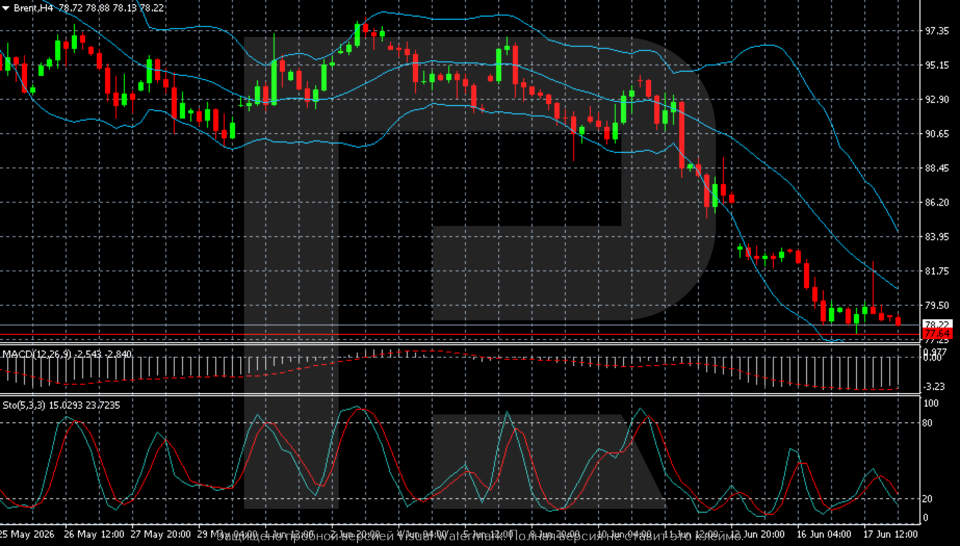
On the Brent H4 chart, a pronounced downward trend remains in place. After a failed attempt to consolidate above 93–94 USD, the quotes turned downwards and have lost more than 15 USD over the past week, falling into the 78 USD per barrel area. The price is now sitting at local lows and testing the important support area of 77.60–78.00 USD, which is holding back a further decline.
The technical picture remains negative. The quotes are moving near the lower Bollinger Band, while the middle line of the indicator is positioned well above current prices in the 81–82 USD area, acting as the nearest resistance. The sequence of lower highs and lower lows remains in place, confirming that sellers remain in control of the market. Brent needs to reclaim the area above 80–82 USD to improve the situation.
The indicators also support the bearish scenario. MACD remains deep in negative territory, although the histogram is starting to contract, which may indicate a slowdown in the downward impulse. Stochastic is near the oversold zone and is turning downwards after a failed recovery attempt. The base scenario remains consolidation near 78 USD, with the risk of a retest of support at 77.60 USD. A break of this level may open the way to a decline into the 75–76 USD area, while a rebound may return prices to 80–82 USD.
Brent overview
- Asset: Brent
- Timeframe: H4 (Intraday)
- Trend: downward
- Key resistance levels: 80.00 and 82.00
- Key support levels: 77.60 and 75.00
Brent trading scenarios for today
Main scenario (Sell Stop)
Consolidation below support at 77.60 will confirm that the downward impulse remains in place against the backdrop of expectations of rising global oil supply after the agreement between the US and Iran, and will increase the risks of a further decline in the quotes.
- Take Profit: 75.00 USD
- Stop Loss: 79.00
Alternative scenario (Buy Stop)
A breakout of resistance at 80.00 will signal the development of a technical rebound after the large-scale sell-off and will open the way to a recovery towards 82.00.
- Take Profit: 82.00
- Stop Loss: 78.50
Risk factors
The main risks to the downside scenario are linked to possible delays in implementing the agreement between the US and Iran or problems with fully reopening the Strait of Hormuz. A reduction in US oil inventories and signs of stronger global demand may also support Brent.
Summary
The Brent price continues to fall against the backdrop of a lower geopolitical risk premium. The forecast for Brent today, 18 June 2026, assumes a retest of 77.60 and then a further decline to 75.00.
comprehensive gold forecast: technical analysis across three timeframes, trading scenarios with specific entry levels, Fed policy and central bank demand outlook, and institutional predictions for 2026 and beyond.
Editors’ picks
 EURUSD forecast 2026–2027: technical analysis, price levels & predictions
The ECB holds rates at 2.15% while the Fed stays at 3.75% — and that divergence is the central driver of EURUSD in 2026. The pair is range-bound between 1.1400 and 1.1915, with Deutsche Bank targeting 1.2500 and Morgan Stanley calling for 1.3000 by year-end. We analyse the technicals, break down the macro factors, and outline three trading scenarios with specific entry levels.
 Gold (XAUUSD) forecast 2026: predictions based on fundamental and technical analysis
Where is gold headed after pulling back from the all-time high of 5,597 USD? XAUUSD is consolidating near 4,518 USD between key levels 4,220 USD and 4,855 USD, with major banks targeting 5,243–6,200 USD by year-end. Read our
Forecasts presented in this section only reflect the author’s private opinion and should not be considered as guidance for trading. RoboForex bears no responsibility for trading results based on trading recommendations described in these analytical reviews.