
Gold (XAUUSD) weekly forecast: the precious metal is giving way under pressure
Gold (XAUUSD) enters the week of 8–12 June near 4,450 USD per ounce, under pressure from rising inflation risks and expectations of a more hawkish stance from major central banks. Additional pressure on gold comes from a strong dollar, rising US yields, and Fed comments about the possibility of rate hikes if price pressures persist.
The baseline scenario for the week suggests continued high volatility and consolidation with a moderately negative bias. As long as XAUUSD prices hold above the 4,370–4,400 support area, the market will have a chance to stabilise and attempt local recoveries towards 4,520–4,660.
XAUUSD forecast for this week: quick overview
- Weekly performance: gold (XAUUSD) ends the week around 4,450 USD per ounce, under pressure from rising inflation risks and expectations of tighter policy from major central banks. The conflict in the Middle East and disruptions around the Strait of Hormuz are keeping energy prices elevated. Additional negative factors for gold include the worsening outlook for a peace agreement between the US and Iran and the Federal Reserve’s comments about the possibility of rate hikes
- Support and resistance: on the daily chart, gold remains under strong pressure after a major correction from the highs around 5,500. Quotes are gradually shifting down towards the 4,370–4,400 support zone, remaining below the middle Bollinger Band. Recovery attempts are capped by the 4,520–4,660 area, where sellers remain active. The nearest support lies around 4,370–4,400 and 4,100, with resistance located in the 4,520–4,660 area
- Fundamentals and outlook: the baseline scenario suggests consolidation with a moderately negative bias. Hawkish Fed rhetoric, a strong dollar, and rising inflation expectations continue to limit gold’s recovery potential. Additional pressure comes from uncertainty around US-Iran talks and the risks of further escalation in the Middle East. Future XAUUSD price movements will depend on news around the Strait of Hormuz, US data, and Fed rate expectations
Gold (XAUUSD) fundamental analysis
Gold (XAUUSD) closed the week around 4,450 USD per troy ounce, pressured by rising inflation risks and expectations of a more hawkish stance from major central banks. The escalation of the conflict in the Middle East and disruptions around the Strait of Hormuz are supporting high energy prices. This reinforces fears of accelerating inflation and forces the market to reassess interest rate forecasts.
An additional negative factor for gold was the worsening outlook for a peace agreement between the US and Iran. During the week, the sides exchanged strikes, and Bahrain and Kuwait became involved in the most serious escalation since the ceasefire regime began in April. Against this backdrop, demand for the dollar increased, and expectations for rates staying high strengthened.
Federal Reserve officials’ comments added support to this scenario. Cleveland Fed President Beth Hammack did not rule out the possibility of a rate hike if inflation pressures continue to mount.
XAUUSD technical analysis
On the daily chart, gold (XAUUSD) remains under strong pressure after a major correction from the all-time highs around 5,500. Following a sharp decline in May, the market has failed to form a sustainable recovery. In recent weeks, quotes have been gradually shifting lower and are now trading around 4,470, below the middle Bollinger Band, indicating that sellers remain in control.
The current market structure remains bearish. Each attempt to rise into the 4,520–4,660 area encounters renewed selling, and highs continue to decline gradually. The nearest support is located in the 4,370–4,400 zone, which has already halted the decline several times, with the next one at a stronger level around 4,100. As long as prices stay below the 4,520–4,660 resistance area, it is premature to talk about a full-fledged upward reversal.
Technical indicators confirm a cautiously negative scenario. MACD remains in negative territory and only slightly reduces the depth of the decline, indicating a weakening of the bearish momentum, but not its end. The Stochastic Oscillator turns down from the middle part of the range, warning of the risk of a new wave of selling after a short stabilisation.
The base-case scenario suggests continued consolidation with a moderately downward bias. If the 4,370–4,400 support area is broken, pressure on gold will intensify and the market may move towards 4,100. To improve the technical picture, buyers need to push prices back above 4,520–4,660 and gain a foothold above this area. Only then will there be grounds for a more sustainable recovery.
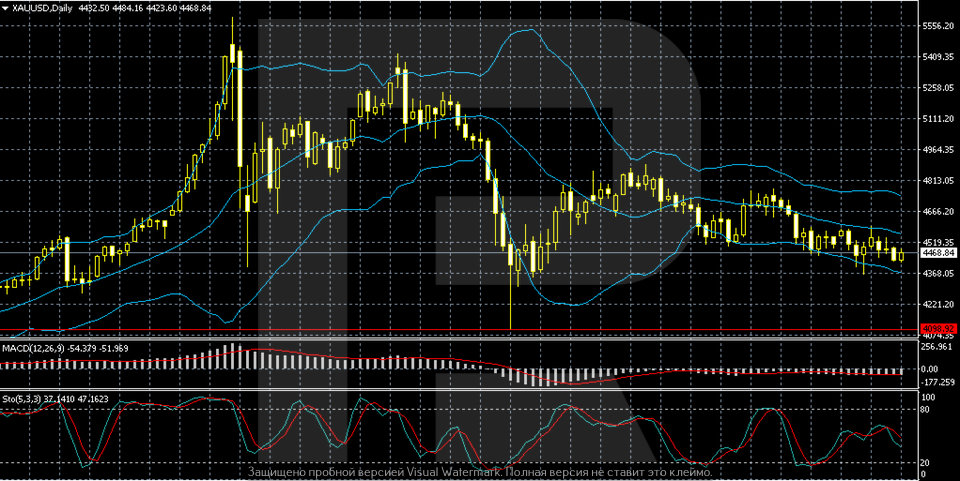
XAUUSD trading scenarios
The fundamental backdrop for gold (XAUUSD) is negative. The market is pricing in the risks of accelerating inflation and a prolonged period of hawkish policy from major central banks amid the escalation of the Middle East conflict. Disruptions around the Strait of Hormuz are keeping energy prices elevated, while the deteriorating outlook for a peace agreement between the US and Iran is boosting demand for the dollar. Fed officials’ comments added to pressure on gold.
Technically, gold remains in a downward phase after the large-scale correction from the highs around 5,500. Quotes are gradually shifting towards the 4,370–4,400 support zone. Attempts to rise are still limited by the 4,520–4,660 area, where selling pressure is intensifying. The nearest support is around 4,370–4,400, with a stronger one near 4,100.
- Buy scenario
A breakout and consolidation above 4,520–4,660 would signal that sellers are losing control and open the way for a recovery towards 4,810.
- Sell scenario
A breakout below the 4,370–4,400 support area would strengthen the downward momentum and increase the likelihood of a decline towards 4,100.
Result: gold (XAUUSD) maintains a moderately negative stance. While prices remain below 4,520–4,660, downside risks prevail.
Summary
Gold (XAUUSD) is hovering around 4,450 USD per ounce, under pressure from rising inflation risks and expectations of a more hawkish stance from major central banks. The escalation of the Middle East conflict, uncertainty surrounding US-Iran talks, and hawkish Fed rhetoric drive demand for the dollar and limit interest in gold.
Technically, XAUUSD remains in a downward phase following the correction from the highs around 5,500. Prices continue to trade below the key 4,520–4,660 resistance area, and the baseline scenario suggests continued high volatility and consolidation with a moderately negative bias. As long as quotes remain below this area, downside risks towards 4,370–4,100 remain.
Editors’ picks
 EURUSD 2026-2027 forecast: key market trends and future predictions
This article provides the EURUSD forecast for 2026 and 2027 and highlights the main factors determining the direction of the pair’s movements. We will apply technical analysis, take into account the opinions of leading experts, large banks, and financial institutions, and study AI-based forecasts. This comprehensive insight into EURUSD predictions should help investors and traders make informed decisions.
 Gold (XAUUSD) forecast 2026 and beyond: expert insights, price predictions, and analysis
Dive deep into the Gold (XAUUSD) price outlook for 2026 and beyond, combining technical analysis, expert forecasts, and key macroeconomic factors. It explains the drivers behind gold’s recent surge, explores potential scenarios including a move toward 4,500 to 5,000 USD per ounce, and highlights why the metal remains a strong hedge during global uncertainty.
Forecasts presented in this section only reflect the author’s private opinion and should not be considered as guidance for trading. RoboForex bears no responsibility for trading results based on trading recommendations described in these analytical reviews.