
Gold (XAUUSD) weekly forecast: at a seven-month low
Gold (XAUUSD) enters the new week near 4,100 USD per ounce, under pressure from high inflation risks, a strong dollar, and expectations that the Federal Reserve will maintain a restrictive policy stance. The situation surrounding Iran and restrictions on traffic through the Strait of Hormuz are also impacting the market, keeping energy prices high and fuelling inflation fears.
The base-case scenario for the week suggests continued high volatility and consolidation with a moderately negative bias. While XAUUSD remains below the 4,150–4,210 resistance area, the risks of a renewed decline towards 4,020–4,000 persist. To improve the technical picture, buyers need to push prices back above 4,150–4,210 and gain a foothold above this area.
XAUUSD forecast for this week: quick overview
- Weekly performance: gold (XAUUSD) closed the week around 4,100 USD per ounce, hitting a seven-month low. Pressure on the market comes from accelerating inflation in the US, expectations of continued tight Fed policy, and tensions in the Middle East. Despite hopes for renewed talks between the US and Iran, restrictions in the Strait of Hormuz continue to support high energy prices and inflation risks
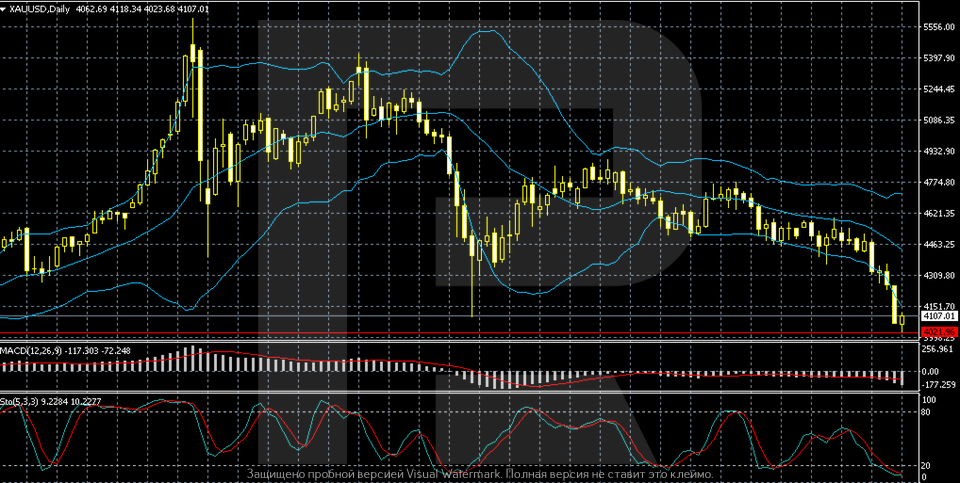
- Support and resistance: on the daily chart, gold remains under strong pressure after a major correction from highs around 5,500. Quotes broke below the 4,300–4,320 support area and fell to 4,020–4,100, holding near the lower Bollinger Band. The nearest support is located around 4,020–4,000, while resistance lies in the 4,150–4,210 area
- Fundamentals and outlook: the baseline scenario suggests consolidation near current lows with a moderately negative bias. High US rates, a strong dollar, and rising bond yields continue to limit interest in gold. Inflation risks associated with the situation in the Middle East are adding to pressure. Further XAUUSD performance will depend on news around Iran and the Strait of Hormuz, US macroeconomic data, and expectations regarding the Federal Reserve’s future actions
Gold (XAUUSD) fundamental analysis
Gold (XAUUSD) ended the week at around 4,100 USD per troy ounce, a seven-month low. Pressure on the market comes from a combination of high inflation risks and expectations that the Fed will maintain tight policy. Despite hopes for renewed talks between the US and Iran after the end of another series of US strikes, the situation in the Middle East remains tense. The Strait of Hormuz continues to operate under significant restrictions.
Additional pressure came from US inflation statistics. In May, consumer prices rose at the fastest pace in more than three years amid higher energy prices. Although the data matched market expectations, it confirmed persistent price pressure and supported a scenario of continued high interest rates.
This week, investors will continue to monitor developments around Iran and the Strait of Hormuz, as well as comments from Federal Reserve officials. For now, the market is fully pricing in a 25-basis-point rate hike in December, limiting gold’s recovery potential.
XAUUSD technical analysis
Gold (XAUUSD) remains under strong pressure on the daily chart after a major correction from its all-time highs around 5,500. In recent weeks, quotes have been falling consistently, with the decline accelerating this week. Prices broke below the key support area of 4,300–4,320 and dropped to the 4,020–4,100 zone, reaching new lows in almost three months. Quotes are hovering near the lower Bollinger Band, reflecting seller dominance and high volatility.
The technical structure remains distinctly bearish. After failed recovery attempts around 4,500–4,600, the market continued to form a series of lower highs and lower lows. The nearest support level is located around 4,020, and below that, market attention may shift to the psychological 4,000 level. Resistance lies in the 4,150–4,210 area, where the previously broken support level is located.
The MACD indicator remains deep in negative territory and continues to indicate persistent strong downside momentum. Although the pace of decline is gradually slowing, there are no signs of a full-fledged reversal yet. The Stochastic Oscillator is in oversold territory, suggesting a short-term technical rebound after the sharp sell-off, but this signal still looks more like an opportunity for a correction than the start of a sustainable recovery.
The baseline scenario remains consolidation near current lows with the risk of a retest of the 4,020–4,000 area. To significantly improve the technical picture, buyers need to push prices back above 4,150–4,210 and settle above this zone. Until then, the medium-term advantage remains with sellers.
XAUUSD trading scenarios
The fundamental backdrop for gold (XAUUSD) remains negative. The market is pricing in a prolonged period of high interest rates in the US amid accelerating inflation and rising energy prices. Despite hopes for renewed talks between the US and Iran, the situation in the Middle East remains tense. Additional pressure on gold comes from a firm dollar and expectations of a Fed rate hike in December.
Technically, gold remains in a pronounced downtrend after the major correction from highs around 5,500. Quotes broke below support at 4,300–4,320 and fell into the 4,020–4,100 area, hitting new lows in several months. Recovery attempts are still capped by the 4,150–4,210 zone, where the previously broken support sits. The nearest support is around 4,020–4,000.
- Buy scenario
A consolidation above 4,150–4,210 would be the first signal of stabilisation, opening the way for a deeper recovery towards 4,300.
- Sell scenario
A breakout below the 4,020–4,000 support area would increase pressure on gold and increase the likelihood of a further decline.
Conclusion: gold (XAUUSD) keeps a negative bias. While prices remain below 4,150–4,210, the risks of continued downside movement prevail.
Summary
Gold (XAUUSD) is hovering around 4,100 USD per ounce, pressured by high inflation risks and expectations that the Fed will maintain tight policy. The situation in the Middle East remains tense, with restrictions in the Strait of Hormuz supporting high energy prices and demand for the dollar.
Technically, XAUUSD remains in a bearish phase after the correction from highs around 5,500. Quotes have consolidated below the 4,300–4,320 zone and are trading in the 4,020–4,100 range. While prices remain below the 4,150–4,210 resistance area, the risks of a renewed decline towards 4,020–4,000 persist.
Editors’ picks
 EURUSD forecast 2026–2027: technical analysis, price levels & predictions
The ECB holds rates at 2.15% while the Fed stays at 3.75% — and that divergence is the central driver of EURUSD in 2026. The pair is range-bound between 1.1400 and 1.1915, with Deutsche Bank targeting 1.2500 and Morgan Stanley calling for 1.3000 by year-end. We analyse the technicals, break down the macro factors, and outline three trading scenarios with specific entry levels.
 Gold (XAUUSD) forecast 2026: predictions based on fundamental and technical analysis
Where is gold headed after pulling back from the all-time high of 5,597 USD? XAUUSD is consolidating near 4,518 USD between key levels 4,220 USD and 4,855 USD, with major banks targeting 5,243–6,200 USD by year-end. Read our comprehensive gold forecast: technical analysis across three timeframes, trading scenarios with specific entry levels, Fed policy and central bank demand outlook, and institutional predictions for 2026 and beyond.
Forecasts presented in this section only reflect the author’s private opinion and should not be considered as guidance for trading. RoboForex bears no responsibility for trading results based on trading recommendations described in these analytical reviews.