
EURUSD under pressure as the US dollar gains support
The EURUSD pair looks weak and is sliding towards 1.1534. The reduced chance of a Federal Reserve rate cut is supporting the US dollar. Find more details in our analysis for 12 March 2026.
EURUSD forecast: key takeaways
- The EURUSD pair is declining; the market looks weak
- The risk of further downward movement remains
- EURUSD forecast for 12 March 2026: 1.1500
Fundamental analysis
The EURUSD rate is falling again and moving towards 1.1534. The US currency is supported by a fresh jump in oil prices, which increases inflation risks and reduces the likelihood of an imminent Federal Reserve rate cut.
Oil prices are rising for the second day in a row. Fears of a prolonged conflict around Iran outweigh the effect of a coordinated release of strategic oil reserves by major economies. The IEA has already approved its largest release ever – 400 million barrels of oil.
Events in Iraq further heightened market tensions. The country’s authorities suspended operations at oil terminals after two oil tankers were attacked in Iraqi waters. This increased concerns about supply stability in the region.
Macroeconomic data also remains in focus. February US inflation data matched forecasts and showed that consumer price growth remains steady but still above the target level. At the same time, the impact of higher energy prices due to the conflict has not yet been fully reflected in the data.
Against this backdrop, the Federal Reserve is expected to keep interest rates unchanged at the upcoming meeting. The market is now pricing in only one 0.25-percentage-point rate cut, no earlier than September.
The EURUSD outlook is moderate.
Technical outlook
On the H4 chart, the EURUSD pair maintains its downward trajectory. After consolidating near 1.1800 in late February, the market formed a strong bearish momentum in early March, breaking below the middle Bollinger Bands and quickly shifting into the 1.1500–1.1600 range. This move confirmed increasing selling pressure.
In recent sessions, the price has been trading at the bottom of the range and gradually approaching the 1.1530–1.1505 support area. Attempts at a corrective rebound remain limited, with quotes regularly encountering resistance in the 1.1610–1.1650 zone, where the middle Bollinger Band runs. This indicates sellers remain in control.
Indicators also reflect market weakness. The Stochastic Oscillator is in oversold territory but has not yet formed a stable reversal signal, while the MACD histogram remains below the zero line. As long as the pair holds below 1.1610, the risk of a further decline towards 1.1500 remains.
EURUSD overview
- Asset: EURUSD
- Timeframe: H4 (Intraday)
- Trend: bearish
- Key resistance levels: 1.1610 and 1.1650
- Key support levels: 1.1530 and 1.1500
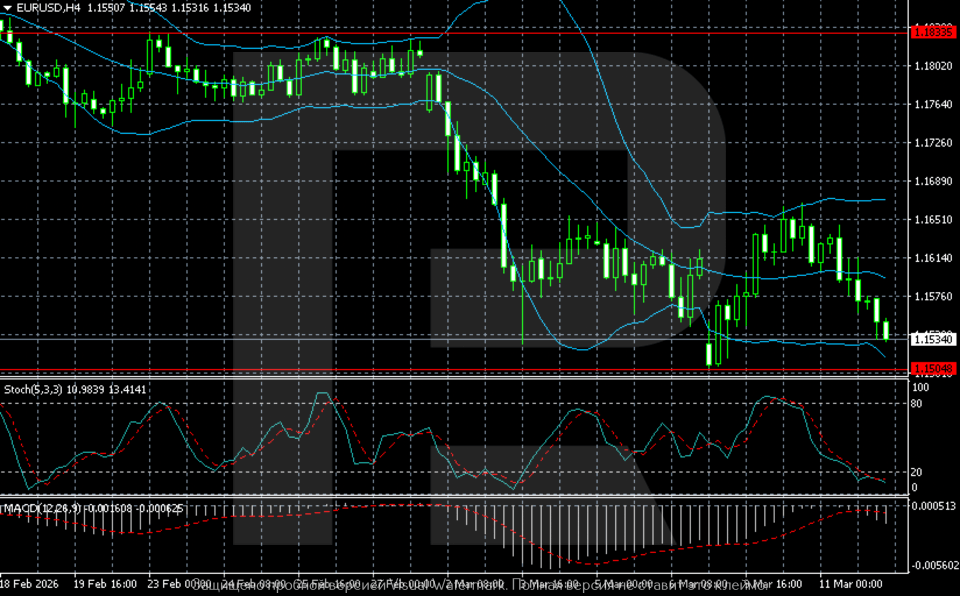
EURUSD trading scenarios for today
Main scenario (Sell Stop)
A breakout and consolidation below 1.1530 would confirm continued bearish momentum formed in early March after the pair broke out of the consolidation zone near 1.1800. Pressure on the euro is rising amid higher oil prices, which increase inflation risks and reduce the likelihood of near-term Fed easing. The move potential is about 30–40 pips with a risk of around 25–30 pips. The risk-to-reward ratio is close to 1:1.5.
- Take Profit: 1.1500
- Stop Loss: 1.1565
Alternative scenario (Buy Stop)
Consolidation above 1.1610 may indicate a corrective rebound after oversold conditions. In this case, the pair could test the next resistance area.
- Take Profit: 1.1650
- Stop Loss: 1.1575
Risk factors
Rising oil prices and ongoing geopolitical tensions support the US dollar. An additional factor is the expectation that the Federal Reserve will keep rates unchanged at the upcoming meeting and deliver only one possible rate cut later this year. Risks to the downside scenario could emerge if the dollar weakens or if the Fed signals a more dovish stance.
Summary
The EURUSD pair is moving lower as markets remain tense. The EURUSD forecast for today, 12 March 2026, does not rule out a slide towards 1.1500.
Editors’ picks
 EURUSD 2026-2027 forecast: key market trends and future predictions
This article provides the EURUSD forecast for 2026 and 2027 and highlights the main factors determining the direction of the pair’s movements. We will apply technical analysis, take into account the opinions of leading experts, large banks, and financial institutions, and study AI-based forecasts. This comprehensive insight into EURUSD predictions should help investors and traders make informed decisions.
 Gold (XAUUSD) forecast 2026 and beyond: expert insights, price predictions, and analysis
Dive deep into the Gold (XAUUSD) price outlook for 2026 and beyond, combining technical analysis, expert forecasts, and key macroeconomic factors. It explains the drivers behind gold’s recent surge, explores potential scenarios including a move toward 4,500 to 5,000 USD per ounce, and highlights why the metal remains a strong hedge during global uncertainty.
Forecasts presented in this section only reflect the author’s private opinion and should not be considered as guidance for trading. RoboForex bears no responsibility for trading results based on trading recommendations described in these analytical reviews.