
EURUSD needs to confirm its rally: this will not be easy
The EURUSD pair rose to 1.1759, with the Middle East and Federal Reserve interest rates back in focus. Find more details in our analysis for 20 April 2026.
EURUSD forecast: key takeaways
- The EURUSD pair is in positive territory, although the market again needs safe-haven assets
- The Federal Reserve will probably not be able to cut the interest rate this year
- EURUSD forecast for 20 April 2026: 1.1820
Fundamental analysis
The EURUSD rate is rising again towards 1.1759 after a slight decline earlier. Demand for safe-haven assets has once again emerged, as the Middle East has again provided reasons for concern.
Escalation in the region has entered a new round. The US detained an Iranian vessel in the Gulf of Oman after it ignored demands to stop while leaving the Strait of Hormuz. In response, Tehran abandoned plans to reopen the strait and effectively suspended participation in the negotiations.
Risks to energy supplies are rising, increasing inflation expectations and changing forecasts for market rates. The likelihood of a Fed rate cut this year is becoming lower.
The Federal Reserve interest rate will most likely remain unchanged in the coming months.
The EURUSD forecast is moderate.
Technical outlook
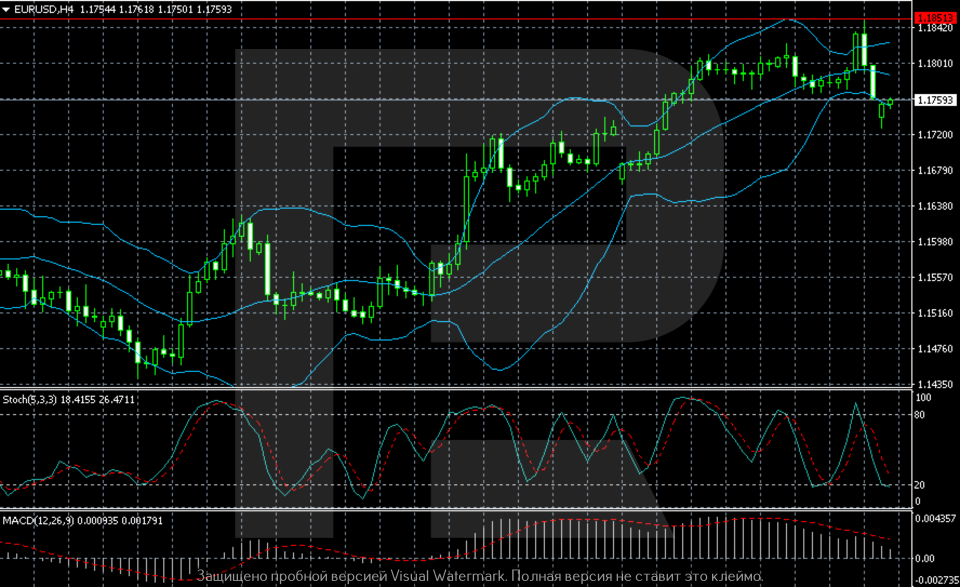
The EURUSD H4 chart shows that the upward structure remains in place after the reversal from local lows. The price consistently formed higher lows and highs, moving along the middle Bollinger Band. The latest impulse pushed quotes into the 1.18+ area, where growth started to slow and moved into a consolidation phase near the upper boundary of the range.
Volatility is currently narrowing. Candlesticks are becoming less impulsive, and the price has pulled back to the middle Bollinger Band and is testing it as dynamic support. The Stochastic Oscillator has sharply exited overbought territory and is pointing downwards, indicating short-term cooling. MACD remains in positive territory, but the histogram is declining, suggesting the upward momentum is losing strength.
Overall, the structure remains bullish, but with signs of a local correction. The nearest resistance is located in the 1.1820–1.1850 zone, where growth had previously stalled. Support is forming around 1.1720–1.1750. The baseline scenario is sideways dynamics with a possible pullback before a new attempt at growth.
EURUSD overview
- Asset: EURUSD
- Timeframe: H4 (Intraday)
- Trend: upward
- Key resistance levels: 1.1820 and 1.1850
- Key support levels: 1.1750 and 1.1720
EURUSD trading scenarios for today
Main scenario (Buy Stop)
Consolidation above 1.1820 would confirm an attempt to continue growth despite rising demand for safe-haven assets. In this case, the pair could head towards 1.1900 if risk appetite remains.
- Take Profit: 1.1900
- Stop Loss: 1.1790
Alternative scenario (Sell Stop)
A breakout below 1.1750 would indicate a correction amid cooling momentum and heightened geopolitical risks. Pressure may shift towards a deeper support level.
- Take Profit: 1.1655
- Stop Loss: 1.1790
Risk factors
Risks to growth are linked to escalating tensions in the Middle East, which are increasing demand for the dollar as a safe-haven asset. An additional factor may be a revision of Fed rate expectations towards a more hawkish policy: this will limit EURUSD’s upside potential.
Summary
The EURUSD pair has resumed growth after a short corrective pause. The EURUSD forecast for today, 20 April 2026, suggests growth towards 1.1820 after testing support levels.
Editors’ picks
 EURUSD 2026-2027 forecast: key market trends and future predictions
This article provides the EURUSD forecast for 2026 and 2027 and highlights the main factors determining the direction of the pair’s movements. We will apply technical analysis, take into account the opinions of leading experts, large banks, and financial institutions, and study AI-based forecasts. This comprehensive insight into EURUSD predictions should help investors and traders make informed decisions.
 Gold (XAUUSD) forecast 2026 and beyond: expert insights, price predictions, and analysis
Dive deep into the Gold (XAUUSD) price outlook for 2026 and beyond, combining technical analysis, expert forecasts, and key macroeconomic factors. It explains the drivers behind gold’s recent surge, explores potential scenarios including a move toward 4,500 to 5,000 USD per ounce, and highlights why the metal remains a strong hedge during global uncertainty.
Forecasts presented in this section only reflect the author’s private opinion and should not be considered as guidance for trading. RoboForex bears no responsibility for trading results based on trading recommendations described in these analytical reviews.