
EURUSD on the verge of change: the Fed is no longer expected to cut rates
The EURUSD pair is holding at 1.1713. The market is reassessing US statistics and changing expectations regarding the Federal Reserve’s actions. Discover more in our analysis for 14 May 2026.
EURUSD forecast: key takeaways
- The EURUSD pair is reacting quickly to the flow of geopolitical news and economic data
- The Fed is no longer expected to lower interest rates in 2026
- EURUSD forecast for 14 May 2026: 1.1675
Fundamental analysis
The EURUSD rate is hovering around 1.1713 on Thursday. The US currency is supported by accelerating inflation in the US amid the conflict around Iran, which is strengthening expectations that the Federal Reserve will maintain its tight policy or even raise rates again.
Wednesday’s data showed that producer inflation in the US rose in April at its fastest pace since 2022. A day earlier, consumer price data recorded an acceleration in inflation to 3.8%, the highest level since May 2023.
Against this backdrop, the market has completely ruled out the probability of a Fed rate cut in 2026 and is increasingly pricing in another rate hike before the end of the year.
Investors also took particular note of the US Senate’s decision to approve Kevin Warsh as Chairman of the Federal Reserve by a narrow margin. The market is assessing how well the new head will be able to preserve the independence of the US regulator under political pressure.
Investors are also keeping an eye on the expected meeting between US President Donald Trump and Chinese President Xi Jinping. According to preliminary reports, the main focus of the talks will be trade relations rather than the conflict around Iran.
The EURUSD forecast is moderate.
Technical outlook
On the H4 chart, the EURUSD pair remains in a sideways consolidation phase after rising in the first half of May. Quotes tested the 1.1780–1.1795 resistance area several times, but buyers have still failed to consolidate above these levels. After another failed breakout attempt, the market moved into a correction and returned to the central part of the range.
The EURUSD pair is now trading near 1.1715, holding slightly below the middle Bollinger Band. Volatility is gradually declining, and the trading range is becoming narrower, indicating a temporary weakening of momentum and the expectation of a new driver to break out of the range. The nearest support level is located near 1.1675, where buyer demand appeared earlier.
The technical picture looks neutral with a moderate downward bias. MACD is gradually moving into negative territory, reflecting the loss of upward momentum, while the Stochastic Oscillator is turning upwards after leaving oversold territory. The nearest resistance remains in the 1.1760–1.1795 area. Consolidation below 1.1675 may increase pressure on the euro and open the way for a deeper correction.
EURUSD overview
- Asset: EURUSD
- Timeframe: H4 (Intraday)
- Trend: sideways with a moderate downward bias
- Key resistance levels: 1.1760 and 1.1795
- Key support levels: 1.1700 and 1.1675
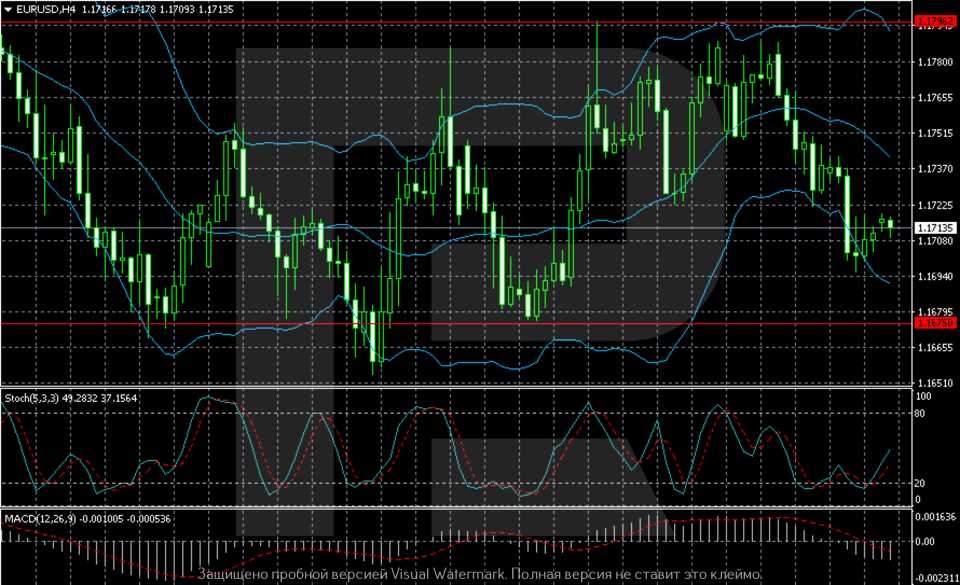
EURUSD trading scenarios for today
Main scenario (Buy Stop)
A breakout and consolidation above the 1.1760 level would create conditions for renewed growth and a retest of the May highs. Stabilising geopolitical conditions and easing pressure from the dollar could support the euro.
- Take Profit: 1.1795
- Stop Loss: 1.1730
Alternative scenario (Sell Stop)
Consolidation below 1.1700 would signal mounting pressure on the euro amid strong US inflation data and expectations of a more hawkish Fed policy. In this case, the decline may continue towards 1.1675.
- Take Profit: 1.1675
- Stop Loss: 1.1725
Risk factors
The EURUSD pair remains in a consolidation phase following its rally in the first half of May. Technical risks for the euro will increase if energy prices continue to rise and the Fed adopts a more hawkish stance.
Summary
The EURUSD pair is reacting to geopolitical developments and US inflation data while taking all prospects into account. The EURUSD forecast for today, 14 May 2026, does not rule out a limited decline towards 1.1675.
Editors’ picks
 EURUSD 2026-2027 forecast: key market trends and future predictions
This article provides the EURUSD forecast for 2026 and 2027 and highlights the main factors determining the direction of the pair’s movements. We will apply technical analysis, take into account the opinions of leading experts, large banks, and financial institutions, and study AI-based forecasts. This comprehensive insight into EURUSD predictions should help investors and traders make informed decisions.
 Gold (XAUUSD) forecast 2026 and beyond: expert insights, price predictions, and analysis
Dive deep into the Gold (XAUUSD) price outlook for 2026 and beyond, combining technical analysis, expert forecasts, and key macroeconomic factors. It explains the drivers behind gold’s recent surge, explores potential scenarios including a move toward 4,500 to 5,000 USD per ounce, and highlights why the metal remains a strong hedge during global uncertainty.
Forecasts presented in this section only reflect the author’s private opinion and should not be considered as guidance for trading. RoboForex bears no responsibility for trading results based on trading recommendations described in these analytical reviews.