
EURUSD at an impasse: demand for the dollar returns
The EURUSD pair has pulled back to 1.1521. Inflation signals remain insufficient, and the market is awaiting producer prices. Discover more in our analysis for 13 August 2026.
EURUSD forecast: key takeaways
- The EURUSD pair edged lower as investors await new data
- The likelihood of a Federal Reserve rate hike is 40%, down from 50% a day earlier
- EURUSD forecast for 13 August 2026: 1.1510
Fundamental analysis
The EURUSD rate slipped to 1.1521 on Thursday. Investors are awaiting July producer price data, which should provide additional signals about the current inflation trend.
Data released on Wednesday showed that US consumer inflation slowed for the second consecutive month, to 3.4% in July. On a monthly basis, prices rose by just 0.1%.
Against this backdrop, the market is pricing in roughly a 40% probability of a 25-basis-point Federal Reserve rate hike in September, down from almost 50% a day earlier.
The situation around the Strait of Hormuz remains an additional factor. Investors continue to assess the prospects of its reopening, but tough rhetoric from the US and Iran amid stalled negotiations reduces the likelihood of a near-term agreement.
The EURUSD forecast is moderately negative.
Technical outlook
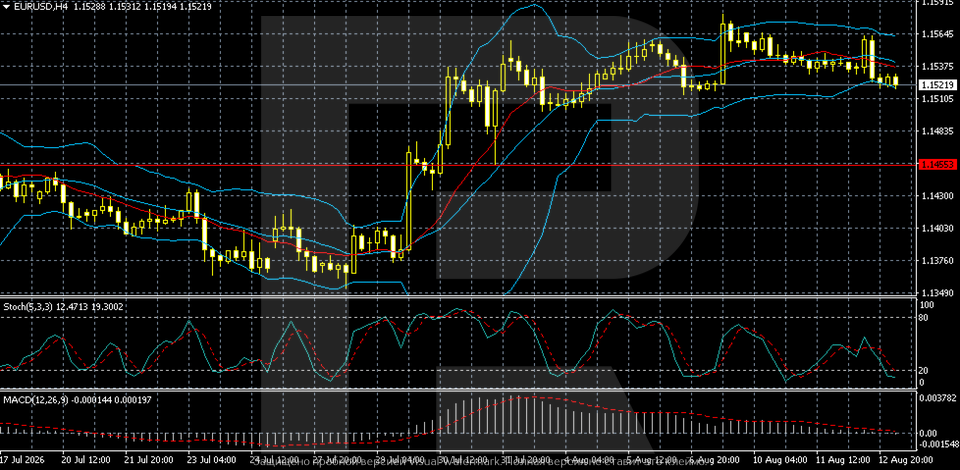
On the H4 chart, the EURUSD pair continues its corrective decline after failing to consolidate above 1.1560. The price is trading around 1.1522, below the middle Bollinger Band and close to the indicator’s lower boundary. Short-term momentum remains weak, although the broader structure following the late-July rise has not yet been broken.
The nearest support level is located at 1.1510. A breakout below this mark would increase selling pressure and open the way towards 1.1484 and then to the key 1.1455 level. The first resistance lies in the 1.1537–1.1540 zone, with the next one at 1.1565. To restore sustained upward momentum, buyers need to gain a foothold above this area.
MACD has moved into negative territory, confirming easing buying pressure, although momentum remains moderate. The Stochastic Oscillator is below 20, indicating oversold conditions, so a local rebound from the 1.1510 support level is possible. The baseline scenario remains movement within the 1.1510–1.1565 range with a neutral-to-negative bias.
EURUSD overview
- Asset: EURUSD
- Timeframe: H4 (intraday)
- Trend: neutral-to-negative
- Key resistance levels: 1.1540 and 1.1565
- Key support levels: 1.1510 and 1.1484
EURUSD trading scenarios for today
Main scenario (Sell Stop)
A breakout and consolidation below the 1.1510 support level would confirm a continued corrective decline and create conditions for a move towards the next support level.
- Take Profit: 1.1484
- Stop Loss: 1.1530
Alternative scenario (Buy Stop)
A breakout and consolidation above the 1.1565 resistance level would invalidate the short-term bearish scenario and indicate that buyers are returning.
- Take Profit: 1.1590
- Stop Loss: 1.1545
Risk factors
The main risks to the EURUSD downside scenario are linked to today’s US producer price data. A weaker PPI reading would boost expectations of a dovish Federal Reserve stance and could renew pressure on the dollar, pushing the pair above 1.1565. Higher producer inflation, by contrast, would increase the likelihood of a September rate hike and weigh on the EURUSD rate. An additional factor is the situation around the Strait of Hormuz and its impact on oil prices and inflation expectations.
Summary
The EURUSD pair has edged lower and is now awaiting US producer price data. The EURUSD forecast for today, 13 August 2026, suggests that the pair will continue to trade sideways within the 1.1510–1.1565 range, with downside risks.
Editors’ picks
 EURUSD forecast 2026–2027: technical analysis, price levels & predictions
EURUSD has pulled back from the 2026 high of 1.1915 and is now trading near 1.1450 — below both EMA65 and EMA200 — with the active scenario shifting from bullish to bearish. The ECB raised rates to 2.40%, but the Fed holds at 3.75%, and US inflation (3.5%) continues to outpace the eurozone (2.8%). A confirmed break below 1.1280 opens the next downward wave toward 1.1080. We break down the key levels, three trading scenarios with entry triggers, and what Deutsche Bank, Morgan Stanley and UBS are forecasting for EURUSD in 2026.
 Gold (XAUUSD) forecast 2026: predictions based on fundamental and technical analysis
Gold has corrected over 25% from its all-time high of 5,597 USD and is now trading near 4,100 USD — testing a critical support zone. Is this the bottom, or will the downtrend continue? We break down the key levels (support 3,920 USD, breakout trigger 4,500 USD), three trading scenarios with entry levels, and what J.P. Morgan, Goldman Sachs and Deutsche Bank are forecasting for gold in 2026.
Forecasts presented in this section only reflect the author’s private opinion and should not be considered as guidance for trading. RoboForex bears no responsibility for trading results based on trading recommendations described in these analytical reviews.