
EURUSD at a standstill: trading continues within a narrow range
EURUSD is trading within a narrow range. US inflation data came in line with forecasts, so it did not trigger a trend reversal or continuation. Discover more in our analysis for 14 August 2026.
EURUSD forecast: key takeaways
- The EURUSD pair is testing a support level
- The likelihood of a Federal Reserve rate hike stands at 31%, down from 40% a day earlier
- EURUSD forecast for 14 August 2026: 1.1595
Fundamental analysis
On Thursday, the EURUSD pair declined towards 1.1515. US consumer inflation slowed from 3.5% to 3.4% year-on-year in July. Meanwhile, monthly CPI was just 0.1%, while core inflation eased from 2.6% to 2.5% year-on-year. These figures indicate that inflationary pressure is gradually weakening.
Today’s producer price report proved more significant for the EURUSD pair. The PPI remained flat in July, while the market had expected a 0.2% increase. The June figure was revised to a 0.1% decline.
For the dollar, this combination of CPI and PPI data is broadly negative. Following the PPI release, market participants reduced the likelihood of a Federal Reserve rate hike in September to around 31%, down from 40% a day earlier and 55% a week earlier.
The EURUSD forecast is moderately positive.
Technical outlook
The EURUSD H4 chart shows increased volatility. The resistance level has formed at 1.1560, while the support level is located at 1.1520. The pair is consolidating between these marks, which may represent a short-term sideways trend.
On the D1 chart, the EURUSD rate is forming a sideways trend. The resistance level has formed at 1.1580, with support at 1.1515. The price occasionally tests these levels.
The broader trend remains upward for now. However, it is on hold and may turn sideways before growth resumes. The key level remains 1.1500. If the price fails to break below it and consolidate underneath, the uptrend will continue.
EURUSD overview
- Asset: EURUSD
- Timeframe: H4 (intraday)
- Trend: neutral to negative
- Key resistance levels: 1.1560 and 1.1580
- Key support levels: 1.1515 and 1.1520
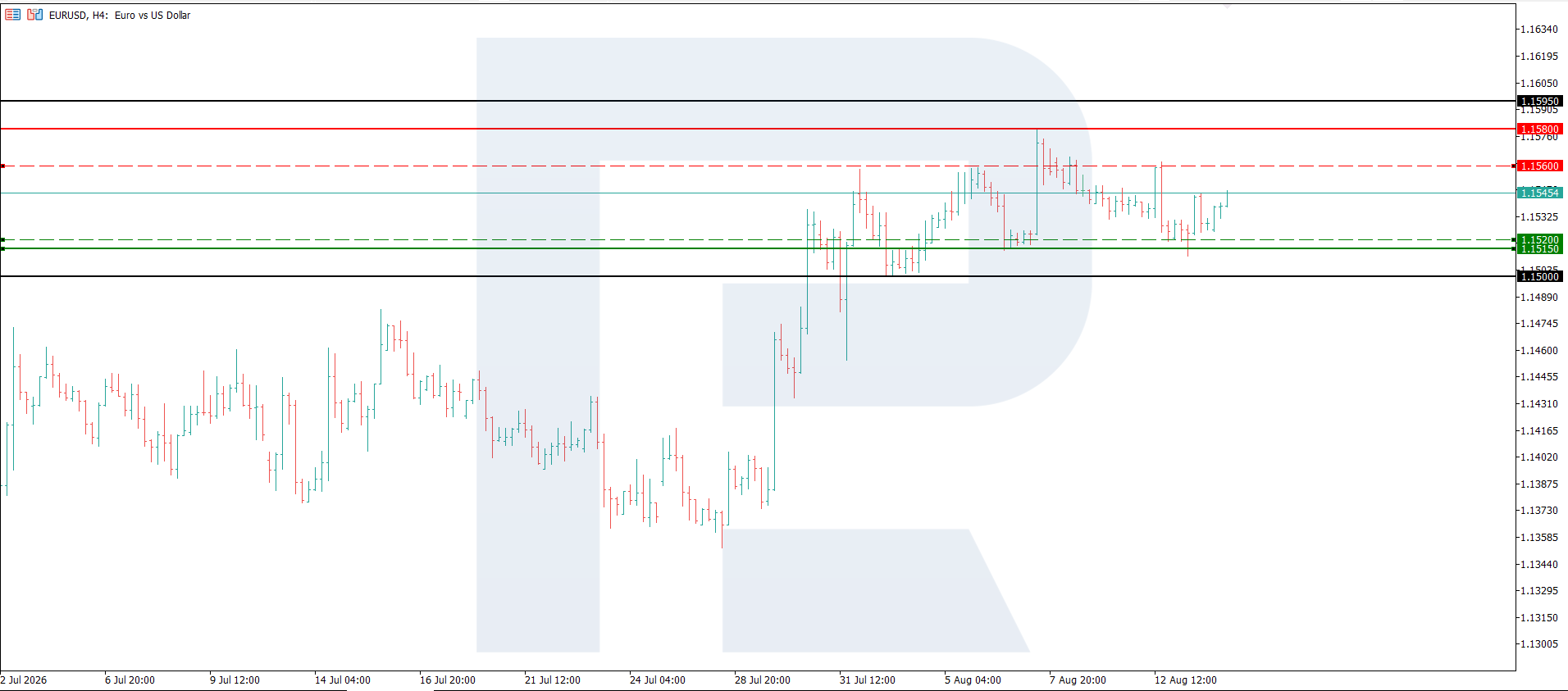
EURUSD trading scenarios for today
Main scenario (Buy Stop)
A breakout and consolidation above the 1.1560 resistance level would confirm the continued upward momentum.
- Take Profit: 1.1595
- Stop Loss: 1.1550
Alternative scenario (Sell Stop)
A breakout and consolidation below the 1.1515 support level would indicate the return of sellers.
- Take Profit: 1.1500
- Stop Loss: 1.1520
Risk factors
The main risks to EURUSD growth are a possible acceleration in inflation and strong US economic data, which could revive expectations of a Federal Reserve rate hike and support the dollar. Pressure on the euro is also possible if the eurozone economy deteriorates or the ECB adopts a more dovish stance. A decline below 1.1500 would be a negative technical signal.
Summary
The EURUSD rate has dropped moderately and continues to trade sideways. The EURUSD forecast for today, 14 August 2026, suggests further growth towards 1.1595 after a sideways trend.
Editors’ picks
 EURUSD forecast 2026–2027: technical analysis, price levels & predictions
EURUSD has pulled back from the 2026 high of 1.1915 and is now trading near 1.1450 — below both EMA65 and EMA200 — with the active scenario shifting from bullish to bearish. The ECB raised rates to 2.40%, but the Fed holds at 3.75%, and US inflation (3.5%) continues to outpace the eurozone (2.8%). A confirmed break below 1.1280 opens the next downward wave toward 1.1080. We break down the key levels, three trading scenarios with entry triggers, and what Deutsche Bank, Morgan Stanley and UBS are forecasting for EURUSD in 2026.
 Gold (XAUUSD) forecast 2026: predictions based on fundamental and technical analysis
Gold has corrected over 25% from its all-time high of 5,597 USD and is now trading near 4,100 USD — testing a critical support zone. Is this the bottom, or will the downtrend continue? We break down the key levels (support 3,920 USD, breakout trigger 4,500 USD), three trading scenarios with entry levels, and what J.P. Morgan, Goldman Sachs and Deutsche Bank are forecasting for gold in 2026.
Forecasts presented in this section only reflect the author’s private opinion and should not be considered as guidance for trading. RoboForex bears no responsibility for trading results based on trading recommendations described in these analytical reviews.