
Dollar under pressure: EURUSD gets a chance for a fresh surge
The euro continues to strengthen amid weak US macroeconomic data, with the EURUSD rate currently at 1.1587. Find out more in our analysis for 17 August 2026.
EURUSD forecast: key takeaways
- The market is reducing expectations of further monetary tightening by the Federal Reserve
- The market is increasingly pricing in further monetary policy tightening in Europe
- EURUSD forecast for 17 August 2026: 1.1615
Fundamental analysis
The EURUSD forecast takes into account that the pair may form a corrective wave after its rise and is testing the 1.1587 level.
Weak US economic data remains the main factor at the start of the week. US retail sales declined for the first time in nine months, while previous employment and inflation data was also not strong enough. Against this backdrop, the market is reducing expectations for further monetary tightening by the Federal Reserve.
Unlike in the US, the market is increasingly pricing in further monetary tightening in Europe. Eurozone inflation accelerated to 2.9% in July from 2.8%, keeping the ECB under pressure and limiting the scope for monetary easing.
Brent prices are hovering above 85.00 USD per barrel amid continued tensions surrounding Iran and the Strait of Hormuz. High energy prices create an additional inflation risk for Europe while also complicating the ECB's task.
The forecast for 17 August takes into account that the fundamental backdrop for the EURUSD pair is moderately positive for the euro. The main reason is lower expectations of further Federal Reserve tightening amid weak US data. At the same time, high eurozone inflation means that there is still a possibility that the ECB will adopt a more hawkish stance. The main risks remain high oil prices and the geopolitical situation surrounding Iran.
Technical outlook
On the H4 chart, the EURUSD pair formed a Hammer reversal pattern near the lower Bollinger Band. At this stage, the price continues to form an upward wave as the signal plays out, with a potential upside target at the 1.1615 resistance level. A breakout above this mark would open the way for the uptrend to continue.
At the same time, the EURUSD forecast for today also suggests another scenario. The price may form a corrective wave and test the 1.1560 support level before resuming growth.
EURUSD overview
- Asset: EURUSD
- Timeframe: H4 (intraday)
- Trend: bullish
- Key resistance levels: 1.1615 and 1.1780
- Key support levels: 1.1560 and 1.1520
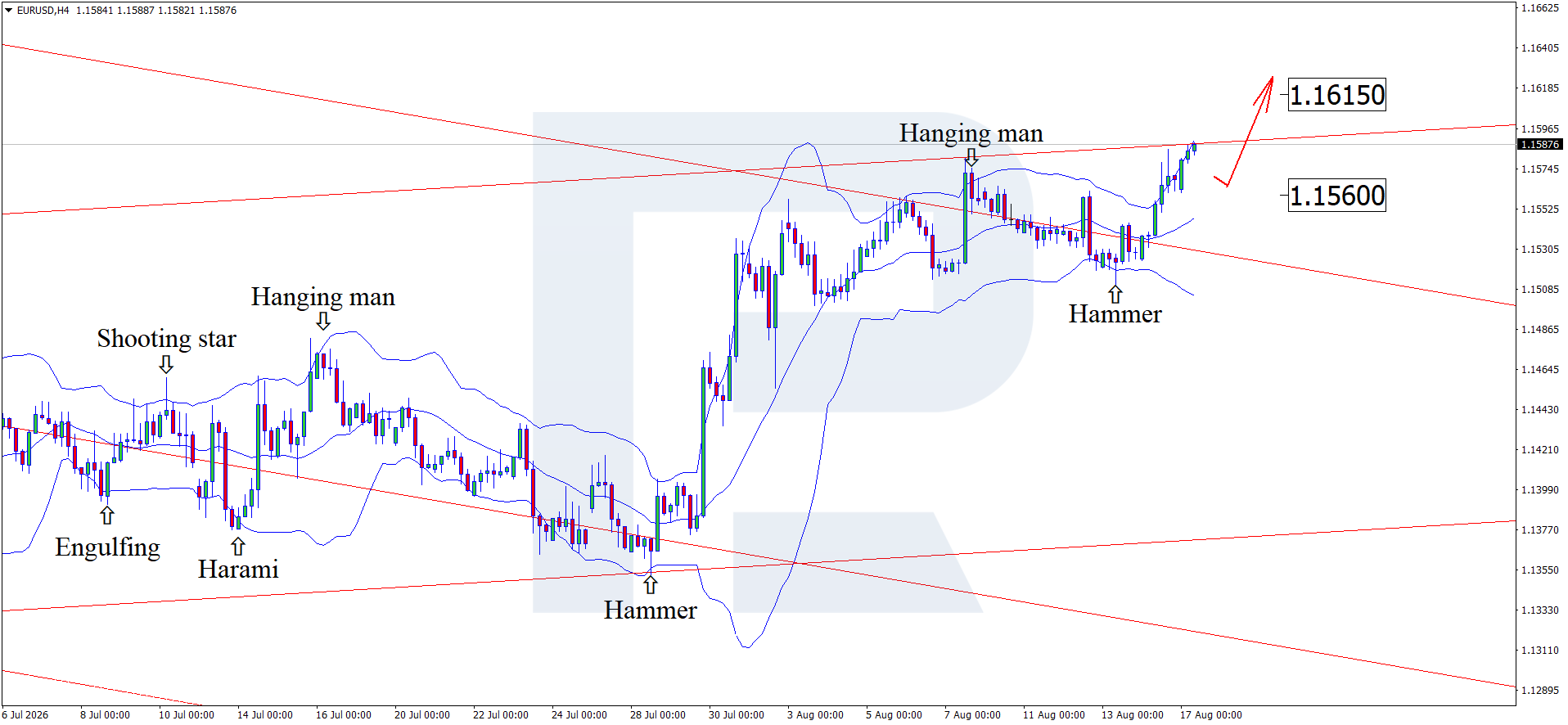
EURUSD trading scenarios for today
Main scenario (Buy Stop)
A breakout and consolidation above the 1.1615 resistance level would confirm continued upward momentum.
- Take Profit: 1.1780
- Stop Loss: 1.1590
Alternative scenario (Sell Stop)
A breakout and consolidation below the 1.1560 support level would indicate stronger selling pressure and a corrective wave.
- Take Profit: 1.1520
- Stop Loss: 1.1580
Risk factors
The main risks to EURUSD growth are a possible acceleration in inflation and strong US economic data, which could revive expectations of a Federal Reserve rate hike and support the dollar. The euro could also come under pressure if the eurozone economy deteriorates or the ECB adopts a more dovish stance.
Summary
The euro continues to strengthen amid weak US data and the prospect of an ECB interest rate hike. EURUSD technical analysis suggests a rise towards 1.1615.
Editors’ picks
 EURUSD forecast 2026–2027: technical analysis, price levels & predictions
EURUSD has pulled back from the 2026 high of 1.1915 and is now trading near 1.1450 — below both EMA65 and EMA200 — with the active scenario shifting from bullish to bearish. The ECB raised rates to 2.40%, but the Fed holds at 3.75%, and US inflation (3.5%) continues to outpace the eurozone (2.8%). A confirmed break below 1.1280 opens the next downward wave toward 1.1080. We break down the key levels, three trading scenarios with entry triggers, and what Deutsche Bank, Morgan Stanley and UBS are forecasting for EURUSD in 2026.
 Gold (XAUUSD) forecast 2026: predictions based on fundamental and technical analysis
Gold has corrected over 25% from its all-time high of 5,597 USD and is now trading near 4,100 USD — testing a critical support zone. Is this the bottom, or will the downtrend continue? We break down the key levels (support 3,920 USD, breakout trigger 4,500 USD), three trading scenarios with entry levels, and what J.P. Morgan, Goldman Sachs and Deutsche Bank are forecasting for gold in 2026.
Forecasts presented in this section only reflect the author’s private opinion and should not be considered as guidance for trading. RoboForex bears no responsibility for trading results based on trading recommendations described in these analytical reviews.