
Pressure on EURUSD intensifies after strong US labour market data
The EURUSD pair is consolidating following a robust US labour market report, with the rate currently at 1.1615. Find out more in our analysis for 7 September 2026.
EURUSD forecast: key takeaways
- US Nonfarm Payrolls increased by 162 thousand in August, significantly exceeding the market consensus of 56 thousand
- The likelihood of a Federal Reserve interest rate hike in September jumped to 58.4%
- EURUSD forecast for 7 September 2026: 1.1685
Fundamental analysis
The EURUSD pair is declining for the second consecutive trading session after buyers failed to break above the local resistance level at 1.1625. At the same time, the pair continues to move within a sideways consolidation range that has persisted for six trading sessions. A breakout from the current range could determine the pair’s next direction.
The US dollar received support from robust US labour market data. According to the Labor Department report published on Friday, US Nonfarm Payrolls increased by 162 thousand in August. Traders had expected a much more modest increase of 56 thousand. In addition, July data was revised: instead of the previously reported decline of 23 thousand, employment is now reported to have increased by 21 thousand.
The strong data led to a notable shift in expectations regarding the Federal Reserve’s future actions. Following the report, traders raised the estimated probability of a rate hike at the Fed’s September meeting to 58.4%, up from 49.4% previously.
Market participants are now turning their attention to fresh US inflation data due this week. These figures could provide further guidance on the future path of Federal Reserve monetary policy and, consequently, the direction of the US dollar.
Technical outlook
The EURUSD rate is rebounding from the upper boundary of the descending channel. Buyers are attempting to consolidate above the EMA-65. Today’s EURUSD forecast suggests growth towards 1.1685.
Analysis of the Stochastic Oscillator provides an additional signal in favour of the upside scenario. The oscillator values are rebounding from the support line, indicating bullish momentum. A breakout above the local resistance level and consolidation above 1.1620 would confirm the bullish EURUSD scenario for today.
At the same time, the risk of an alternative scenario remains if the 1.1605 support level is broken. If bears push the price back to the descending channel and break below a local support level, this would signal easing bullish pressure. In this case, the EURUSD pair could continue to decline towards the nearest target at 1.1565.
EURUSD overview
- Asset: EURUSD
- Timeframe: H4 (intraday)
- Trend: bullish
- Key resistance levels: 1.1620 and 1.1635
- Key support levels: 1.1605 and 1.1585
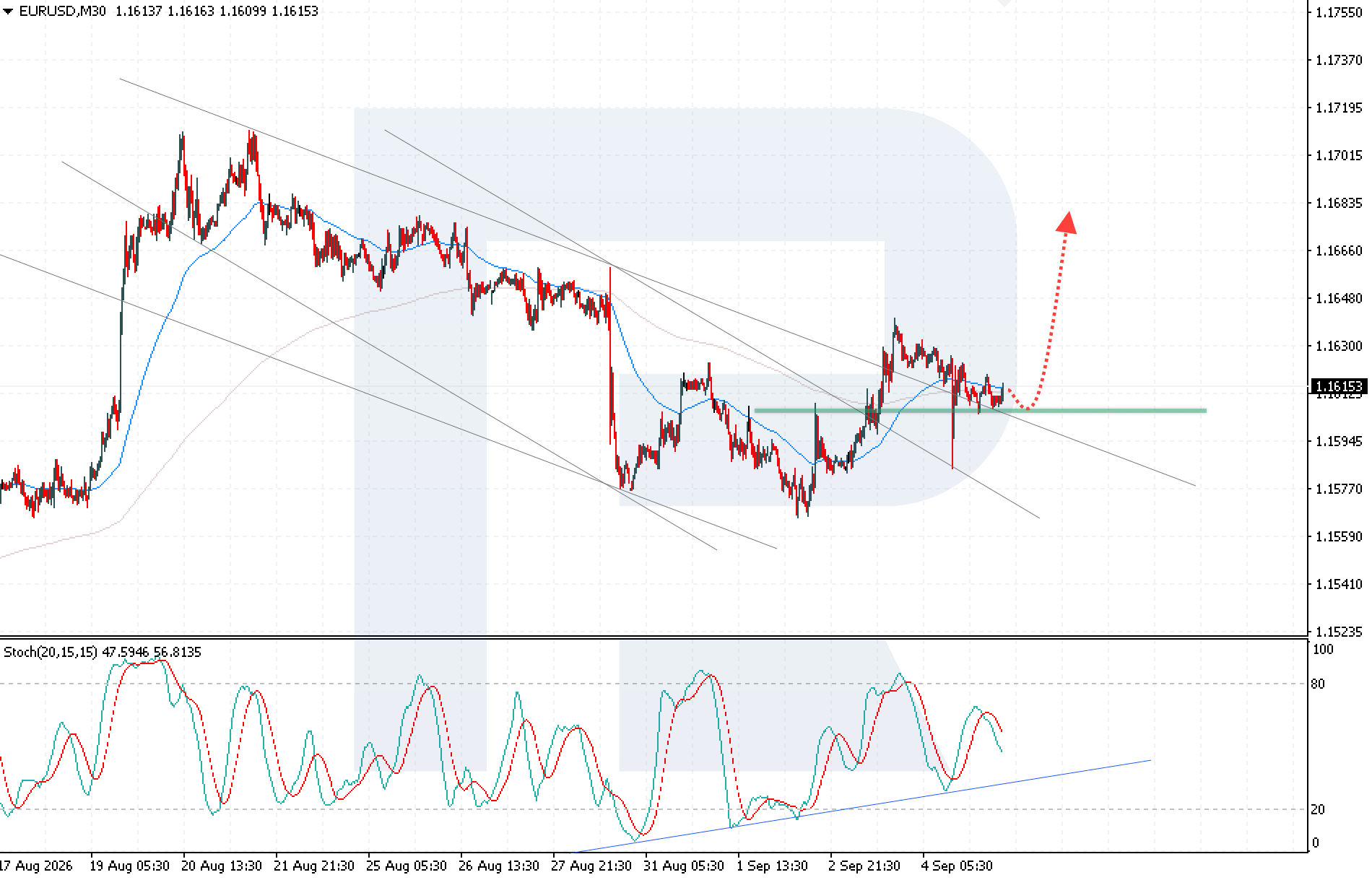
EURUSD trading scenario for today
Main scenario (Buy Stop)
A breakout above the local resistance level and consolidation above 1.1620 would indicate increasing buying pressure and create conditions for opening long positions.
- Current price: 1.1615
- Entry level: 1.1620
- Stop loss: 1.1605
- Take profit: 1.1680
- Risk-to-reward ratio: 1:4
The trade idea is valid until 08:00 AM on 8 September 2026 (server time, UTC+3).
Risk factors
The main risk to the EURUSD upside scenario remains further strengthening of the US dollar amid rising expectations of a Federal Reserve rate hike in September. A breakout below the 1.1605 support level would provide an additional signal in favour of sellers and could open the way for the pair towards 1.1565.
Summary
Despite the robust US labour market data, EURUSD technical analysis suggests growth towards 1.1685.
Editors’ picks
 EURUSD forecast 2026–2027: technical analysis, price levels & predictions
EURUSD has recovered from the July lows and is trading near 1.1545 — back in bullish territory. The pair has reclaimed EMA65 on the daily, formed a bullish EMA crossover on H4, and the US-eurozone GDP gap has narrowed sharply (US 1.5% vs eurozone 1.0%). Goldman Sachs and Deutsche Bank both now target 1.2500 by year-end. A confirmed close above 1.1700 opens the path to 1.1805. We break down the key levels, three trading scenarios, and what the unprecedented 9-3 FOMC dissent vote means for EURUSD.
 Gold (XAUUSD) forecast 2026: technical analysis, price levels & predictions
Gold has reversed its downtrend and is trading near 4,360 USD, back above both EMA65 and EMA200. ETF flows turned positive in July with 3 billion USD of net inflows, and central banks bought 288.9 tonnes in Q2 — up 62% year-on-year. A breakout above 4,500 USD opens the path to 4,855 USD and the 5,597 USD all-time high. We break down the key levels, three trading scenarios with entry triggers, and what J.P. Morgan, Deutsche Bank and Goldman Sachs are forecasting for gold in 2026.
Forecasts presented in this section only reflect the author’s private opinion and should not be considered as guidance for trading. RoboForex bears no responsibility for trading results based on trading recommendations described in these analytical reviews.