
EURUSD returns to sideways trading, poised to resume its decline after a sharp move
Despite attempts by the euro to recover from its October decline, the US dollar continues to find support in the resilience of the US economy. The rate currently stands at 1.1247. For more details, see our analysis for 4 November 2026.
EURUSD forecast: key takeaways
- The ISM manufacturing PMI rose to 55.5 points in October, up from 54.5 in September
- As of 2 November, market participants estimated the probability of a Federal Reserve rate hike in December at around 77%, down from 80% a week earlier
- US GDP grew by 3.4% year-on-year in Q3 2026
- EURUSD forecast for 4 November 2026: 1.1125
Fundamental analysis
The EURUSD pair is trading around 1.1247 on Wednesday. The Federal Reserve's monetary policy remains the main factor supporting the dollar. Recent US macroeconomic data is providing additional support for the US currency.
According to the BEA's preliminary estimate, seasonally adjusted US GDP grew at an annual rate of 3.4% in Q3, up from 2.2% in Q2, primarily driven by investment, consumer spending, and government expenditure. Strong economic activity allows the Federal Reserve to maintain tight monetary policy without a significant risk of an immediate economic slowdown.
The fundamental outlook for the euro remains mixed. The ECB emphasised that rising energy prices create additional inflation risks while also worsening the economic outlook. According to published Eurostat data, eurozone inflation accelerated to 3.8% in September from 3.2% in August. High inflation limits the scope for interest rate cuts and increases the likelihood of further ECB policy tightening. This is a key factor supporting the euro, as the market is beginning to price in the possibility of further interest rate hikes in Europe.
The EURUSD forecast for 4 November 2026 is bearish.
Technical outlook
On the D1 chart, the EURUSD rate has formed a resistance level at 1.1260 and a support level at 1.1115. On the H4 chart, local resistance is located at 1.1263, while support lies at 1.1145. After testing last autumn's lows, the price formed a sideways channel with a downward bias. A breakout below support would create conditions for opening short positions. The downside target could be 1.1030.
However, today's EURUSD forecast also envisages an alternative scenario. The price could form a corrective wave and break above the 1.1263 resistance level, targeting 1.1305.
EURUSD overview
- Asset: EURUSD
- Timeframe: H4
- Trend: sideways
- Key resistance levels: 1.1260 and 1.1263
- Key support levels: 1.1115 and 1.1145
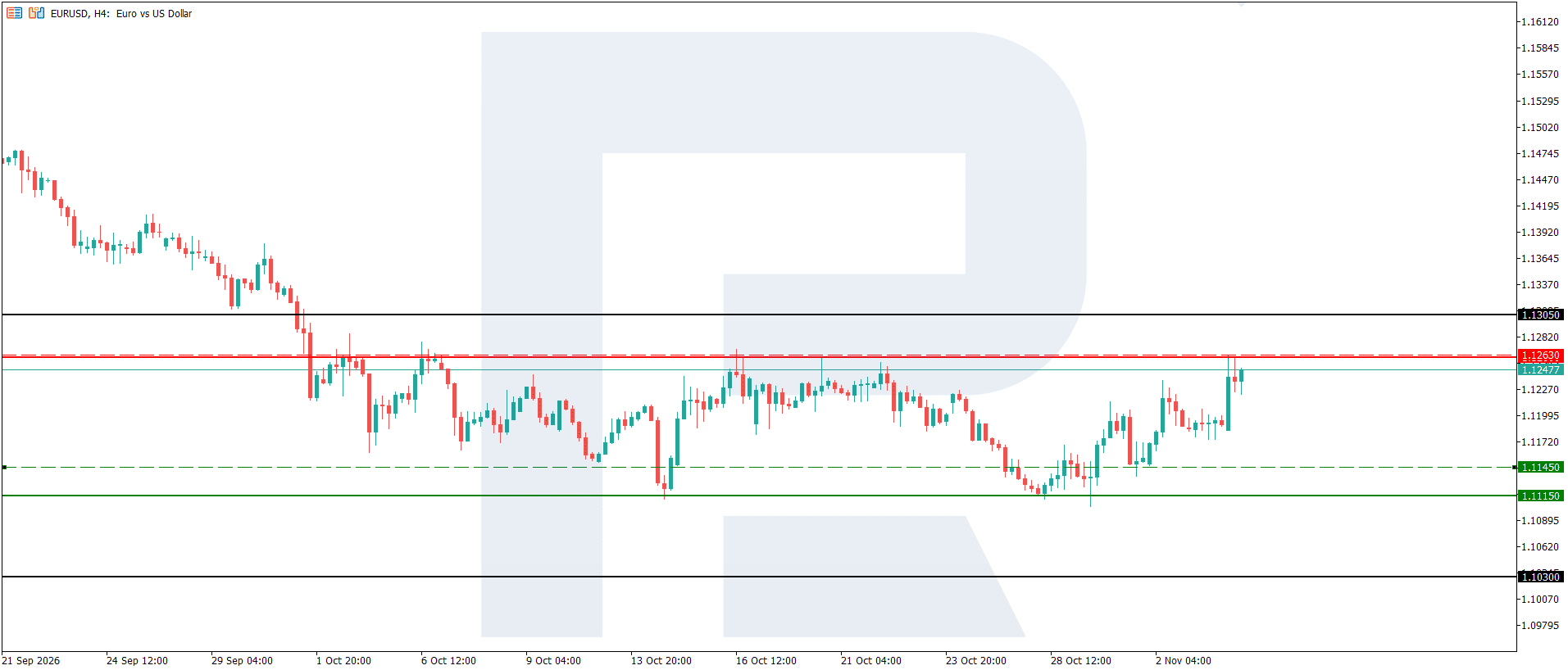
EURUSD trading scenario for today
A breakout below daily support, followed by consolidation below 1.1115, would set the stage for opening short positions and indicate continued downward momentum.
Risk factors
Near-term factors likely to influence the EURUSD trend include the release of October eurozone inflation data on 4 November, the upcoming US employment figures on 6 November, the results of the US midterm elections, and changes in expectations regarding the ECB's and Fed's December decisions. A combination of weak US data and more hawkish signals from the European central bank would pose a particularly significant risk to the pair's bearish scenario.
Summary
Fundamental factors currently point to a moderately negative outlook for the EURUSD pair. Higher US interest rates, resilient economic growth, and strong US labour market data continue to support the dollar. Despite mounting inflationary pressure in the eurozone and the possibility of ECB rate hikes, the European economy remains more vulnerable to the energy crisis and a slowdown in business activity.
Editors’ picks


EURUSD forecast 2026–2027: technical analysis, price levels & predictions
The EURUSD outlook for 2026 and 2027: key levels on the daily chart, three trading scenarios and the policy gap between the Fed and the ECB that drives the pair.

Gold (XAUUSD) forecast 2026: technical analysis, price levels & predictions
Where gold could trade in 2026: key levels, three trading scenarios with entry triggers and the forecasts from J.P. Morgan, Deutsche Bank and Goldman Sachs.
Forecasts presented in this section only reflect the author’s private opinion and should not be considered as guidance for trading. RoboForex bears no responsibility for trading results based on trading recommendations described in these analytical reviews.