
Range-bound trading: EURUSD has remained in a broad sideways channel since mid-October
The main factor weighing on the euro has been strong US labour market data, which has increased the likelihood of further Federal Reserve monetary policy tightening. The EURUSD rate currently stands at 1.1187. Find out more in our analysis for 9 November 2026.
EURUSD forecast: key takeaways
- US Nonfarm Payrolls increased by 165 thousand, exceeding a forecast of 65 thousand
- The US unemployment rate stood at 4.1%, against expectations of 4.2%
- EURUSD forecast for 9 November 2026: 1.1030
Fundamental analysis
The main factor weighing on the European currency is the strengthening of the US dollar amid strong macroeconomic data and rising expectations of further Federal Reserve monetary policy tightening. At the same time, accelerating inflation in the eurozone limits the euro's downside potential, as the ECB may also need to continue raising interest rates.
Fundamental analysis for 9 November 2026 takes into account that the key event of the previous week was the release of US labour market data for October. Nonfarm Payrolls increased by 165 thousand, above a forecast of 65 thousand, while the unemployment rate stood at 4.1%, against expectations of 4.2%. These results indicate the resilience of the US economy and reduce the need for monetary policy easing. Following the release, the market estimates the likelihood of a Federal Reserve interest rate hike in December at nearly 80%, up from 67% the previous day.
The macroeconomic situation in the eurozone remains mixed. According to preliminary Eurostat data, annual inflation accelerated to 4.0% in October, up from 3.8% in September. The main source of price pressure is the energy sector, where inflation reached 20.8%. Core inflation stood at 2.5%. Accelerating consumer price growth increases the likelihood of further ECB monetary policy tightening. At its 29 October meeting, the regulator kept the deposit rate at 2.50% but highlighted the risk of renewed inflationary pressure resulting from an energy shock.
The forecast for 9 November 2026 takes into account that the current situation has conflicting implications for the European currency. On the one hand, expectations of ECB interest rate hikes could support the euro by making euro-denominated assets more attractive. On the other hand, high energy costs are worsening the eurozone's economic growth outlook, increasing businesses' production costs, and putting pressure on consumer demand. Slowing economic activity is another negative factor. Eurozone GDP grew by 0.4% in Q3, following growth of 0.6% in Q2, while retail sales fell by 0.7% month-on-month in September.
Technical outlook
On the D1 chart, the EURUSD pair is trading within a broad sideways channel, with its upper boundary formed by resistance at 1.1260 and its lower boundary defined by support at 1.1115. On the H4 chart, a local resistance level has shifted to 1.1240, while the support level lies at 1.1135. If the price consolidates below 1.1190, the local trend would remain bearish, with the downside target at 1.1030.
However, today's EURUSD forecast also envisages an alternative scenario. The price could form a corrective wave and test the 1.1240 resistance level before declining. A breakout above this level would create scope for a rise towards 1.1350.
EURUSD overview
- Asset: EURUSD
- Timeframe: D1
- Trend: bearish
- Key resistance levels: 1.1240 and 1.1260
- Key support levels: 1.1135 and 1.1115
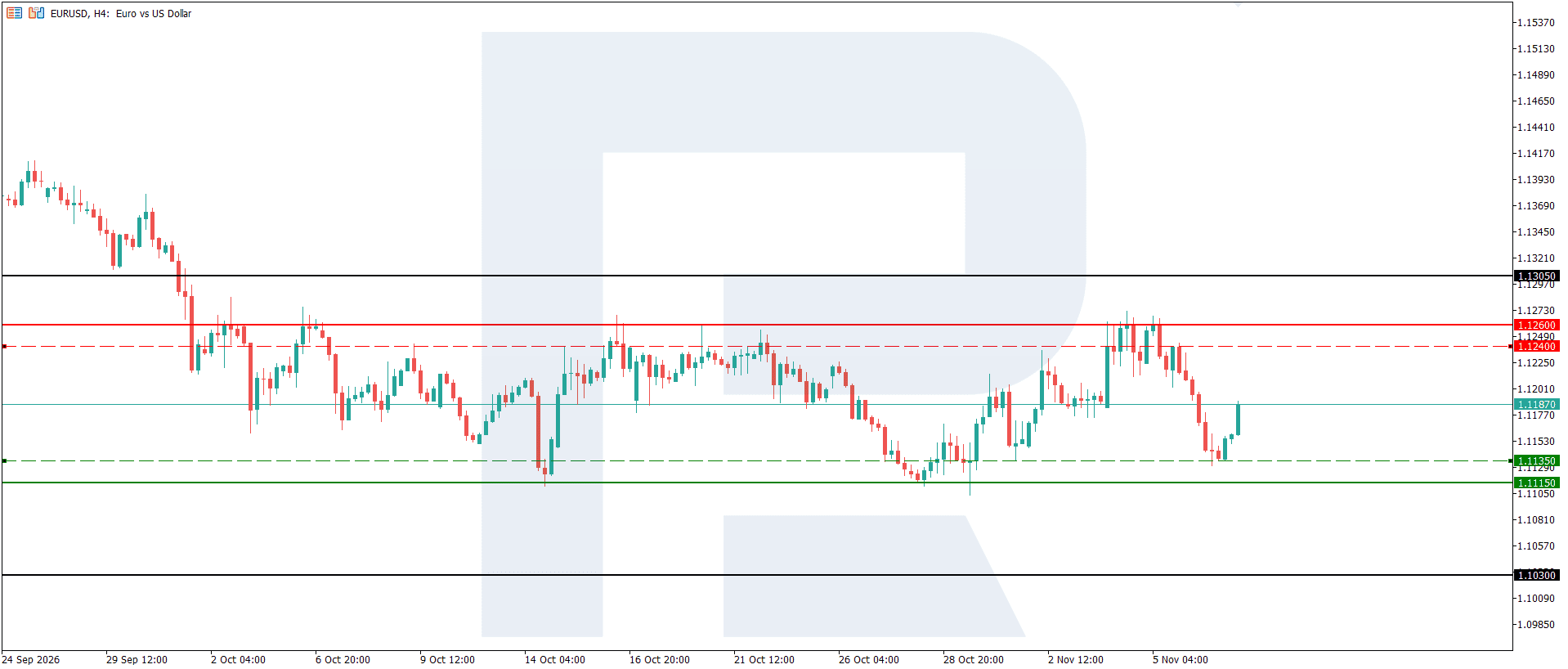
EURUSD trading scenario for today
A breakout below the support level, with the price consolidating below 1.1135, would create conditions for opening short positions and confirm continued downward momentum.
Risk factors
The main risk factors remain uncertainty surrounding future Federal Reserve and ECB policies, a possible deterioration in the eurozone economy, and escalating geopolitical tensions in the Middle East. Rising energy costs could exacerbate inflationary pressures in the European economy while also restricting economic growth. Changes in US Treasury yields, stock market volatility, and fluctuations in global demand for safe-haven assets create additional uncertainty.
Summary
Fundamental and technical factors predominantly point to continued downside potential for the EURUSD pair. The resilience of the US labour market, relatively high yields on US dollar-denominated assets, and expectations of further Federal Reserve policy tightening create favourable conditions for a stronger dollar. EURUSD technical analysis suggests a decline towards 1.1030.
Editors’ picks


EURUSD forecast 2026–2027: technical analysis, price levels & predictions
The EURUSD outlook for 2026 and 2027: key levels on the daily chart, three trading scenarios and the policy gap between the Fed and the ECB that drives the pair.

Gold (XAUUSD) forecast 2026: technical analysis, price levels & predictions
Where gold could trade in 2026: key levels, three trading scenarios with entry triggers and the forecasts from J.P. Morgan, Deutsche Bank and Goldman Sachs.
Forecasts presented in this section only reflect the author’s private opinion and should not be considered as guidance for trading. RoboForex bears no responsibility for trading results based on trading recommendations described in these analytical reviews.