
EURUSD declines, but the pace of the fall is slowing
The euro remains under pressure primarily due to the widening interest rate differential between the US and the eurozone and persistent concerns about the outlook for the European economy. The EURUSD rate currently stands at 1.0980. Discover more in our analysis for 20 November 2026.
EURUSD forecast: key takeaways
- Eurozone inflation reached 4.0%
- Core inflation was revised upwards to 2.6%, while energy prices rose by 21.0%
- EURUSD forecast for 20 November 2026: 1.0885
Fundamental analysis
The EURUSD forecast takes into account the release of the Federal Reserve's October meeting minutes on 18 November as a key factor supporting the dollar. The document showed that the US central bank maintained its hawkish stance: virtually all meeting participants considered further interest rate hikes likely to be necessary to bring inflation back to the 2% target. Some Federal Reserve officials also acknowledged the possibility of an increase of more than 25 basis points at the December meeting if inflation developments prove unfavourable.
The US consumer inflation figures released on 10 November provided another argument for maintaining the Federal Reserve's restrictive policy. In October, the CPI rose by 0.4% month-on-month, following an increase of 0.6% in September. Despite the slowdown in the monthly rise, inflationary pressure remains significant, particularly in housing and food.
The fundamental backdrop for the EURUSD pair remains negative, as inflation risks are also intensifying in the eurozone. According to Eurostat's final figures published on 18 November, annual inflation accelerated to 4.0% in October from 3.8% in September. Core inflation was revised upwards to 2.6%, while energy prices rose by 21.0% year-on-year. These figures strengthen the case for further ECB interest rate hikes. However, the support that inflation data provides to the euro remains limited.
Technical outlook
On the D1 chart, the EURUSD pair is trading in a strong downtrend. The resistance level has shifted to 1.1025, while support at 1.0985 has been broken and a new support level has yet to form. On the H4 chart, local resistance has formed near 1.1020, while support has shifted from 1.1135 to 1.0955. Both the local and broader trends remain bearish if the price consolidates below 1.1020, with the target for this move at 1.0885.
However, today's EURUSD forecast also envisages an alternative scenario. The price could form a corrective wave and test the 1.1025 resistance level before declining. A breakout above this level would open the door for a rise towards 1.1130.
EURUSD overview
- Asset: EURUSD
- Timeframe: H4
- Trend: bearish
- Key resistance levels: 1.1020
- Key support levels: 1.0955
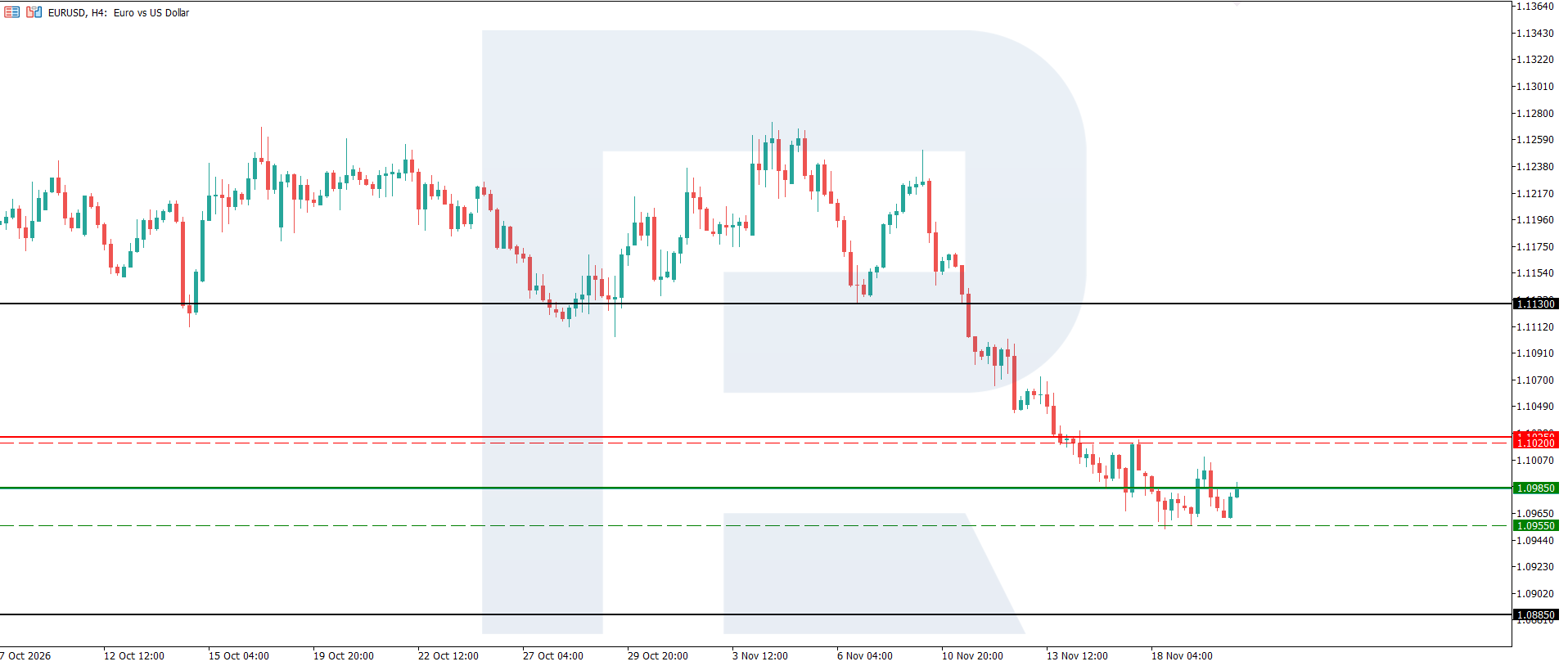
EURUSD trading scenario for today
A breakout below the 1.0955 support level would create conditions for opening short positions.
Risk factors
The main risk factors for the EURUSD pair remain uncertainty over future Federal Reserve and ECB monetary policy, persistent inflationary pressure in the US and the eurozone, and differences in economic growth rates. A more hawkish Federal Reserve stance could strengthen the dollar and accelerate the pair's decline, while ECB rate hikes could support the euro. Additional risks include a slowdown in the US economy, energy-related problems in the eurozone, geopolitical tensions, and changes in global demand for safe-haven assets.
Summary
The US central bank is maintaining a higher interest rate and signalling its readiness to tighten policy further, giving the dollar an advantage. At the same time, accelerating European inflation could prompt more hawkish ECB rhetoric and limit the extent of the euro's decline. Meanwhile, EURUSD technical analysis suggests a correction towards the 1.1020 resistance level before a fall to 1.0885.
Editors’ picks


EURUSD forecast 2026–2027: technical analysis, price levels & predictions
The EURUSD outlook for 2026 and 2027: key levels on the daily chart, three trading scenarios and the policy gap between the Fed and the ECB that drives the pair.

Gold (XAUUSD) forecast 2026: technical analysis, price levels & predictions
Where gold could trade in 2026: key levels, three trading scenarios with entry triggers and the forecasts from J.P. Morgan, Deutsche Bank and Goldman Sachs.
Forecasts presented in this section only reflect the author’s private opinion and should not be considered as guidance for trading. RoboForex bears no responsibility for trading results based on trading recommendations described in these analytical reviews.