
The euro is tumbling ahead of key US economic data
The EURUSD rate is falling again after a short-term recovery. Investors remain cautious ahead of US inflation and GDP data, which could reinforce expectations of further Federal Reserve rate hikes. The EURUSD rate currently stands at 1.0956. Find out more in our analysis for 25 November 2026.
EURUSD forecast: key takeaways
- The market puts the probability of a Federal Reserve rate hike in December at 96.4%, with a further increase in January estimated at 64.3%
- Budgetary uncertainty in France and the lack of signals that the ECB will soon accelerate its rate-hiking cycle are limiting the euro's recovery potential
- EURUSD forecast for 25 November 2026: 1.0874
Fundamental analysis
The EURUSD pair is resuming its decline after a short-term recovery from local lows. The dollar retains its advantage amid expectations of further Federal Reserve monetary tightening, while market participants remain cautious ahead of the release of key US economic data.
Today, investors will focus primarily on October's PCE price index, the Federal Reserve's preferred inflation gauge. US Q3 GDP data will also be released. The US economy is expected to have grown at an annualised rate of 3.4%. A combination of resilient economic growth and high inflation could strengthen the case for further rate hikes.
According to the CME FedWatch Tool, the probability of a Federal Reserve rate hike in December stands at 96.4%, while the likelihood of an additional increase in January is 64.3%.
ECB policymaker Gediminas Šimkus noted that a rate hike in December might not be sufficient to bring inflation fully under control, but there is currently no need for rapid additional monetary tightening. The market has almost fully priced in the ECB's December move, while the next rate hike is fully priced in only for June 2027.
France's budgetary problems remain an additional source of pressure on the euro. The yield spread between French and German government bonds has stabilised but remains elevated, reflecting investors' concerns about the state of France's public finances.
The EURUSD forecast for 25 November 2026 is bearish.
Technical outlook
The EURUSD pair maintains a pronounced bearish structure on the H4 timeframe. After rebounding from the 1.0874 support level, the price recovered towards the middle Bollinger Band, but buyers have so far failed to build upward momentum. Today's EURUSD forecast suggests a renewed decline, with a potential target at 1.0874.
MACD remains in negative territory, although the indicator's values are above the signal line, reflecting weakening downward momentum. Meanwhile, the Stochastic Oscillator has formed a bearish crossover after emerging from overbought territory, with the %K line at 72.27 and the %D line at 81.78, indicating a decline in buying activity.
A breakout below a local support level at 1.0927 would further confirm the bearish scenario. The main scenario would be invalidated if the price consolidates above the 1.0981 resistance level. In that case, the recovery could continue towards 1.1010 and then 1.1035.
EURUSD overview
- Asset: EURUSD
- Timeframe: H4
- Trend: bearish
- Key resistance levels: 1.0981 and 1.1010
- Key support levels: 1.0927 and 1.0874
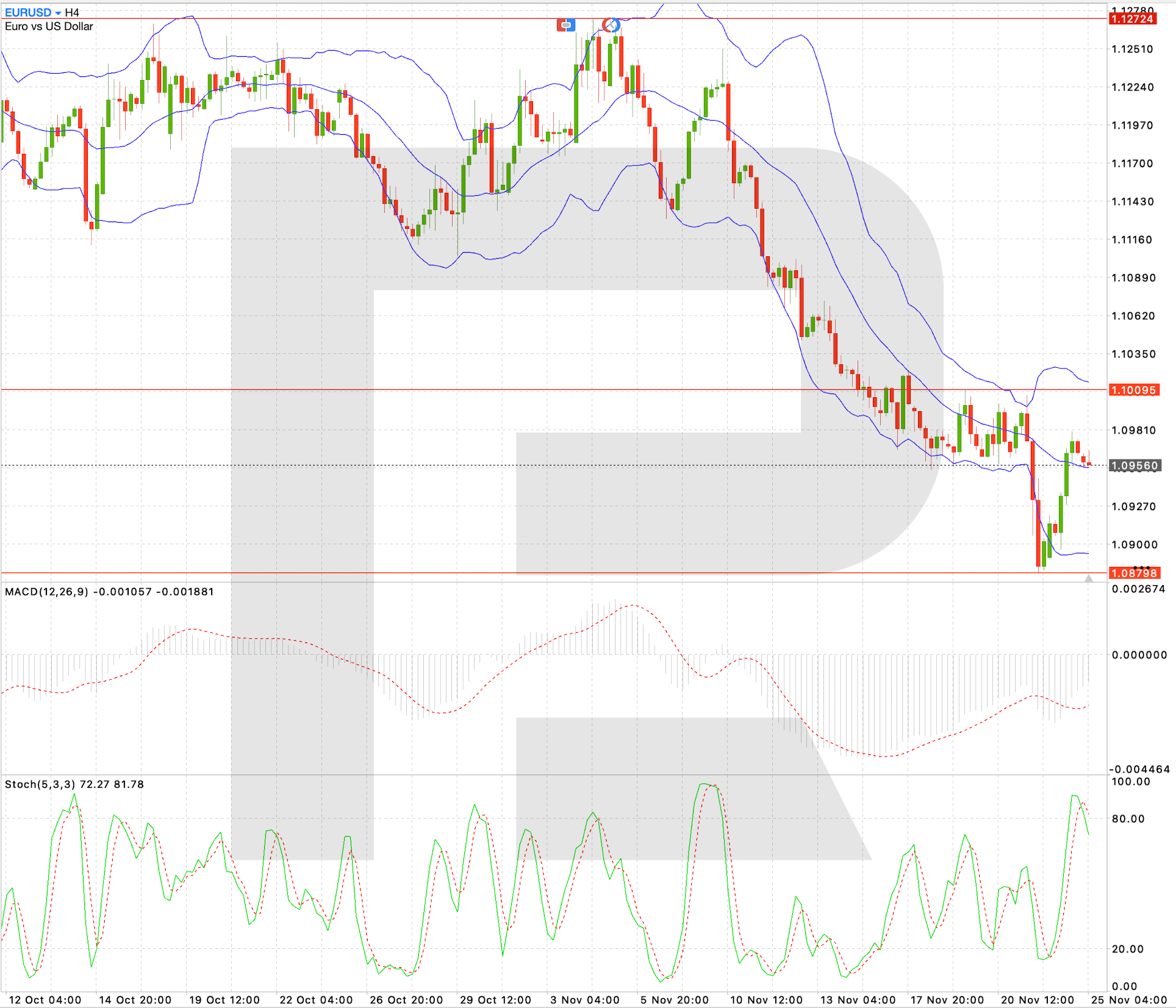
EURUSD trading scenario for today
A breakout below local support, followed by consolidation below 1.0927, would confirm the end of the corrective recovery and create conditions for opening short positions.
Risk factors
The main risk to the bearish EURUSD scenario would be a lower-than-expected PCE inflation reading, which could reduce expectations of additional Federal Reserve rate hikes in 2027. Weaker US GDP figures could also trigger a correction in the dollar. Consolidation above the 1.0981 resistance level would increase the likelihood of a further recovery in the pair.
Summary
The EURUSD pair is nearing the end of its short-term corrective recovery ahead of the release of key US economic data. The EURUSD forecast for today, 25 November 2026, suggests a renewed decline towards the 1.0874 target if the 1.0927 support level is broken.
Editors’ picks


EURUSD forecast 2026–2027: technical analysis, price levels & predictions
The EURUSD outlook for 2026 and 2027: key levels on the daily chart, three trading scenarios and the policy gap between the Fed and the ECB that drives the pair.

Gold (XAUUSD) forecast 2026: technical analysis, price levels & predictions
Where gold could trade in 2026: key levels, three trading scenarios with entry triggers and the forecasts from J.P. Morgan, Deutsche Bank and Goldman Sachs.
Forecasts presented in this section only reflect the author’s private opinion and should not be considered as guidance for trading. RoboForex bears no responsibility for trading results based on trading recommendations described in these analytical reviews.