
EURUSD attempts to find a bottom and stage a correction
The EURUSD pair maintains its downward momentum, with the US administration's plans to impose new import tariffs adding to the pressure on the euro. The rate currently stands at 1.0970. Find more details in our analysis for 26 November 2026.
EURUSD forecast: key takeaways
- The market estimates the likelihood of a Federal Reserve rate hike in December at 97.5%
- The US core PCE price index rose by 3.3% year-on-year
- EURUSD forecast for 26 November 2026: 1.0805
Fundamental analysis
US macroeconomic data released today was largely favourable for the dollar. Annual growth in the Personal Consumption Expenditures (PCE) price index accelerated to 3.8%, in line with market expectations. Meanwhile, the core PCE price index rose from 3.1% to 3.3% year-on-year, above a forecast of 3.2%, with monthly core inflation coming in at 0.3%. Persistent inflationary pressure well above the Federal Reserve's 2% target increases the likelihood that the interest rate hiking cycle will continue in 2027.
The macroeconomic situation in the eurozone remains less favourable. According to data released today, German Q3 GDP grew by 0.1% quarter-on-quarter, compared to a preliminary estimate of 0.2%. Slower growth in the eurozone's largest economy limits the ECB's scope for further interest rate hikes. At the same time, Germany's Ifo Business Climate Index rose from 90.1 to 90.6 points in November, while France's Consumer Confidence Index reached 82 points, indicating some improvement in economic sentiment.
The European currency is receiving some support from the continued hawkish rhetoric of ECB officials. Annual inflation in the eurozone reached 4.0% in October. Market participants expect the ECB to raise its deposit rate by 25 basis points to 2.75%, but the prospects for further monetary tightening remain uncertain amid relatively weak economic growth.
The EURUSD forecast for 26 November 2026 is bearish.
Technical outlook
On the D1 chart, the EURUSD pair is trading in a strong downtrend. A resistance level has shifted to 1.1025, while support at 1.0985 has been broken and a new support level has yet to form. On the H4 chart, local resistance has formed around 1.0995, with the support level shifting to 1.0905. Both the local and broader trends remain bearish if the price consolidates below 1.1020. The target for this move is 1.0805.
However, today's EURUSD forecast also suggests an alternative scenario. The price could form a corrective wave and test resistance around 1.1025 before declining. A breakout above that level would open the way for a rise towards 1.1130.
EURUSD overview
- Asset: EURUSD
- Timeframe: D1
- Trend: bearish
- Key resistance levels: 1.1020
- Key support levels: 1.0880
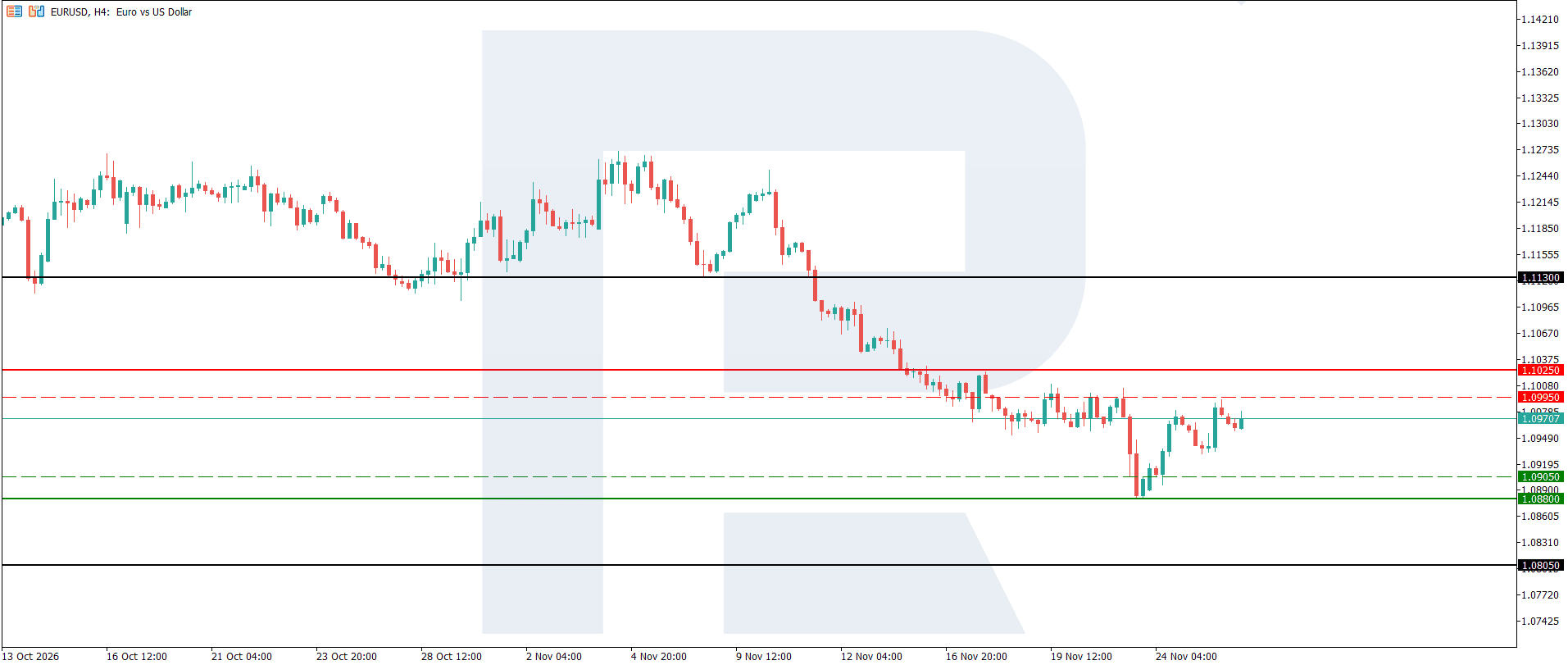
EURUSD trading scenario for today
A breakout of the local support level, with the price consolidating below 1.0805, would create conditions for opening short positions.
Risk factors
The main risk to the bearish EURUSD scenario would be a lower-than-expected PCE inflation reading, which could reduce expectations of additional Federal Reserve rate hikes in 2027. Weaker US GDP figures could also trigger a correction in the dollar. Consolidation above the 1.0981 resistance level would increase the likelihood of a further recovery in the pair.
Summary
The resilience of the US economy, accelerating core inflation in the US, expectations of further Federal Reserve rate hikes, and the risk of escalating trade tensions between the US and the EU create conditions for the currency pair to continue declining. However, hawkish ECB rhetoric and declining US government bond yields could limit the extent of the euro's fall. The EURUSD forecast for today, 26 November 2026, suggests a renewed decline towards the 1.0805 target.
Editors’ picks


EURUSD forecast 2026–2027: technical analysis, price levels & predictions
The EURUSD outlook for 2026 and 2027: key levels on the daily chart, three trading scenarios and the policy gap between the Fed and the ECB that drives the pair.

Gold (XAUUSD) forecast 2026: technical analysis, price levels & predictions
Where gold could trade in 2026: key levels, three trading scenarios with entry triggers and the forecasts from J.P. Morgan, Deutsche Bank and Goldman Sachs.
Forecasts presented in this section only reflect the author’s private opinion and should not be considered as guidance for trading. RoboForex bears no responsibility for trading results based on trading recommendations described in these analytical reviews.