
EURUSD weekly forecast: more sellers than buyers
During the week of 19–23 January, the EURUSD pair is expected to maintain a moderately bearish bias. The US dollar is supported by strong macroeconomic data and signals from the Federal Reserve highlighting labour market resilience and persistent inflation risks. These factors have reduced expectations of an imminent policy easing: markets now expect the Fed to keep rates unchanged, with the next cut postponed until June or later.
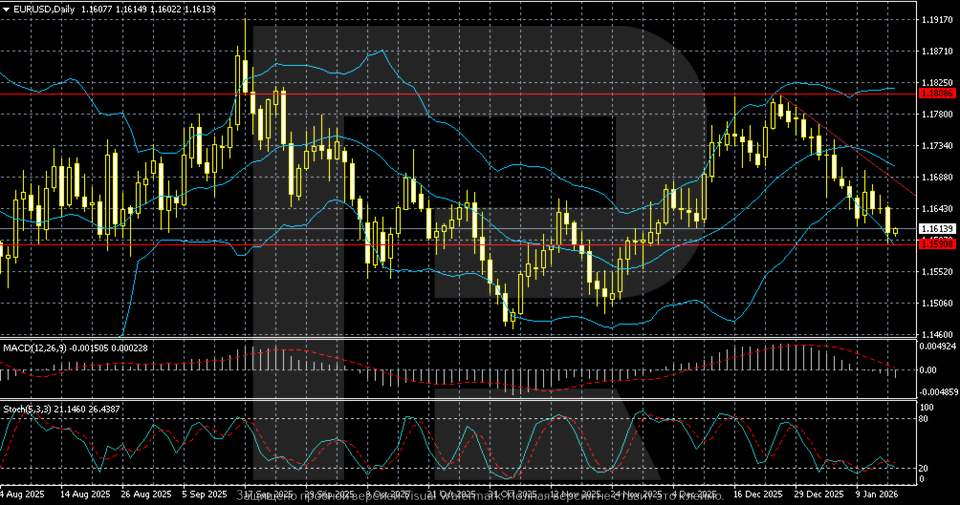
From a technical standpoint, the pair is trading near 1.1600 within a descending channel. Pressure on the EURUSD rate persists, and for sentiment to shift, the market needs to return and consolidate above 1.1700–1.1750, which is not yet the baseline scenario.
EURUSD forecast for this week: quick overview
- Market focus: the EURUSD pair has fallen for the third consecutive week and is hovering near 1.1600. The dollar received support from strong US data, as jobless claims came in significantly below expectations, and Fed rhetoric emphasised labour market stability and inflation risks. This pushed expectations of the first rate cut to at least June. Additional background factors include the US–Taiwan trade agreement and ongoing geopolitical uncertainty
- Current trend: the technical picture remains moderately bearish. After failing to consolidate above 1.1800–1.1820 in December, the pair is moving within a downward channel. The price is hovering below the midline of the Bollinger Bands; MACD remains negative, and the Stochastic Oscillator is at the bottom of the range
- Weekly outlook: the baseline scenario is consolidation with downside risk in the 1.1550–1.1650 range. A breakout below 1.1550 would open the path towards 1.1450–1.1500. A shift in sentiment requires a return above 1.1700–1.1750
EURUSD fundamental analysis
The EURUSD pair declined for the third consecutive week. The US dollar was supported by strong macroeconomic data: initial jobless claims came in significantly below expectations, indicating a resilient labour market. Some manufacturing surveys also outperformed forecasts. Throughout the week, Fed officials highlighted labour market strength and persistent inflation risks – this dampened expectations for near-term policy easing.
Markets now expect the Fed to keep rates unchanged at the next meeting, with the anticipated timeline for the first cut shifting to June or later.
Externally, attention turned to trade developments. The US agreed to lower tariffs on Taiwanese goods from 20% to 15%, while Taiwanese companies pledged to invest at least 250 billion USD in expanding chip production in the US. On the geopolitical side, US President Donald Trump signalled a possible delay in action against Iran but reiterated his intention to pursue the acquisition of Greenland, adding to the overall level of uncertainty.
EURUSD technical analysis
On the daily chart, the EURUSD pair maintains a medium-term downtrend after failing to consolidate above the 1.1800–1.1820 zone in December. After forming a local high, the pair reversed and began a steady decline, with the price falling confidently below the Bollinger midline and testing the lower boundary of the range. It is currently trading near 1.1600, indicating seller dominance and weak buying interest during pullbacks.
The movement is developing within a descending channel. The 1.1800–1.1820 zone serves as key resistance and has previously halted rallies multiple times. The nearest support level lies in the 1.1550–1.1580 area. A breakout below this range increases the risk of further downside towards 1.1450–1.1500.
Indicators confirm downward pressure without extreme signals. MACD remains negative and is pointed lower, indicating persistent bearish momentum. The Stochastic Oscillator is in the lower part of its range, occasionally attempting to exit oversold territory, but no sustained reversal has formed.
Overall, the technical picture for EURUSD remains moderately bearish. A change in sentiment would require a return and consolidation above 1.1700–1.1750. Until then, the base case remains continued downside pressure with the risk of new local lows.
EURUSD trading scenarios
The EURUSD pair has declined for the third consecutive week and is hovering near 1.1600, with the US dollar bolstered by strong macroeconomic data. Fed officials during the week emphasised job market strength and lingering inflation risks, reducing expectations of a near-term rate cut. Markets expect the Fed to hold rates steady at the upcoming meeting, with the first cut not expected before June.
The technical outlook remains moderately bearish. After the failed attempt to consolidate above 1.1800–1.1820 in December, the pair entered a steady decline within a descending channel. The price remains below the Bollinger midline; MACD is negative, and the Stochastic Oscillator is at the bottom of its range without forming clear reversal signals.
- Sell scenario
Short positions are valid if the price consolidates below 1.1550–1.1580.
Targets: 1.1450–1.1500
Stop-loss: above 1.1700
- Buy scenario
Long positions are only valid if the price returns and consolidates above 1.1700–1.1750, which would ease selling pressure and open the path to 1.1800.
Conclusion: the base case is continued pressure on the EURUSD pair with a risk of new local lows. The medium-term structure remains downward.
Summary
The EURUSD pair closed its third consecutive week lower, holding near 1.1600 amid dollar strength. The US dollar was supported by strong labour market data and Fed officials’ comments highlighting persistent inflation risks. This reduced expectations of near-term easing and shifted the outlook for the first rate cut to June or later. Additional uncertainty was fuelled by trade and geopolitical statements from the Trump administration.
From a technical perspective, the EURUSD pair remains in a medium-term downtrend after failing to consolidate above 1.1800–1.1820 in December. As long as the price stays below 1.1700–1.1750, the risks are skewed towards continued pressure and a retest of local lows.
Editors’ picks
 EURUSD 2026-2027 forecast: key market trends and future predictions
This article provides the EURUSD forecast for 2026 and 2027 and highlights the main factors determining the direction of the pair’s movements. We will apply technical analysis, take into account the opinions of leading experts, large banks, and financial institutions, and study AI-based forecasts. This comprehensive insight into EURUSD predictions should help investors and traders make informed decisions.
 Gold (XAUUSD) forecast 2026 and beyond: expert insights, price predictions, and analysis
Dive deep into the Gold (XAUUSD) price outlook for 2026 and beyond, combining technical analysis, expert forecasts, and key macroeconomic factors. It explains the drivers behind gold’s recent surge, explores potential scenarios including a move toward 4,500 to 5,000 USD per ounce, and highlights why the metal remains a strong hedge during global uncertainty.
Forecasts presented in this section only reflect the author’s private opinion and should not be considered as guidance for trading. RoboForex bears no responsibility for trading results based on trading recommendations described in these analytical reviews.