
EURUSD weekly forecast: sideways trend remains the priority
The EURUSD pair enters the week of 16–20 February in a consolidation mode. The January US labour market report confirmed the economy’s resilience, and the market shifted expectations for the first Federal Reserve rate cut from June to July.
Technically, the EURUSD pair remains in a correction phase within an uptrend. Holding above the support level keeps a moderately bullish scenario in place, while a breakout would increase the risk of a decline towards 1.1580–1.1600.
EURUSD forecast for this week: quick overview
- Market focus: the EURUSD pair finished the week in sideways movement. A strong US labour market report supported the dollar, with the economy adding 130 thousand nonfarm payrolls in January, above the forecast of 66 thousand, and unemployment falling to 4.3% vs 4.4% expected. Initial jobless claims came in at 227 thousand (expected at 222 thousand and previously at 232 thousand), while continuing claims totalled 1.862 million (expected at 1.850 million and previously at 1.841 million). There is no clear deterioration, and the market shifted expectations for the first Fed rate cut from June to July. In March, the rate is expected to remain unchanged, according to consensus
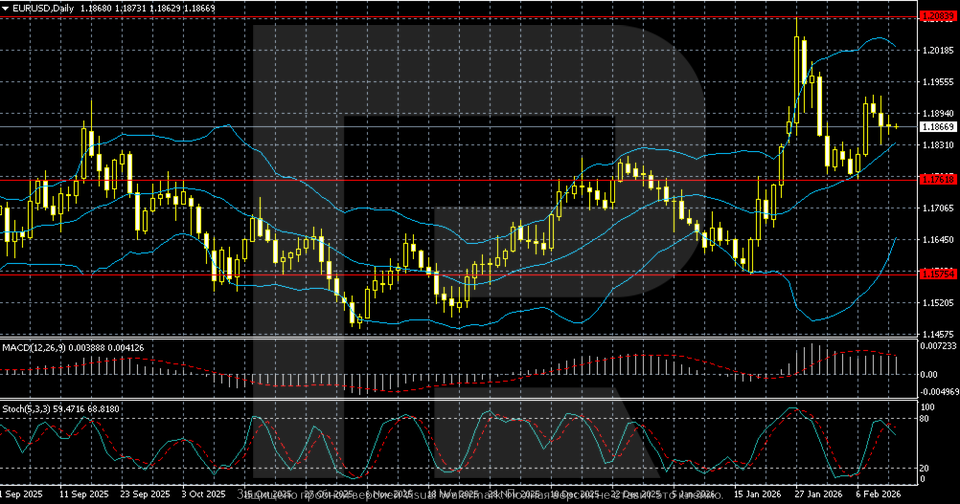
- Current trend: on the daily chart, the medium-term bullish momentum remains in place after January’s surge to 1.20+. The price is consolidating in the 1.1850–1.1900 area, with Bollinger Bands narrowing. MACD is in positive territory, but momentum is weakening – a stabilisation phase after volatility
- Weekly outlook: the baseline scenario is consolidation with a moderately bullish bias while holding the 1.1750–1.1760 support area. A breakout lower would increase correction risks towards 1.1580–1.1600. Resistance is located within 1.2000–1.2080
EURUSD fundamental analysis
The EURUSD pair closed the week in a sideways range. Earlier, a strong labour market report confirmed the resilience of the US economy. January Nonfarm Payrolls increased by 130 thousand versus a 66 thousand forecast and a revised previous reading of 48 thousand. The unemployment rate fell to 4.3% compared to 4.4% expected.
At the same time, weekly jobless claims data delivered a mixed signal. Initial jobless claims came in at 227 thousand versus 222 thousand expected, but declined from the previous 232 thousand. Continuing claims rose to 1.862 million from the previous 1.841 million, above expectations of 1.850 million. No clear deterioration in the labour market is visible so far.
As a result, markets shifted expectations for the first rate cut from June to July. In March, the Federal Reserve is expected to hold rates steady. At the same time, two 25-basis-point cuts are still priced in by year-end – roughly in June and September.
In the currency market, last week’s moves were uneven overall. The dollar lost more than 2% versus the yen on the back of Prime Minister Sanae Takaichi’s victory and verbal intervention from Tokyo. The Australian dollar strengthened amid more hawkish signals from the Reserve Bank of Australia.
Further USD dynamics will depend on inflation data and whether it confirms economic resilience or strengthens the case for earlier Fed easing.
EURUSD technical analysis
On the daily timeframe, the EURUSD pair maintains medium-term upward momentum after the January surge to 1.20+. A correction followed from the peak, but the structure of higher lows remains intact. The price is consolidating around 1.1850–1.1900, holding above the middle Bollinger Band. The bands are gradually narrowing as the market is shifting into a stabilisation phase after a volatility spike.
While MACD remains in positive territory, the histogram is declining, meaning momentum is losing strength. The Stochastic Oscillator has exited overbought territory and is moving in a neutral area, confirming a sideways phase.
The key support level is located within 1.1750–1.1760, while the nearest resistance lies in the 1.2000–1.2080 area. As long as the price holds above 1.1750, the base trend remains moderately bullish, but the market has shifted into consolidation ahead of the next impulse.
EURUSD trading scenarios
The EURUSD pair ended the week trading sideways after a strong US labour market report. January Nonfarm Payrolls increased by 130 thousand, above expectations of 66 thousand, while unemployment fell to 4.3% compared to the forecast of 4.4%. Initial jobless claims came in at 227 thousand (expected at 222 thousand and previously at 232 thousand), with continuing claims at 1.862 million (expected at 1.850 million and previously at 1.841 million). There is no clear deterioration in the labour market, and expectations for the first Federal Reserve rate cut shifted from June to July, with the regulator expected to keep rates unchanged in March.
Technically, the EURUSD pair remains in a correction phase within the medium-term uptrend after the January surge to 1.20+. The pair is consolidating in the 1.1850–1.1900 zone, holding above the middle Bollinger Band, while volatility is declining. MACD remains in positive territory, but momentum is weakening; the Stochastic Oscillator confirms a pause.
- Buy scenario
Holding above the 1.1750–1.1760 support area keeps the potential for stabilisation and a return to 1.2000–1.2080.
- Sell scenario
A breakout below 1.1750 would increase the risk of a deeper correction towards 1.1580–1.1600.
Conclusion: the baseline scenario is consolidation near 1.1850–1.1900 within a moderately bullish trend.
Summary
The EURUSD pair finished the week in a sideways range, consolidating in the 1.1850–1.1900 zone. Robust US labour market data (NFP +130 thousand, unemployment 4.3%) confirmed economic resilience and shifted expectations for the first Federal Reserve rate cut from June to July. At the same time, jobless claims data (227 thousand) delivered a mixed signal.
Technically, the EURUSD pair remains in a correction phase within the medium-term uptrend after January’s rally towards 1.20+. The key support level lies at 1.1750–1.1760, while resistance is located at 1.2000–1.2080. As long as the price holds above 1.1750, the structure remains moderately bullish, but the market has moved into a consolidation phase.
Editors’ picks
 EURUSD 2026-2027 forecast: key market trends and future predictions
This article provides the EURUSD forecast for 2026 and 2027 and highlights the main factors determining the direction of the pair’s movements. We will apply technical analysis, take into account the opinions of leading experts, large banks, and financial institutions, and study AI-based forecasts. This comprehensive insight into EURUSD predictions should help investors and traders make informed decisions.
 Gold (XAUUSD) forecast 2026 and beyond: expert insights, price predictions, and analysis
Dive deep into the Gold (XAUUSD) price outlook for 2026 and beyond, combining technical analysis, expert forecasts, and key macroeconomic factors. It explains the drivers behind gold’s recent surge, explores potential scenarios including a move toward 4,500 to 5,000 USD per ounce, and highlights why the metal remains a strong hedge during global uncertainty.
Forecasts presented in this section only reflect the author’s private opinion and should not be considered as guidance for trading. RoboForex bears no responsibility for trading results based on trading recommendations described in these analytical reviews.