
EURUSD weekly forecast: the US dollar has the upper hand
The EURUSD pair enters the week of 2–6 March after moving in a sideways range near 1.1800–1.1810. The dollar ended February higher. The market is pricing in a slowdown in producer inflation; however, trade risks and the Trump administration’s rhetoric about tariffs up to 15% support the US currency.
Technically, the EURUSD pair remains in a correction phase within a medium-term uptrend following the January rally towards 1.2000–1.2050. Holding above the 1.1700–1.1720 support area maintains a moderately bullish scenario with the potential for a return to 1.1900–1.1950. A breakout below this zone will increase the risks of a decline towards 1.1580–1.1600.
EURUSD forecast for this week: quick overview
- Market focus: the EURUSD pair traded sideways around 1.1808 last week. Investors were waiting for US inflation data. The market expected the PPI to slow to 0.3% m/m from 0.5% previously, while jobless claims data remained strong and supported the dollar. The Fed is expected to keep rates unchanged at least until June. Trade risks add further pressure, with the Trump administration considering a tariff hike of up to 15%. The dollar strengthened over the month, ending a three-month decline
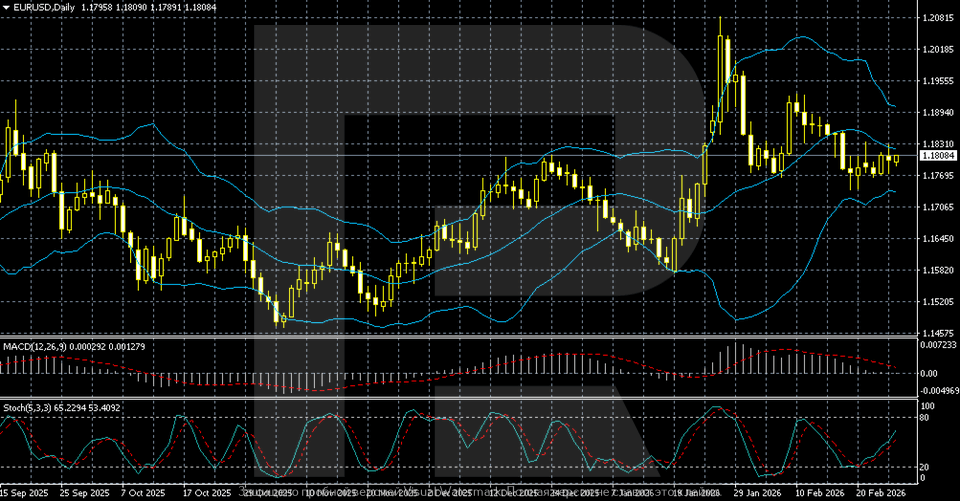
- Current trend: after January’s rise to 1.2000–1.2050, the pair moved into a correction phase and is now trading around 1.1780–1.1810. Bollinger Bands are narrowing and volatility is declining. MACD remains in positive territory, but momentum is weakening, and the Stochastic Oscillator is neutral. The medium-term structure remains upward
- Weekly outlook: the baseline scenario suggests consolidation with a moderately bearish bias if the price remains above the 1.1700–1.1720 support zone. Losing this area will increase the risks of a decline towards 1.1580–1.1600. The resistance level is located within 1.1900–1.1950.
EURUSD fundamental analysis
The EURUSD pair moved in a sideways range throughout the week, hovering near 1.1808. Investors took a wait-and-see stance ahead of inflation data, which could adjust expectations for Federal Reserve policy.
The market expected the January PPI to slow to 0.3% m/m from 0.5% in December. At the same time, the latest labour market statistics previously came out better than expected: initial and continuing jobless claims were below forecasts, indicating employment resilience.
By consensus, the Fed will keep rates unchanged at least until June. It will balance current inflation risks against labour market conditions.
Trade risks have an additional impact. The Trump administration allows for raising tariffs for some countries from 10% to 15%. Meanwhile, the US and Iran agreed to continue nuclear talks next week.
By the end of February, the US dollar was showing gains, thus ending a three-month streak of declines.
EURUSD technical analysis
On the daily chart, the EURUSD pair formed a strong bullish momentum in January, advancing towards the 1.2000–1.2050 area. After reaching a new local high, the price entered a correction phase.
In recent weeks, the pair has been gradually declining and is now trading around 1.1780–1.1810. The move is unfolding within Bollinger Bands, which, after expanding during the momentum, have begun to narrow, indicating declining volatility and a transition into a consolidation phase.
The nearest support is seen in the 1.1700–1.1720 zone, with the next one in the 1.1580–1.1600 area. The resistance level is located around 1.1900–1.1950.
MACD remains in positive territory on the daily timeframe, but the histogram is shrinking, signalling weakening upward momentum. The Stochastic Oscillator is fluctuating in the middle of the range, without a clear reversal signal.
The overall structure remains upward in the medium term. However, in the short term the pair is in a correction phase following the strong January rally.
EURUSD trading scenarios
The EURUSD pair traded sideways near 1.1808 during the week as investors waited for US inflation data. The market expected the PPI to slow to 0.3% m/m from the previous 0.5%, while jobless claims statistics pointed to labour market resilience. The Federal Reserve is expected to hold rates steady at least until June. Trade risks add further pressure, with the Trump administration considering a tariff hike of up to 15%. The dollar strengthened at the end of the month.
Technically, after rising to 1.2000–1.2050, the pair moved into a correction phase and is now trading in the 1.1780–1.1810 zone. Volatility is declining and momentum is weakening.
- Buy scenario
Holding above 1.1700–1.1720 opens the way to 1.1900–1.1950.
- Sell scenario
A breakout below 1.1700 will increase the risk of a decline towards 1.1580–1.1600.
Conclusion: the baseline scenario is consolidation with a moderately bearish bias while maintaining the medium-term upward structure above 1.1700.
Summary
The EURUSD pair traded in a sideways range near 1.1808 last week. By consensus, the Fed will keep rates unchanged at least until June. Trade risks add further pressure as the Trump administration allows for raising tariffs up to 15%. The dollar strengthened over the month.
Technically, the EURUSD pair is in a correction phase after the January rally towards 1.2000–1.2050. The price is hovering in the 1.1780–1.1810 area, volatility is declining, and momentum is weakening. The key support level stands at 1.1700–1.1720, followed by 1.1580–1.1600, with resistance within 1.1900–1.1950. While the pair holds above 1.1700, the medium-term upward structure remains intact, but the market is in a consolidation phase.
Editors’ picks
 EURUSD 2026-2027 forecast: key market trends and future predictions
This article provides the EURUSD forecast for 2026 and 2027 and highlights the main factors determining the direction of the pair’s movements. We will apply technical analysis, take into account the opinions of leading experts, large banks, and financial institutions, and study AI-based forecasts. This comprehensive insight into EURUSD predictions should help investors and traders make informed decisions.
 Gold (XAUUSD) forecast 2026 and beyond: expert insights, price predictions, and analysis
Dive deep into the Gold (XAUUSD) price outlook for 2026 and beyond, combining technical analysis, expert forecasts, and key macroeconomic factors. It explains the drivers behind gold’s recent surge, explores potential scenarios including a move toward 4,500 to 5,000 USD per ounce, and highlights why the metal remains a strong hedge during global uncertainty.
Forecasts presented in this section only reflect the author’s private opinion and should not be considered as guidance for trading. RoboForex bears no responsibility for trading results based on trading recommendations described in these analytical reviews.