
EURUSD weekly forecast: the dollar relies on the Middle East factor
The EURUSD pair enters the week of 9–13 March around 1.1617 after declining amid a stronger dollar. The US currency was supported by demand for safe-haven assets due to the escalation of the conflict in the Middle East and rising oil prices. The market also revised expectations for Federal Reserve policy, with the first rate cut now priced in no earlier than September or October. US macroeconomic data remains resilient: initial jobless claims are holding around 213 thousand, and the ISM services PMI rose to 56.1.
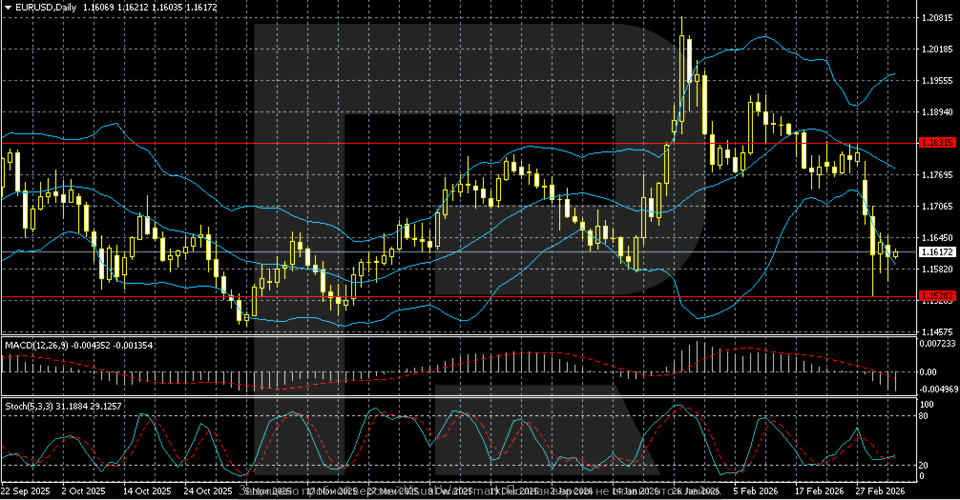
Technically, the EURUSD pair is in a correction phase after the January momentum rally to 1.2000–1.2050. The key support level is now at 1.1528, while the resistance level lies in the 1.1830 area. Holding above 1.1528 suggests a base for a recovery could form. A breakout below this level will increase downside risks and extend the bearish correction.
EURUSD forecast for this week: quick overview
- Market focus: the EURUSD pair ended the first week of March around 1.1617. The dollar was bolstered by safe-haven demand amid the escalation of the conflict in the Middle East and higher oil prices. Investors also revised Fed policy expectations: the first rate cut is now expected no earlier than September or October instead of July. US macroeconomic data proved resilient
- Current trend: after a strong rally to 1.2000–1.2050 in January, the pair entered a correction phase. Since mid-February, a series of lower highs has formed, and quotes have fallen towards the 1.16 area. The EURUSD pair is now trading around 1.1617 after testing the key support level at 1.1528. MACD is in negative territory, while the Stochastic Oscillator is turning up from oversold territory, indicating a possible short-term stabilisation
- Weekly outlook: the baseline scenario suggests movement within the 1.1528–1.1830 range with a moderately bearish bias. Losing the 1.1528 support level will increase downside risks, while a consolidation above 1.1800 could restore interest in a recovery
EURUSD fundamental analysis
The EURUSD pair closed the first week of March near 1.1617. The US currency was supported by demand for safe-haven assets due to the escalation of the Middle East conflict and rising oil prices.
The US and Israel’s military operation against Iran continued throughout the week. Tehran responded with a new wave of missile and drone strikes on Persian Gulf countries. US President Donald Trump said Washington intends to participate in shaping Iran’s future political leadership. This increased geopolitical uncertainty in the markets.
Rising energy prices fuelled concerns about a new wave of global inflation. Against this backdrop, investors revised expectations for Federal Reserve policy, with the market now expecting the first rate cut no earlier than September or October instead of July. This added to pressure on the currencies of countries that depend on oil imports.
US macroeconomic data was broadly resilient. Initial jobless claims came in at 213 thousand versus expectations of 215 thousand, while continuing claims rose to 1.868 million. The ISM services PMI for February climbed to 56.1 from 53.8, pointing to resilience in the services economy. The S&P Global indices showed some cooling in activity, with the composite PMI down to 51.9 from 53.0, and the services PMI down to 51.7 from 52.7.
Last week, the dollar posted its strongest gains against the euro due to the European economy’s high dependence on energy supplies from the Middle East.
EURUSD technical analysis
On the daily chart, the EURUSD pair is in a correction phase after the strong momentum rally in late January.
In January, the pair produced a powerful bullish surge, with quotes breaking through several resistance levels and peaking in the 1.2000–1.2050 area. This momentum was accompanied by expanding Bollinger Bands, reflecting rising volatility and accelerating trend strength.
After reaching new local highs, the pair entered a correction phase. Since mid-February, the price has consistently formed lower highs, gradually declining towards the lower part of the range. Pressure intensified in late February when quotes broke below intermediate support levels and approached the 1.1600 area.
The EURUSD pair is now trading around 1.1617 after a sharp drop to the 1.1528 zone, where the key support level is located. The market attempted a rebound from this level.
Technical indicators confirm waning momentum. MACD is in negative territory, indicating ongoing bearish pressure. The Stochastic Oscillator has turned up from oversold territory, which may signal short-term stabilisation or a technical rebound.
The nearest resistance level is around 1.1830, where a previously broken level and the middle Bollinger Band were located. The key support level remains at 1.1528. As long as the price holds above this mark, there is still a chance that a base for recovery will form, but the overall short-term trend remains a bearish correction within a broader range.
EURUSD trading scenarios
The EURUSD pair ended the first week of March around 1.1617. The dollar was bolstered by safe-haven demand amid the escalation of the conflict in the Middle East and rising oil prices. Investors also revised Fed policy expectations, with the first rate cut now expected no earlier than September or October instead of July. US macroeconomic statistics were broadly resilient.
Technically, after the strong January rally to 1.2000–1.2050, the pair moved into a correction, currently trading around 1.1617. The price remains in a bearish phase within a broader range. The key support level is located at 1.1528, while the resistance level lies in the 1.1830 area.
- Buy scenario
Holding above the 1.1528 support level may form a base for a recovery, with a target at 1.1800.
- Sell scenario
A breakout below 1.1528 would increase pressure on the pair and open the way for a deeper decline.
Conclusion: the baseline scenario suggests consolidation with a moderately bearish bias while pressure from a stronger dollar persists.
Summary
The EURUSD pair closed the first week of March around 1.1617. The dollar was bolstered by demand for safe haven assets amid the escalation of the conflict in the Middle East and rising oil prices. Investors also revised Fed policy expectations, currently pricing in the first rate cut no earlier than September or October instead of July.
Technically, the EURUSD pair is in a correction phase after the January rally to 1.2000–1.2050. The pair is now trading around 1.1617 after testing the 1.1528 support level. MACD remains in negative territory, while the Stochastic Oscillator is turning up from oversold territory. The nearest resistance level is at 1.1830, and the key support level lies at 1.1528. As long as the price holds above this level, stabilisation remains possible.
Editors’ picks
 EURUSD 2026-2027 forecast: key market trends and future predictions
This article provides the EURUSD forecast for 2026 and 2027 and highlights the main factors determining the direction of the pair’s movements. We will apply technical analysis, take into account the opinions of leading experts, large banks, and financial institutions, and study AI-based forecasts. This comprehensive insight into EURUSD predictions should help investors and traders make informed decisions.
 Gold (XAUUSD) forecast 2026 and beyond: expert insights, price predictions, and analysis
Dive deep into the Gold (XAUUSD) price outlook for 2026 and beyond, combining technical analysis, expert forecasts, and key macroeconomic factors. It explains the drivers behind gold’s recent surge, explores potential scenarios including a move toward 4,500 to 5,000 USD per ounce, and highlights why the metal remains a strong hedge during global uncertainty.
Forecasts presented in this section only reflect the author’s private opinion and should not be considered as guidance for trading. RoboForex bears no responsibility for trading results based on trading recommendations described in these analytical reviews.