
EURUSD weekly forecast: data and Islamabad will decide
The EURUSD pair enters the week of 13–17 April near 1.1687 amid ongoing geopolitical uncertainty and mixed US macro data. The market is watching the Islamabad talks involving JD Vance and assessing the outlook for inflation and Federal Open Market Committee policy.
In this analysis, we will examine which events and data will influence EURUSD dynamics this week.
EURUSD forecast for this week: quick overview
- Market focus: EURUSD ended the week at 1.1687. In focus are the Islamabad talks, where the US delegation is led by JD Vance. Sentiment remains cautious due to strikes in the region and disruptions in the Strait of Hormuz. The market still expects one Fed rate cut this year.
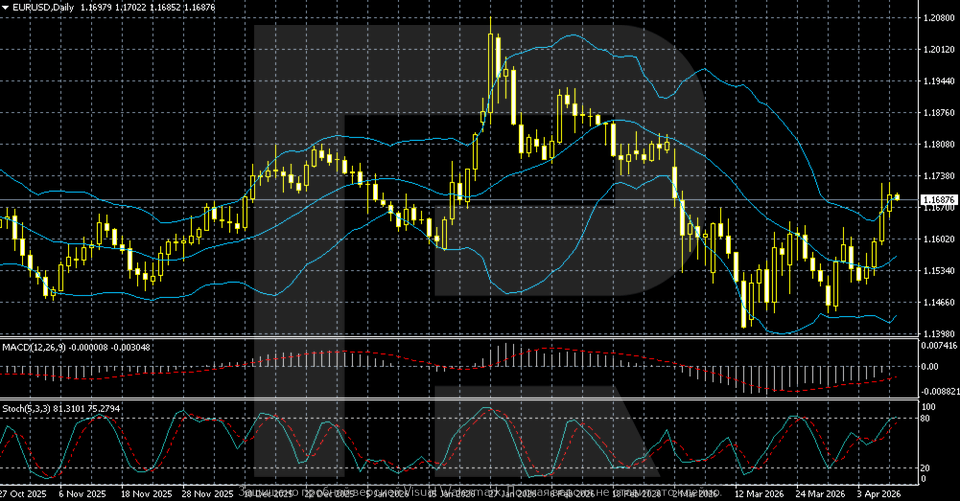
- Current trend: after the decline, EURUSD formed a local low in the 1.3150–1.3200 area and moved into recovery. The latest impulse pushed price to 1.3380–1.3410 — a resistance zone. The structure is an upward correction within a range. The upper Bollinger Band runs around 1.3450–1.3470, support is at 1.3300–1.3320. The Stochastic Oscillator in overbought territory points to pullback risk, while MACD is turning up, signaling a weakening of the downward impulse.
- Outlook for the week: the baseline scenario is consolidation in the 1.3300–1.3450 range with attempts to break higher. A закрепление above 1.3450 would open the way for further growth. A breakout below 1.3300 would strengthen the correction and bring the pair back to 1.3200–1.3150.
EURUSD fundamental analysis
The EURUSD pair ended the April week at 1.1687. Investors’ focus is on the Islamabad talks, where the US delegation is led by JD Vance. The market is hoping for more clarity on the conflict outlook, but overall sentiment remains cautious. Strikes in the region and disruptions to operations in the Strait of Hormuz keep risks to any agreements elevated and limit risk appetite.
US macroeconomic data look uneven. GDP growth in Q4 slowed to 0.5% q/q versus 4.4% previously, signaling cooling in the economy. The labor market is sending mixed signals: initial jobless claims rose to 219K, but continuing claims fell to 1.794M.
PCE inflation remains resilient. On a monthly basis it was 0.4%, on an annual basis 2.8%, while core held at 3.0%. This confirms that price pressures are easing slowly.
Fed minutes showed the regulator is keeping a cautious stance. Participants noted the risk of persistent inflation amid the conflict, but still allow for one rate cut this year.
As a result, the US dollar remains under pressure due to lower inflation expectations via oil, but the fundamental backdrop does not provide a basis for sustained weakening. This week, the key driver will be the CPI release. It will determine whether the dollar can recover or whether pressure will persist.
EURUSD technical analysis
On the daily chart, after the decline price formed a local low in the 1.3150–1.3200 area and moved into recovery. The latest upward impulse brought quotes into the 1.3380–1.3410 area, where the nearest resistance now lies. This points to buyers becoming more active, but the move is already approaching a zone where selling previously intensified.
The current structure is an upward correction within a broader range. The upper Bollinger Band runs roughly around 1.3450–1.3470, and this is where the rise may slow or a pullback may begin. Support has shifted higher — into the 1.3300–1.3320 area, where the indicator midline is now located and where local pauses in price previously formed.
The market is close to overheating: the Stochastic Oscillator is in overbought territory, raising the probability of a short-term correction. MACD is still below zero but is turning up — a sign that the downside impulse is losing strength. The baseline scenario предполагает consolidation between 1.3300 and 1.3450 with attempts to break higher. But without confirmation, the market can quickly return to support.
EURUSD trading scenarios
The EURUSD pair ended the April week at 1.1687. The dollar remained influenced by geopolitics and macro data. In focus are the Islamabad talks, where the US delegation is led by JD Vance. Sentiment remains cautious: strikes in the region and disruptions in the Strait of Hormuz keep risks to the talks elevated.
US macro data look mixed. GDP in Q4 slowed to 0.5% q/q, the labor market is sending mixed signals, and PCE inflation remains resilient (0.4% m/m and 2.8% y/y). Federal Open Market Committee minutes confirm a cautious approach: inflation risks remain, but the baseline scenario is one rate cut this year. As a result, the dollar is under pressure, but without a sustained weakening trend.
From a technical perspective, after the decline EURUSD formed a local low and moved into recovery. The latest impulse brought price into the 1.3380–1.3410 area, where the nearest resistance lies. The current structure is an upward correction within a range. The upper Bollinger Band runs around 1.3450–1.3470, support is 1.3300–1.3320. The Stochastic Oscillator is in overbought territory, while MACD is turning up.
- Buy scenario
A consolidation above 1.3410 would open the way to 1.3450–1.3470.
- Sell scenario
A break below 1.3300 would strengthen the correction with a target at 1.3200–1.3150.
Conclusion: consolidation in the 1.3300–1.3450 range with attempts to rise, but with pullback risk.
Summary
The EURUSD pair ended the week at 1.1687. Pressure on the dollar eased amid falling oil prices and softer inflation expectations, but geopolitical uncertainty persists: the market is watching the Islamabad talks. US macro data remain mixed. Federal Open Market Committee minutes confirm a cautious approach — the market still prices in one rate cut this year.
Technically, EURUSD moved into recovery after forming a bottom in the 1.3150–1.3200 area. Price approached resistance at 1.3380–1.3410, maintaining an upward correction within a range. Indicators point to overheating: the Stochastic Oscillator is in overbought territory, while MACD is turning up. Resistance is at 1.3450–1.3470, support is at 1.3300–1.3320. A break below 1.3300 would strengthen the correction, while a consolidation above 1.3450 would open potential for continued growth.
Editors’ picks
 EURUSD 2026-2027 forecast: key market trends and future predictions
This article provides the EURUSD forecast for 2026 and 2027 and highlights the main factors determining the direction of the pair’s movements. We will apply technical analysis, take into account the opinions of leading experts, large banks, and financial institutions, and study AI-based forecasts. This comprehensive insight into EURUSD predictions should help investors and traders make informed decisions.
 Gold (XAUUSD) forecast 2026 and beyond: expert insights, price predictions, and analysis
Dive deep into the Gold (XAUUSD) price outlook for 2026 and beyond, combining technical analysis, expert forecasts, and key macroeconomic factors. It explains the drivers behind gold’s recent surge, explores potential scenarios including a move toward 4,500 to 5,000 USD per ounce, and highlights why the metal remains a strong hedge during global uncertainty.
Forecasts presented in this section only reflect the author’s private opinion and should not be considered as guidance for trading. RoboForex bears no responsibility for trading results based on trading recommendations described in these analytical reviews.