
EURUSD weekly forecast: can the euro maintain its upward momentum?
The EURUSD pair begins the week of 20–24 April near 1.1775 due to a weaker US dollar and expectations of easing geopolitical tensions. The market is assessing the prospects for US-Iran talks, oil prices, and the Federal Reserve’s signals amid mixed macroeconomic data.
The focus is on inflation expectations, comments from regulators, and the further trajectory of the US labour market. The combination of these factors will determine whether the EURUSD pair continues its upward trajectory or reverts to a range-bound correction.
EURUSD forecast for this week: quick overview
- Market focus: the EURUSD pair closed the week at 1.1775, with the dollar under pressure from reduced demand for safe-haven assets amid expectations of a de-escalation of the US-Iran conflict and a potential reopening of the Strait of Hormuz. Falling oil prices are lowering inflation expectations and easing pressure on the Federal Reserve. US macroeconomic data was mixed: industrial production fell by 0.5% month-on-month, while the labour market shows early signs of cooling due to a rise in continuing claims
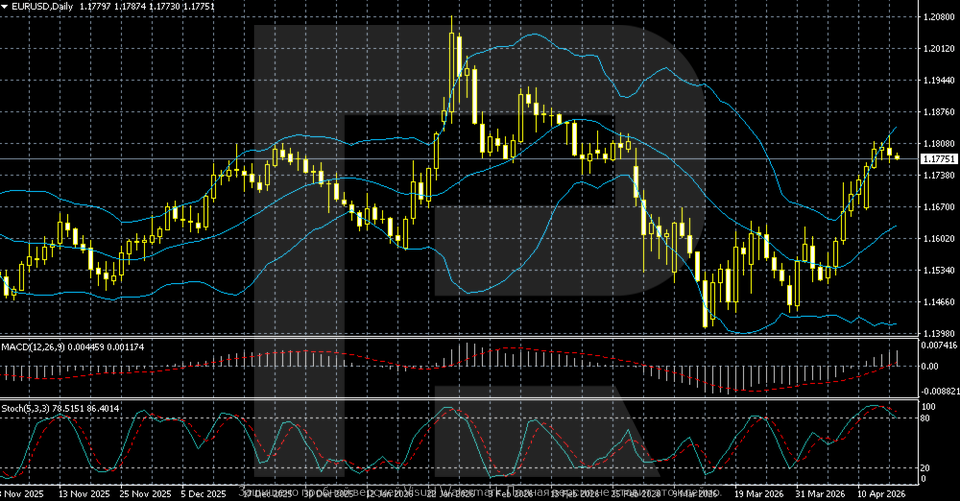
- Current trend: the daily chart still shows a broad sideways structure. After falling to 1.1400–1.1500, the pair recovered into the 1.1700–1.1800 zone and is trading near the middle Bollinger Band. The range is narrowing, reflecting a balance of forces. MACD is moving out of negative territory and indicates a moderate recovery, while the Stochastic Oscillator is near overbought levels, signalling the risk of a pullback. Resistance is located at 1.1800–1.1900, while support is at 1.1600–1.1500
- Weekly outlook: the baseline scenario is consolidation within the 1.1600–1.1900 range. A consolidation above 1.1800–1.1900 would open the way for further gains. A loss of 1.1600 will deepen the correction and may bring the pair back to the lower boundary of the range
EURUSD fundamental analysis
The EURUSD pair closed the week at 1.1775, with the US dollar pressured by reduced demand for safe-haven assets, as the market is pricing in a de-escalation scenario in the US-Iran conflict. Donald Trump stated that the war could end soon, including potential agreements on the nuclear program and the reopening of the Strait of Hormuz. An additional factor was the announcement of a 10-day ceasefire between Israel and Lebanon.
Falling oil prices are dampening inflation expectations and reducing pressure on the Federal Reserve to tighten policy. At the same time, the regulator’s rhetoric remains cautious. Some monetary policymakers say elevated uncertainty limits rate guidance. However, the baseline scenario still includes expectations of rate cuts in the long run.
US macroeconomic data was mixed. Industrial production fell by 0.5% month-on-month in March, missing market expectations of a 1.8% increase, indicating cooling in the real sector. At the same time, initial jobless claims came in better than expected at 207 thousand versus expectations of 213 thousand. But continuing claims rose to 1.818 million, signalling a gradual deterioration in labour market conditions.
Overall, the week was marked by a weaker dollar: fundamentals are shifting towards a softer policy stance, but uncertainty remains.
EURUSD technical analysis
On the daily chart, the EURUSD pair maintains a volatile sideways structure with a wide range. After rising above 1.2000, the market reversed and fell to the 1.1400–1.1500 area, from which a recovery began. The price is currently trading around 1.1700–1.1800, returning to the middle of the range.
Bollinger Bands indicate a consolidation phase: after expanding during strong moves, the range has gradually narrowed. The price is hovering near the midline, reflecting a balance of power. The latest rise looks like a corrective rebound after the March decline.
MACD is exiting negative territory, indicating a moderate recovery in momentum. The Stochastic Oscillator is near overbought levels and is turning lower, which may limit short-term growth.
Overall, the structure remains neutral, with the nearest resistance at 1.1800–1.1900 and support at 1.1600–1.1500. For sustainable upside, the pair needs to consolidate above the upper boundary of the range.
EURUSD trading scenarios
The EURUSD pair closed the week at 1.1775. The dollar remained under pressure amid reduced demand for safe-haven assets: the market is pricing in a de-escalation scenario in the US-Iran conflict and a potential reopening of the Strait of Hormuz. Sentiment was additionally supported by the announcement of a ceasefire between Israel and Lebanon. Falling oil prices are easing inflation expectations and reducing pressure on the Fed. However, the regulator’s rhetoric remains cautious, as uncertainty is limiting rate signals despite long-term expectations of cuts.
US macroeconomic data looks mixed. Industrial production fell by 0.5% month-on-month in March, missing expectations of growth and signalling cooling in the economy. The labour market sends mixed signals: initial claims came in better than forecast, while continuing claims are rising, reflecting a gradual weakening. As a result, the dollar is losing ground, but without a steady downtrend.
Technically, the EURUSD pair remains in a broad sideways structure. After dipping to 1.1400–1.1500, the pair recovered into the 1.1700–1.1800 range and is trading near the middle Bollinger Band. The range is narrowing, reflecting balance. MACD is moving out of negative territory; the Stochastic Oscillator is turning down from overbought levels. Resistance lies at 1.1800–1.1900, with support located at 1.1600–1.1500.
- Buy scenario
A consolidation above 1.1800–1.1900 would open the way for further growth.
- Sell scenario
A breakout below 1.1600 would deepen the correction, bringing the price back to 1.1500.
Conclusion: consolidation in the 1.1600–1.1900 range with attempts to rise, but with the risk of a pullback amid an uncertain fundamental backdrop.
Summary
The EURUSD pair ended the week at 1.1775. Pressure on the dollar eased amid expectations of a de-escalation in the US-Iran conflict and reduced demand for safe-haven assets. Sentiment was additionally supported by a ceasefire in the Middle East and lower oil prices. US macroecomic data remains mixed. As a result, the dollar is weakening, but without a stable trend.
Technically, the EURUSD pair is in a broad sideways structure. After falling to 1.1400–1.1500, the pair recovered into the 1.1700–1.1800 range and is trading near the middle Bollinger Band. Indicators suggest balance: MACD is moving out of negative territory, while the Stochastic Oscillator is turning down from overbought levels. Resistance is located at 1.1800–1.1900, while support lies at 1.1600–1.1500. A consolidation above the range’s upper boundary will open upside potential, while a breakout below the support level will deepen the correction.
Editors’ picks
 EURUSD 2026-2027 forecast: key market trends and future predictions
This article provides the EURUSD forecast for 2026 and 2027 and highlights the main factors determining the direction of the pair’s movements. We will apply technical analysis, take into account the opinions of leading experts, large banks, and financial institutions, and study AI-based forecasts. This comprehensive insight into EURUSD predictions should help investors and traders make informed decisions.
 Gold (XAUUSD) forecast 2026 and beyond: expert insights, price predictions, and analysis
Dive deep into the Gold (XAUUSD) price outlook for 2026 and beyond, combining technical analysis, expert forecasts, and key macroeconomic factors. It explains the drivers behind gold’s recent surge, explores potential scenarios including a move toward 4,500 to 5,000 USD per ounce, and highlights why the metal remains a strong hedge during global uncertainty.
Forecasts presented in this section only reflect the author’s private opinion and should not be considered as guidance for trading. RoboForex bears no responsibility for trading results based on trading recommendations described in these analytical reviews.