
EURUSD weekly forecast: EURUSD down, the US dollar favoured amid geopolitics
The EURUSD pair starts the week of 27 April–1 May near 1.1677 following a decline during the first correction in three weeks. The dollar strengthened due to a lack of progress in US-Iran talks and growing demand for safe-haven assets.
The focus is on geopolitics, oil prices, and signals from the Federal Reserve. Data on the US labour market is also significant, as it already points to a gradual cooling without any sharp deterioration. The combination of these factors will determine whether the EURUSD rate remains range-bound or declines more sharply as part of the current correction.
EURUSD forecast for this week: quick overview
- Market focus: the EURUSD pair ended the week at 1.1677, marking its first decline in three weeks. The dollar was supported by increased demand for safe-haven assets amid a lack of progress in US-Iran negotiations. Rising energy prices are increasing inflation risks and supporting expectations of a more hawkish Fed stance
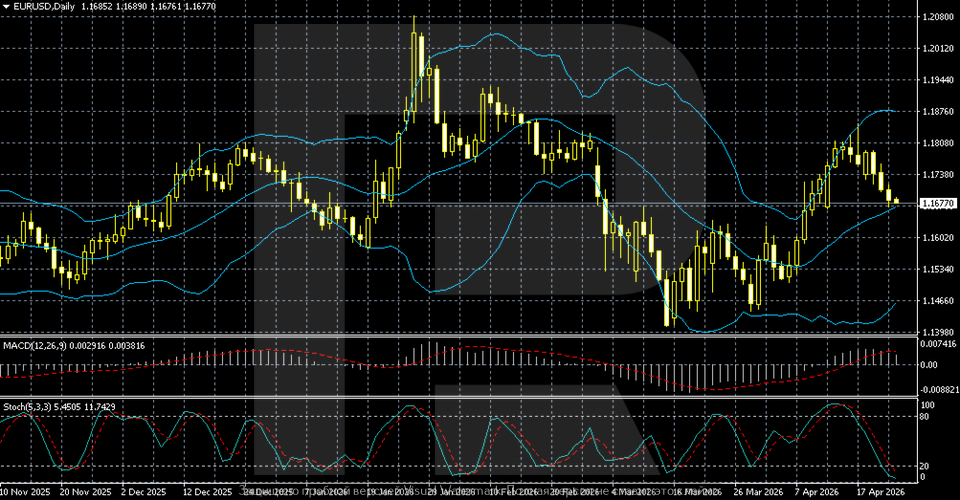
- Current trend: the daily chart still shows a broad sideways structure after the decline from levels above 1.2000 to 1.1400–1.1500. The current recovery looks corrective. The price has returned to the middle Bollinger Band, and the range is narrowing, reflecting a balance of forces. MACD remains in positive territory but is declining, while the Stochastic Oscillator is turning down from overbought territory. Resistance is located at 1.1800–1.1900, with support at 1.1600–1.1500
- Weekly outlook: the baseline scenario is consolidation within the 1.1600–1.1900 range with a downward bias. A consolidation above 1.1800–1.1900 would open the way for renewed growth. A breakout below the 1.1600 level would deepen the correction and return the pair to the lower boundary of the range
EURUSD fundamental analysis
The EURUSD pair closed the week lower at 1.1677, marking the euro’s first week of losses in the past three. The US dollar was bolstered by the lack of progress in talks between the US and Iran, as this increased demand for safe-haven assets.
The Strait of Hormuz remains effectively closed: both sides maintain a blockade, keeping energy prices high and increasing inflation risks. Donald Trump said he was ready to use force against vessels laying mines in the strait, which further escalated tensions.
The market expects the Federal Reserve to keep interest rates unchanged at the upcoming meeting. The same is likely to remain true for most of the year, as the regulator needs time to assess the impact of the conflict on inflation and the economy. Statements by Fed chair nominee Kevin Warsh about the regulator’s independence increased expectations of a more hawkish policy approach.
US macroeconomic data was mixed. Initial jobless claims rose to 214 thousand versus expectations of 212 thousand, with continuing claims up to 1.821 million. This data signals a gradual cooling in the labour market without a sharp deterioration.
Overall, the week was marked by a stronger dollar: geopolitics and inflation risks outweigh signals of slowing economic momentum.
EURUSD technical analysis
On the daily chart, the EURUSD pair maintains a broad sideways structure after falling sharply from highs above 1.2000. Following the drop into the 1.1400–1.1500 area, a local bottom formed, and a recovery began. However, this move currently looks like a corrective rebound within a larger range rather than a sustained trend.
The price rose towards the 1.1800 area, where it encountered resistance and then started to decline again. Quotes are now returning to the middle Bollinger Band, indicating a balance between buyers and sellers. The range has been gradually narrowing after the prior expansion, signalling that the market is transitioning into a consolidation phase.
Bollinger Bands confirm the lack of directional movement: the price regularly tests both the upper and lower boundaries without forming a stable trend. The 1.1800–1.1900 zone remains key resistance, while the 1.1500–1.1600 area acts as support, where demand previously intensified.
Indicators signal slowing momentum. MACD is in positive territory but is starting to decline, signalling weakening growth. The Stochastic Oscillator has moved out of overbought territory and is edging lower, increasing the likelihood of a short-term correction. Overall, the market remains range-bound and awaits a new driver to break out of the current structure.
EURUSD trading scenarios
The EURUSD pair closed the week lower at 1.1677, marking its first weekly decline in three. The dollar was supported by increased demand for safe-haven assets amid the breakdown of US-Iran talks. The Strait of Hormuz remains closed, which is keeping energy prices high and increasing inflationary risks. Donald Trump stated his readiness to use force, which heightened tensions. The market expects the Fed to hold rates steady, while Kevin Warsh’s comments about the regulator’s independence strengthened expectations of a more hawkish stance.
US macroeconomic data was mixed. Initial jobless claims rose to 214 thousand, and continuing claims were up to 1.821 million, indicating a gradual cooling in the labour market. At the same time, there are no signs of a sharp deterioration, so the dollar remains resilient amid inflation risks.
Technically, the EURUSD rate remains in a broad sideways structure. After falling from 1.2000 to 1.1400–1.1500, the pair recovered, but the rise proved corrective. The price is now returning to the middle Bollinger Band, and the range is narrowing, reflecting balance. MACD is in positive territory but declining, while the Stochastic Oscillator is turning down. Resistance is located at 1.1800–1.1900, and support lies at 1.1600–1.1500.
- Buy scenario
A consolidation above 1.1800–1.1900 would open the way for continued growth.
- Sell scenario
A breakout below 1.1600 would deepen the correction, with the price returning towards 1.1500.
Conclusion: consolidation in the 1.1600–1.1900 range with a downward bias amid a strong dollar and ongoing geopolitical risks.
Summary
The EURUSD pair ended the week at 1.1677, posting its first decline in three weeks. The dollar strengthened amid the collapse of US-Iran negotiations and rising demand for safe-haven assets. The closure of the Strait of Hormuz supports energy prices and inflation risks, while Fed expectations remain hawkish. US macroeconomic data came out mixed, merely pointing to a gradual labour market cooling.
Technically, the EURUSD pair remains in the broad 1.1500–1.1900 range. The price is hovering near the middle Bollinger Band, and momentum is weakening. The baseline scenario suggests consolidation: a move above 1.1800 would revive growth, while a breakout below 1.1600 would deepen the correction.
Editors’ picks
 EURUSD 2026-2027 forecast: key market trends and future predictions
This article provides the EURUSD forecast for 2026 and 2027 and highlights the main factors determining the direction of the pair’s movements. We will apply technical analysis, take into account the opinions of leading experts, large banks, and financial institutions, and study AI-based forecasts. This comprehensive insight into EURUSD predictions should help investors and traders make informed decisions.
 Gold (XAUUSD) forecast 2026 and beyond: expert insights, price predictions, and analysis
Dive deep into the Gold (XAUUSD) price outlook for 2026 and beyond, combining technical analysis, expert forecasts, and key macroeconomic factors. It explains the drivers behind gold’s recent surge, explores potential scenarios including a move toward 4,500 to 5,000 USD per ounce, and highlights why the metal remains a strong hedge during global uncertainty.
Forecasts presented in this section only reflect the author’s private opinion and should not be considered as guidance for trading. RoboForex bears no responsibility for trading results based on trading recommendations described in these analytical reviews.