
EURUSD weekly forecast: geopolitics and data in focus
The EURUSD pair begins the week of 11–15 May near 1.1735 and appears subdued after a corrective rebound. Demand for safe-haven assets is supported by geopolitical factors, but without a pronounced imbalance. The Middle East situation remains key, with clashes in the Strait of Hormuz and the anticipation of Iran’s response to the US proposal keeping the market in uncertainty.
Geopolitics, oil prices, and US macroeconomic data remain in focus. The baseline scenario is consolidation in the 1.1600–1.1800 range. A breakout beyond it will determine the next direction. Overall, the current structure remains neutral with a corrective bias.
EURUSD forecast for this week: quick overview
- Market focus: the EURUSD pair ended the week around 1.1735. The market remains in a wait-and-see mode amid geopolitical uncertainty. New clashes in the Strait of Hormuz support demand for safe-haven assets, but the dollar is not forming a sustainable trend. Additional attention should be paid to US macroeconomic data: jobless claims came in better than expected, but overall still signal a gradual cooling in the labour market
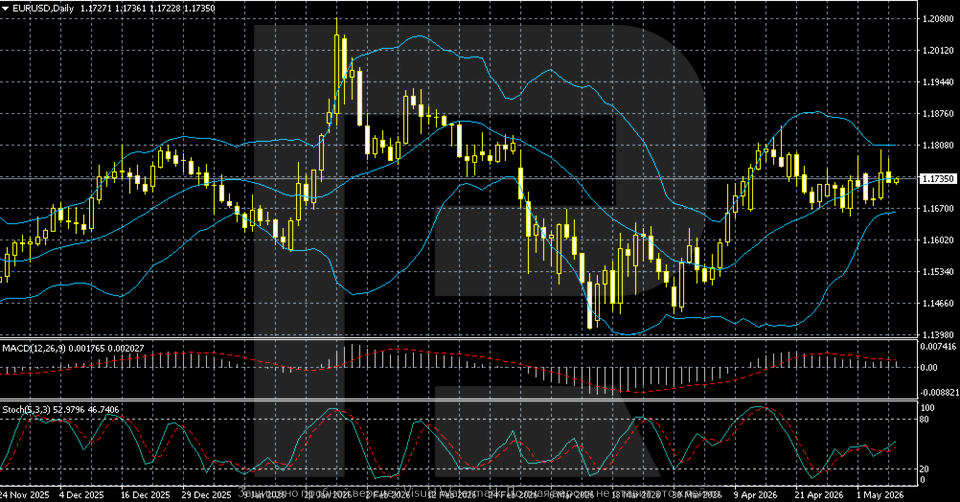
- Current trend: on the daily chart, a broad sideways structure persists after the decline from 1.2000–1.2100 to 1.1400–1.1500. The current rebound appears corrective and unstable, with advances alternating with pullbacks. The price is moving near the middle Bollinger Band, and the range is narrowing. MACD is near zero without momentum, and the Stochastic Oscillator is in the neutral zone. Resistance is located at 1.1800–1.1900, with support lying at 1.1600–1.1500
- Weekly outlook: the baseline scenario is consolidation in the 1.1600–1.1800 range. While the price holds within these boundaries, the market will remain in an accumulation phase. A consolidation above 1.1800 would improve the odds of further upside, while a breakout below 1.1600 would open the way for a deeper correction
EURUSD fundamental analysis
The EURUSD pair closed the week around 1.1735, with the market again pricing in geopolitical risk. Despite a local strengthening of the US dollar at the end of last week, momentum remains muted: overall, the USD is trading without a pronounced trend against major currencies.
The key factor remains the Middle East situation. New clashes in the Strait of Hormuz support demand for safe-haven assets. US destroyers repelled attacks and carried out retaliatory strikes, even though a formal ceasefire remains in place. Washington is still awaiting Iran’s response to its proposal to reopen the strait and end the conflict, which is keeping the market in a state of uncertainty.
The macroeconomic backdrop is also in focus. Labour market data indicates a gradual cooling, with initial jobless claims coming in at 200 thousand (better than expected) and continuing claims totalling 1.766 million.
Further movement will depend on Iran-related headlines and US labour market data.
EURUSD technical analysis
The EURUSD daily chart shows that the market has been in a steady uptrend since the end of 2025 and reached a local peak around 1.2000–1.2100 in January. This was followed by a reversal and a gradual decline, which evolved into a broader correction. The downward move was accompanied by a series of lower highs, signalling weakening bullish control and a shift toward sellers.
The decline brought the pair to the 1.1400–1.1500 area, where a stable bottom formed. From this zone, the market began to recover, but the rise has been uneven: upward impulses are followed by pullbacks, without a clear uptrend forming. The price has now returned to the 1.17–1.18 range, but has not yet been able to hold above it.
Bollinger Bands indicate a narrowing range after a period of high volatility, signalling a consolidation phase. The price is moving near the middle band, reflecting a balance between buyers and sellers. The nearest resistance level is in the 1.1800–1.1900 zone, while support remains in the 1.1600–1.1500 area.
Indicators confirm a neutral structure. MACD is near the zero line without clear momentum, and the Stochastic Oscillator is fluctuating in the mid-range, indicating neither overbought nor oversold conditions. Overall, the market is in a sideways range and building potential. A breakout beyond 1.1600–1.1800 will determine the next direction.
EURUSD trading scenarios
The EURUSD pair ended the week around 1.1735. The market remains in a wait-and-see mode, with geopolitical factors back in focus, but the dollar is failing to establish a sustainable trend. New clashes in the Strait of Hormuz support demand for safe-haven assets, while uncertainty persists around Iran’s response to the US proposal. Macroeconomic data suggests a gradual cooling in the labour market: jobless claims came in better than expected, but the overall signal remains moderately soft.
Technically, the EURUSD pair remains in a broad sideways structure. After falling from 1.2000–1.2100 to 1.1400–1.1500, the pair rebounded, but the move looks corrective. The price is fluctuating in the 1.17–1.18 range without holding above. Bollinger Bands are narrowing, reflecting balance; MACD is near zero; the Stochastic Oscillator is neutral. The resistance area is located at 1.1800–1.1900, with support at 1.1600–1.1500.
- Buy scenario
A consolidation above 1.1800–1.1900 would strengthen bullish momentum and open the way for further gains.
- Sell scenario
A breakout below 1.1600 would bring back pressure and push the pair towards 1.1500.
Conclusion: the market is in a consolidation phase with a downward bias. Further movement will depend on geopolitics and signals from the US labour market.
Summary
The EURUSD pair ended the week around 1.1735. The market remains influenced by geopolitics: clashes in the Strait of Hormuz support demand for safe-haven assets, but the dollar is not forming a sustainable trend. Uncertainty persists as the US awaits Iran’s response to the deal. US macroeconomic data is moderately soft: jobless claims indicate a gradual cooling of the labour market.
Technically, the EURUSD pair remains in a wide 1.1500–1.1800 range. After declining from 1.2000, the pair rebounded, but the move is corrective. The price is near the middle Bollinger Band, the range is narrowing, and momentum is weak. The baseline scenario suggests consolidation: a breakout above 1.1800 would open the path higher, while a breakout below 1.1600 would increase downside pressure.
Editors’ picks
 EURUSD 2026-2027 forecast: key market trends and future predictions
This article provides the EURUSD forecast for 2026 and 2027 and highlights the main factors determining the direction of the pair’s movements. We will apply technical analysis, take into account the opinions of leading experts, large banks, and financial institutions, and study AI-based forecasts. This comprehensive insight into EURUSD predictions should help investors and traders make informed decisions.
 Gold (XAUUSD) forecast 2026 and beyond: expert insights, price predictions, and analysis
Dive deep into the Gold (XAUUSD) price outlook for 2026 and beyond, combining technical analysis, expert forecasts, and key macroeconomic factors. It explains the drivers behind gold’s recent surge, explores potential scenarios including a move toward 4,500 to 5,000 USD per ounce, and highlights why the metal remains a strong hedge during global uncertainty.
Forecasts presented in this section only reflect the author’s private opinion and should not be considered as guidance for trading. RoboForex bears no responsibility for trading results based on trading recommendations described in these analytical reviews.