
EURUSD weekly forecast: pressure is mounting
The EURUSD pair starts the week of 18–22 May around 1.1651 under pressure from a strong US dollar. Robust retail sales data is fuelling expectations that the Federal Reserve will maintain its tight policy stance. The market has already completely ruled out a rate cut in 2026 and is pricing in the possibility of another rate hike by December.
Geopolitics, oil prices, and talks between Donald Trump and China’s President Xi Jinping remain in focus. Technically, the EURUSD pair remains in a broad consolidation phase with a moderate downside bias. The baseline scenario suggests movement within the 1.1600–1.1800 range. The risks of a deeper correction towards 1.1530–1.1450 remain until the pair returns above 1.1730–1.1800.
EURUSD forecast for this week: quick overview
- Market focus: the EURUSD pair ended the week around 1.1651, pressured by a strong dollar. The main market driver was accelerating inflation in the US amid an energy shock linked to the conflict around Iran. Producer inflation rose at its fastest pace since 2022, while consumer prices posted the strongest increase since 2023
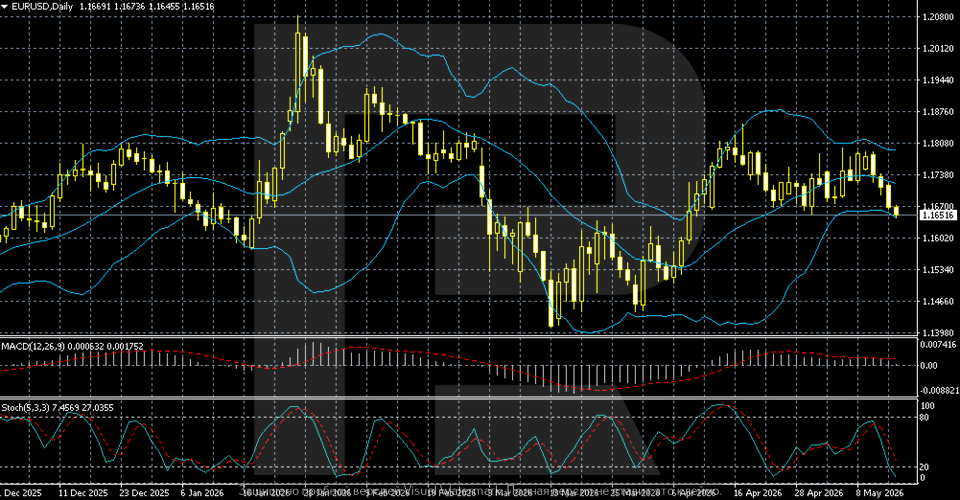
- Current trend: on the daily chart, the EURUSD pair remains in a broad sideways consolidation after correcting from highs above 1.2000. The price is now testing the 1.1650 support level and remains slightly below the middle Bollinger Band. Volatility is gradually declining, MACD is losing upward momentum, and the Stochastic Oscillator is turning down, indicating growing pressure on the euro. Resistance is located in the 1.1730–1.1800 area, with support at 1.1650–1.1600
- Weekly outlook: the baseline scenario suggests consolidation with a mild downside bias. As long as the EURUSD pair holds above 1.1600, the market may continue to attempt to stabilise within the range. A breakout below the 1.1650–1.1600 area would increase the risks of a drop towards 1.1530–1.1450, while a return above 1.1730–1.1800 would be the first signal of a recovering bullish momentum
EURUSD fundamental analysis
The EURUSD pair ended the week around 1.1651. The primary driver behind the US dollar’s strength remained accelerating US inflation amid an energy shock linked to the conflict around Iran.
US producer inflation rose in April at its fastest pace since 2022, and consumer prices recorded the strongest rise since 2023. The market was additionally supported by resilient retail sales data, confirming strong US consumer demand.
Against this backdrop, investors completely ruled out a Federal Reserve rate cut in 2026 and are increasingly pricing in the probability of another rate hike by December. This supports the dollar and US Treasury yields.
The market is also paying close attention to talks between Donald Trump and China’s President Xi Jinping. Investors are assessing the outlook for US-China trade relations after Beijing’s tough statements on the Taiwan issue.
Overall, downside risks for the dollar would likely increase only if inflation pressures ease or if the Fed softens its tone.
EURUSD technical analysis
On the daily chart, the EURUSD pair remains in a broad sideways consolidation after the strong rally in early 2026. Prices previously climbed above 1.2000, but after reaching local highs, the market faced intensified selling and entered a correction phase. In March, the pair dropped to the 1.1450–1.1400 area, where steady buyer demand reappeared.
In April, the EURUSD pair managed to recover and return above 1.1700, but buyers failed to gain a foothold above the 1.1780–1.1800 area. Prices are now slipping again and testing the support level near 1.1650, remaining slightly below the middle Bollinger Band. Volatility is gradually declining, with the trading range narrowing, indicating an accumulation phase ahead of the next directional move.
The technical picture appears neutral to negative. MACD remains near the zero line and is gradually losing upward momentum, reflecting weakening buyer activity. The Stochastic Oscillator is turning decisively lower from the mid-zone, signalling increasing short-term pressure on the euro.
The nearest support lies in the 1.1650–1.1600 area. A breakout below it could deepen the correction towards 1.1530–1.1450. Resistance remains in the 1.1730–1.1800 area. To regain sustainable bullish momentum, buyers need to reclaim and hold above this zone.
EURUSD trading scenarios
The EURUSD pair ended the week around 1.1651, under pressure from a strong dollar. The primary market driver remains accelerating US inflation amid an energy shock associated with the conflict around Iran. The dollar was additionally supported by expectations that the Federal Reserve may keep policy tight for longer or even raise rates before the end of the year.
From a technical perspective, the EURUSD pair remains in a broad consolidation phase after correcting from highs above 1.2000. After recovering from 1.1400–1.1450, the pair encountered selling in the 1.1780–1.1800 area again and is now testing the support level near 1.1650. Resistance remains around 1.1730–1.1800, with support at 1.1650–1.1600.
- Buy scenario
A consolidation above 1.1730–1.1800 would restore demand for the euro and open the way for continued recovery.
- Sell scenario
A breakout below 1.1650–1.1600 would increase pressure on the pair and raise the risks of a decline towards 1.1530–1.1450.
Conclusion: the EURUSD pair remains in a consolidation phase with a moderate downside bias. The main drivers for the market remain US inflation, Fed rate expectations, and the geopolitical backdrop around Iran and China.
Summary
The EURUSD pair ended the week around 1.1651, pressured by a strong dollar. The primary market driver remains accelerating US inflation amid the conflict around Iran. Strong inflation and retail sales data fuelled expectations of a prolonged tight Fed stance and supported US Treasury yields.
Technically, the EURUSD pair remains within the broad 1.1500–1.1800 range. The pair is now testing the support level near 1.1650, while volatility is gradually declining. The baseline scenario is consolidation with a mild downside bias: a move back above 1.1730–1.1800 would improve the outlook for further upside, while a breakout below 1.1600 would increase pressure on the euro.
Editors’ picks
 EURUSD 2026-2027 forecast: key market trends and future predictions
This article provides the EURUSD forecast for 2026 and 2027 and highlights the main factors determining the direction of the pair’s movements. We will apply technical analysis, take into account the opinions of leading experts, large banks, and financial institutions, and study AI-based forecasts. This comprehensive insight into EURUSD predictions should help investors and traders make informed decisions.
 Gold (XAUUSD) forecast 2026 and beyond: expert insights, price predictions, and analysis
Dive deep into the Gold (XAUUSD) price outlook for 2026 and beyond, combining technical analysis, expert forecasts, and key macroeconomic factors. It explains the drivers behind gold’s recent surge, explores potential scenarios including a move toward 4,500 to 5,000 USD per ounce, and highlights why the metal remains a strong hedge during global uncertainty.
Forecasts presented in this section only reflect the author’s private opinion and should not be considered as guidance for trading. RoboForex bears no responsibility for trading results based on trading recommendations described in these analytical reviews.