
EURUSD weekly forecast: all eyes on core PCE
The EURUSD pair starts the week of 25–29 May around 1.1598, pressured by a strong dollar and expectations that the Federal Reserve will maintain a hawkish policy stance. The FOMC minutes confirmed that the US regulator considers a rate hike if inflation remains above target. The approval of Kevin Warsh as Fed chair further supported the dollar.
The key event of the new week will be the US core PCE release – the Fed’s key inflation gauge. Technically, the EURUSD pair remains under pressure after turning down from 1.1780–1.1800 and maintains a bearish structure.
EURUSD forecast for this week: quick overview
- Market focus: the EURUSD pair ended the week around 1.1598 under pressure from a strong dollar and expectations that the Fed will keep policy tight. The market continues to monitor the US-Iran talks, which sustain concerns about inflation and interest rate prospects. An additional factor supporting the dollar was the approval of Kevin Warsh as Federal Reserve chairman. The highlight of the week will be the US core PCE release, the key inflation indicator for the US regulator
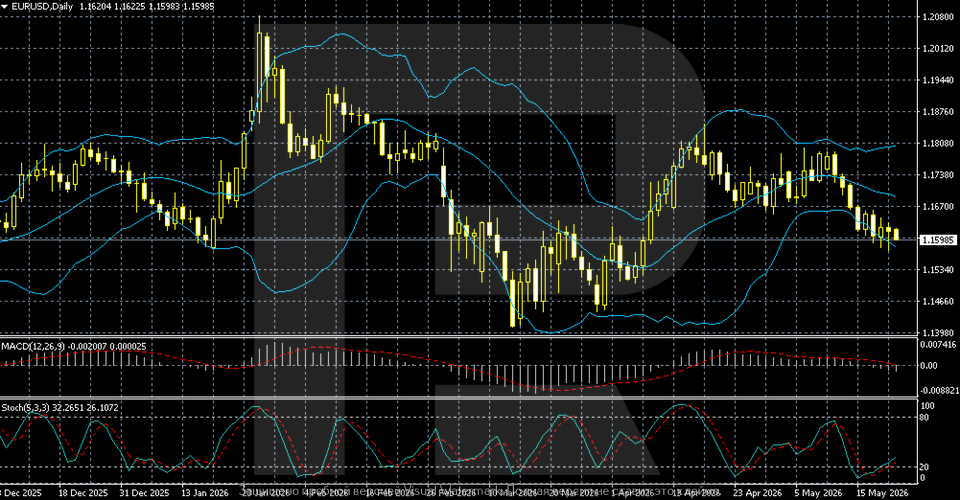
- Current trend: on the daily chart, the EURUSD pair remains under pressure after reversing lower from 1.1780–1.1800. The pair has gradually shifted into the 1.1600 area and is trading near the lower Bollinger Band. Volatility is declining, and the market is consolidating near local lows. MACD is moving into negative territory, while the Stochastic Oscillator is trying to stabilise after being oversold. The resistance level is in the 1.1670–1.1730 area, with support at 1.1575–1.1530
- Weekly outlook: the baseline scenario suggests consolidation with a moderate downside bias. While the EURUSD pair remains below 1.1670–1.1730, there is a risk of the downtrend persisting. A breakout below the 1.1575–1.1530 area would increase pressure on the pair and open the door for a decline to 1.1450. A weaker core PCE could temporarily weigh on the dollar and support the euro’s corrective recovery
EURUSD fundamental analysis
The EURUSD pair closed the week at 1.1598, close to a six-week low. The market continues to assess conflicting signals around the US-Iran talks, which are fuelling concerns about inflation and the interest rate outlook. The approval of Kevin Warsh as Federal Reserve chairman further supported the dollar, with investors now closely watching the policy of the new Fed leadership.
The minutes of the latest FOMC meeting confirmed that most Federal Reserve officials still see the possibility of a rate hike if inflation remains above the 2% target. At the same time, the market’s baseline scenario suggests that interest rates will remain unchanged until the end of the year. The likelihood of a 25-basis-point hike in December is already estimated at around 40%.
The key event for the currency market this week will be the US core PCE release – the Fed’s key inflation gauge. Robust data could further strengthen the dollar and heighten expectations that the Federal Reserve will keep policy tight. Weaker figures will reduce pressure on risk assets and emerging market currencies.
EURUSD technical analysis
On the daily chart, the EURUSD pair remains under pressure after a failed attempt to consolidate above 1.1780–1.1800 in early May. After reversing downwards, the market formed a series of lower highs and gradually shifted into the 1.1600 area. The quotes are now trading near the lower Bollinger Band, reflecting increased selling pressure.
Recent sessions have seen a steady downward movement with limited attempts at corrective rebounds. The euro remains weak amid dollar strength and expectations that the Federal Reserve will maintain a hawkish stance. Meanwhile, volatility is gradually decreasing, and the market is entering a consolidation phase near local lows.
The technical picture remains moderately negative. MACD is near the zero line and is gradually moving into negative territory, indicating weakening upward momentum. The Stochastic Oscillator is hovering at the bottom of the range and attempting to stabilise after being oversold, but it has not yet provided strong signals of a full-fledged upward reversal.
The nearest support level for the EURUSD pair is located around 1.1575–1.1530. A breakout below this area will add to pressure on the pair and open the way for a deeper correction towards 1.1450. Resistance lies in the 1.1670–1.1730 area. As long as the EURUSD pair remains below this zone, downside risks are high.
EURUSD trading scenarios
The EURUSD pair ended the week around 1.1598 under pressure from a strong dollar and expectations that the Fed will keep policy tight. The market continues to assess conflicting signals around the US–Iran talks. An additional factor supporting the dollar was the approval of Kevin Warsh as Federal Reserve chairman. The key event for the market this week will be the US core PCE release, the key inflation indicator for the US regulator.
From a technical perspective, the EURUSD pair remains under pressure after failing to gain a foothold above 1.1780–1.1800. The pair has edged lower towards 1.1600 and is trading near the lower Bollinger Band. Resistance remains in the 1.1670–1.1730 area, with support located at 1.1575–1.1530.
- Buy scenario
A consolidation above 1.1670–1.1730 would bring back demand for the euro and create conditions for a more sustainable recovery.
- Sell scenario
A breakout below the 1.1575–1.1530 area would increase pressure on the EURUSD pair and open the door for a decline to 1.1450.
Conclusion: the EURUSD pair maintains a moderately negative bias. The key drivers for the market remain US inflation, Fed rate expectations, the policy of the new Federal Reserve chairman, and developments around Iran and the Strait of Hormuz.
Summary
The EURUSD pair closed the week around 1.1598, pressured by a strong dollar. The main market driver remains expectations that the Federal Reserve will maintain its tight policy amid inflation risks and the situation around Iran.
Technically, the EURUSD pair remains pressured after reversing downwards from 1.1780–1.1800. The pair is now testing the 1.1575–1.1530 support area, while volatility is gradually declining. The baseline scenario suggests consolidation with a moderate downside bias: a return above 1.1670–1.1730 will improve recovery prospects, while a breakout below 1.1575 will increase pressure on the euro and open the way towards 1.1450.
Editors’ picks
 EURUSD 2026-2027 forecast: key market trends and future predictions
This article provides the EURUSD forecast for 2026 and 2027 and highlights the main factors determining the direction of the pair’s movements. We will apply technical analysis, take into account the opinions of leading experts, large banks, and financial institutions, and study AI-based forecasts. This comprehensive insight into EURUSD predictions should help investors and traders make informed decisions.
 Gold (XAUUSD) forecast 2026 and beyond: expert insights, price predictions, and analysis
Dive deep into the Gold (XAUUSD) price outlook for 2026 and beyond, combining technical analysis, expert forecasts, and key macroeconomic factors. It explains the drivers behind gold’s recent surge, explores potential scenarios including a move toward 4,500 to 5,000 USD per ounce, and highlights why the metal remains a strong hedge during global uncertainty.
Forecasts presented in this section only reflect the author’s private opinion and should not be considered as guidance for trading. RoboForex bears no responsibility for trading results based on trading recommendations described in these analytical reviews.