
EURUSD weekly forecast: the Middle East will support the euro, but there is a nuance
The EURUSD pair starts the week of 1–5 June around 1.1640 after the dollar dipped following reports of possible progress in talks between the US and Iran. PCE data confirmed that inflation in the US is not slowing fast enough for the Fed to shift towards easing monetary policy, so expectations of a prolonged period of high rates remain in place.
The key events of the week will be the release of ISM PMI data, JOLTS data, and Friday’s US labour market report. Technically, the EURUSD pair remains in a broad range between 1.1580 and 1.1780. As long as the pair holds above 1.1580–1.1600, there are chances for a move towards 1.1670–1.1735. Stronger US data will restore support for the dollar and increase pressure on the euro.
EURUSD forecast for this week: quick overview
- Market focus: the EURUSD pair ended the week around 1.1640 amid a weaker dollar after reports of possible progress in talks between the US and Iran. The market is hoping that a de-escalation of the conflict and a potential restoration of shipping through the Strait of Hormuz will help reduce inflation risks. US PCE inflation data did not provide a clear signal. This week, the spotlight will be on ISM manufacturing, ISM services, and JOLTS data, and Friday’s US labour market report
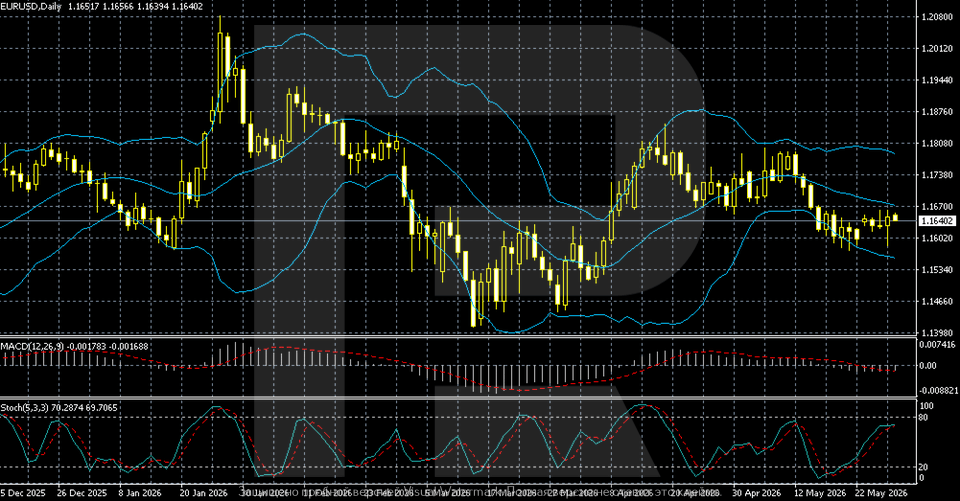
- Current trend: on the daily chart, the EURUSD pair remains in a broad consolidation phase after recovering from the March lows around 1.1420. The pair is trading near the middle Bollinger Band, holding within the 1.1580–1.1780 range. Selling pressure is gradually easing, but there is still no sustained bullish momentum. Resistance is located around 1.1670–1.1735, with support around 1.1580–1.1600
- Weekly outlook: the baseline scenario implies continued consolidation within the current range. While the EURUSD pair remains below 1.1670–1.1735, the market maintains a neutral stance with the risk of a return to the 1.1580–1.1600 support zone
EURUSD fundamental analysis
The EURUSD pair closed the week around 1.1640, with the dollar under pressure from reports of possible progress in talks between the US and Iran. The market expects that a de-escalation of the conflict and a possible restoration of shipping through the Strait of Hormuz will help reduce the risks to inflation and the global economy.
US PCE inflation data did not give the market an unambiguous signal. The core PCE, the key indicator for the Fed, rose by 3.3% y/y, up from the previous 3.2%. The headline index accelerated to 3.8% y/y from 3.5%. At the same time, monthly price growth slowed to 0.4% after 0.7%.
The main conclusion remains the same: inflation is gradually cooling, but still not fast enough for a confident Fed pivot towards policy easing. Therefore, the market still expects high interest rates to remain in place for an extended period.
This week, the main focus will be on US data, with the ISM manufacturing PMI to be released on Monday and the ISM services PMI and JOLTS data on job openings due on Wednesday. The key event will be Friday’s US labour market report. The forecast suggests non-farm payrolls rising by 102 thousand after 115 thousand the month before. The unemployment rate may rise to 4.4% from 4.3%.
Weaker-than-expected data will increase pressure on the dollar, while stronger statistics will support the US currency and further fuel expectations that the Federal Reserve will maintain its tight policy.
EURUSD technical analysis
On the daily chart, the EURUSD pair remains in a consolidation phase following the correction from the January highs around 1.2050–1.2060. In March, the price hit a local low of around 1.1420, followed by a recovery wave towards 1.1800. However, buyers failed to gain a foothold above this area, and the market returned to a broad sideways range. The EURUSD pair is now trading around 1.1640, near the middle Bollinger Band, indicating the absence of a pronounced trend.
Recent weeks have seen trading within the 1.1580–1.1780 range. After the decline in the first half of May, sellers are gradually losing initiative, with a series of new lows yet to form. The nearest resistance is located in the 1.1670–1.1735 area, where selling pressure has intensified repeatedly previously. Support remains around 1.1580–1.1600. While the price holds within this range, the market looks neutral and continues to build momentum for the next move.
The technical picture remains mixed. MACD is holding slightly below the zero line, indicating continued moderate selling pressure, but the depth of the decline is shrinking. The Stochastic Oscillator has turned upwards and is approaching overbought territory, signalling the possibility of continued local recovery. To improve the medium-term picture, the EURUSD pair needs to break and consolidate above 1.1670–1.1735. Otherwise, the risks of a retest of the 1.1580 support level remain.
EURUSD trading scenarios
The EURUSD pair closed the week around 1.1640. The market expects that a de-escalation of the conflict and the restoration of shipping through the Strait of Hormuz will help reduce inflation risks for the global economy. US PCE inflation data did not provide a clear signal. This week, investors will be focused on US statistics, including ISM and JOLTS data, and Friday’s labour market report.
From a technical standpoint, the EURUSD pair remains in a broad consolidation phase after recovering from the March lows. The pair is trading in the 1.1580–1.1780 range near the middle Bollinger Band, indicating the absence of a pronounced trend. Resistance is located around 1.1670–1.1735, while support lies around 1.1580–1.1600.
- Buying scenario
A breakout and consolidation above 1.1670–1.1735 would strengthen demand for the euro and create conditions for a continued recovery towards the range’s upper boundary.
- Selling scenario
A breakout below the 1.1580–1.1600 support would bring pressure back on the EURUSD pair and open the way for a decline towards 1.1500–1.1450.
Conclusion: the EURUSD pair remains neutral within a broad sideways range.
Summary
The EURUSD pair ended the week around 1.1640 amid a weakening dollar following reports of possible progress in US-Iran talks. PCE data confirmed that US inflation is not slowing fast enough for the Fed to shift towards easing policy. Therefore, expectations of a prolonged period of high rates remain in place.
Technically, the EURUSD pair remains in a broad consolidation phase within the 1.1580–1.1780 range. The pair is trading near the middle Bollinger Band, indicating the absence of a pronounced trend. The baseline scenario suggests continued sideways movement: a breakout above 1.1670–1.1735 would improve recovery prospects, while a breakout below the 1.1580–1.1600 support area would increase pressure on the euro and open the way for a decline towards 1.1500–1.1450.
Editors’ picks
 EURUSD 2026-2027 forecast: key market trends and future predictions
This article provides the EURUSD forecast for 2026 and 2027 and highlights the main factors determining the direction of the pair’s movements. We will apply technical analysis, take into account the opinions of leading experts, large banks, and financial institutions, and study AI-based forecasts. This comprehensive insight into EURUSD predictions should help investors and traders make informed decisions.
 Gold (XAUUSD) forecast 2026 and beyond: expert insights, price predictions, and analysis
Dive deep into the Gold (XAUUSD) price outlook for 2026 and beyond, combining technical analysis, expert forecasts, and key macroeconomic factors. It explains the drivers behind gold’s recent surge, explores potential scenarios including a move toward 4,500 to 5,000 USD per ounce, and highlights why the metal remains a strong hedge during global uncertainty.
Forecasts presented in this section only reflect the author’s private opinion and should not be considered as guidance for trading. RoboForex bears no responsibility for trading results based on trading recommendations described in these analytical reviews.