
EURUSD weekly forecast: US inflation to test market resilience
The EURUSD pair ended the week around 1.1220 after attempting to recover from the 1.1160 support level. Pressure from the US dollar eased somewhat following a decline in Treasury yields and oil prices, but the pair's broader downward structure remains intact.
This week, US inflation will be the key test for the market, as it could once again shift expectations for Federal Reserve rates.
EURUSD forecast for this week: quick overview
- Market focus: the main event of the week of 12–16 October will be the release of US inflation data. Following the September rate hike, the market currently estimates the probability of a Federal Reserve pause in October at around 82%, while expectations of another hike by December remain high. Strong inflation would push yields and demand for the US dollar higher again, increasing pressure on the EURUSD rate. Slower price growth, by contrast, would reinforce expectations of an October pause and give the euro room for a corrective recovery
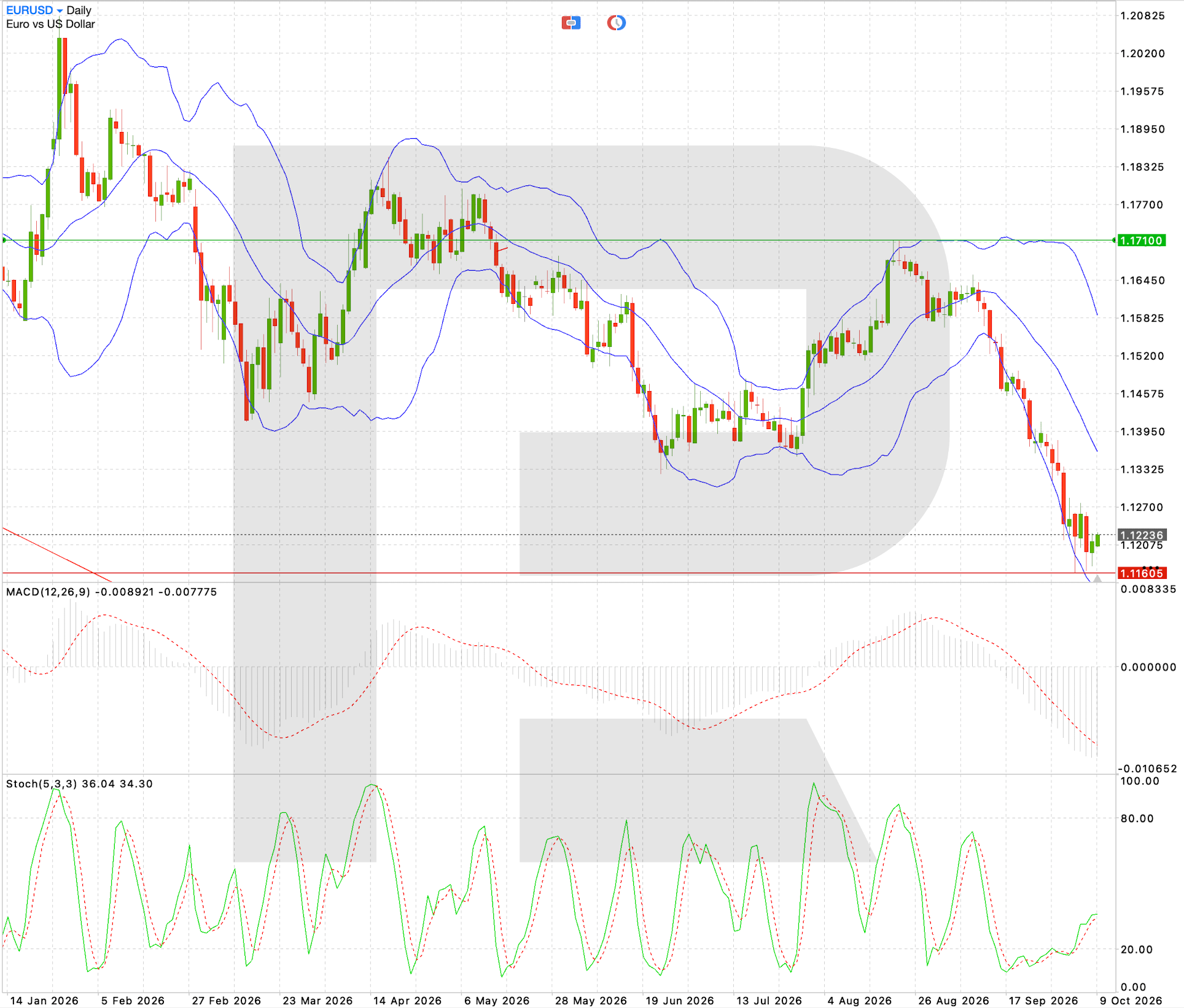
- Current trend: on the daily chart, the EURUSD pair remains within a downward structure, but the first signs of stabilisation appeared after the price reached the 1.1160 level. Quotes rebounded from the lower Bollinger Band and climbed back above 1.1200. MACD remains deep in negative territory, so sellers still retain the medium-term advantage. The Stochastic Oscillator, meanwhile, turned upwards after leaving oversold territory and rose to around 35 points, indicating a recovery in short-term buying momentum
- Weekly outlook: the baseline scenario suggests an attempt at a corrective recovery while the EURUSD pair remains above 1.1160. The first condition for the rebound to develop will be consolidation above the 1.1270 level. In this case, the pair could extend its advance towards 1.1330–1.1395. A return below 1.1160 would invalidate the recovery scenario and confirm that the dominant downtrend remains intact
EURUSD key levels for next week
The fundamental backdrop for the US dollar has softened somewhat at the start of the week. The DXY Index retreated towards 102 after US Treasury yields declined. Robust demand for 30-year securities at auction bolstered the bond market, easing concerns about the sustainability of demand for long-term US government debt.
Another factor was the fall in oil prices following Donald Trump's comments about ‘productive’ talks with Iran. Lower commodity prices reduce the risk of a renewed inflationary impulse driven by energy costs and therefore lessen the need for immediate policy tightening.
At the same time, the Federal Reserve is not yet ready to declare victory over inflation. Christopher Waller noted that further rate hikes would likely be required to bring inflation back to 2%, although the regulator has flexibility in choosing the pace of tightening. This leaves the door open to a pause in October without ruling out another hike later.
The US dollar's short-term support has therefore weakened, but its fundamental advantage has not disappeared completely. The next significant signal will come from US inflation data.
EURUSD technical analysis
On the daily chart, the EURUSD pair remains in a downtrend following the August reversal from the 1.1710 level. The latest downward wave brought the pair to the horizontal support at 1.11605 and the lower Bollinger Band.
The 1.1160 support level remains key to the current structure. Holding above it opens the door for a recovery first towards 1.1270, then towards 1.1330 and 1.1395. The 1.1455–1.1495 area remains a stronger resistance zone.
MACD is below zero and continues to confirm bearish medium-term momentum. However, the Stochastic Oscillator has turned upwards after leaving oversold territory, and the price has stopped moving along the lower Bollinger Band.
This combination of signals suggests a technical rebound, but it should currently be viewed as a correction within the broader downtrend.
EURUSD trading scenario for next week
After a sharp decline, the EURUSD pair is attempting to rebound from the 1.1160 support level, but buying directly within the current consolidation is premature. A signal will appear after a breakout above the nearest local resistance level.
Buy scenario
Consolidation above 1.1270 would confirm a corrective recovery and open the way for a move towards the next technical zone.
- Entry level: buy stop 1.1272
- Stop loss: 1.1215
- Take profit: 1.1395
- Risk-to-reward ratio: approximately 1:2.2
The trade idea is valid until 8:00 AM on 16 October 2026 (server time, GMT+3).
If the EURUSD rate remains below 1.1270, the trade idea will not be activated.
Summary
The EURUSD pair begins the new week after rebounding from the key 1.1160 support level, while falling yields and easing oil-related risks are giving the pair room for a technical recovery. However, the overall downtrend remains intact.
The EURUSD forecast for 12–16 October suggests corrective growth if the pair consolidates above 1.1270, with the nearest target at 1.1395.
Editors’ picks
 EURUSD forecast 2026–2027: technical analysis, price levels & predictions
The EURUSD outlook for 2026 and 2027: key levels on the daily chart, three trading scenarios and the policy gap between the Fed and the ECB that drives the pair.
 Gold (XAUUSD) forecast 2026: technical analysis, price levels & predictions
Where gold could trade in 2026: key levels, three trading scenarios with entry triggers and the forecasts from J.P. Morgan, Deutsche Bank and Goldman Sachs.
Forecasts presented in this section only reflect the author’s private opinion and should not be considered as guidance for trading. RoboForex bears no responsibility for trading results based on trading recommendations described in these analytical reviews.