
EURUSD weekly forecast: buyers attempt to regain the initiative
The EURUSD pair is starting the new week near 1.1190 after attempting to recover from its October lows. The dollar weakened as Treasury yields declined, but high US inflation is keeping expectations of another Federal Reserve interest rate hike later this year alive.
This week, the pair's direction will be determined by US labour market data and EURUSD's ability to stage a technical rebound.
- Price at the time of writing
- 1.1189
- Bias for the week
- Moderately bullish, D1
- Weekly range
- 1.1120–1.1310
- Trigger level
- 1.1260
- Forecast invalid below
- 1.1100
- Main event
- US Nonfarm Payrolls
Updated 30 October 2026, 11:27 (UTC+3)
What moves EURUSD next week
- Market focus: the key macroeconomic event of the week will be Friday's US employment report. Following September's unexpectedly strong rise in the PCE price index, the market continues to price in a high probability of a Federal Reserve rate hike in December. The NFP figures should therefore show how resilient the US labour market remains after an extended period of high interest rates. Strong employment would revive demand for the dollar, while signs of an economic slowdown would support a EURUSD recovery
- Current trend: on the daily chart, the EURUSD pair has rebounded from the lower Bollinger Band after a prolonged decline and returned to the 1.1190 area. MACD remains below zero, but the gap between its main and signal lines is narrowing. The Stochastic Oscillator has turned sharply higher from oversold territory and risen to around 50, indicating stronger short-term recovery momentum
- Weekly outlook: the baseline scenario suggests the corrective rise could continue if the price remains above 1.1120. Consolidation above 1.1260 would confirm increased buying pressure and open the way towards 1.1310–1.1370. A return below 1.1100 would invalidate the recovery scenario
Week calendar
| Day | Event | Why it matters for EURUSD |
|---|---|---|
| 2 November | US ISM manufacturing PMI | This will indicate the state of US manufacturing following a period of high interest rates. A strong reading would support the dollar by reinforcing expectations of a more resilient economy. |
| 3 November | US JOLTS job openings | This will provide an early indication of labour demand ahead of Friday's NFP report and could change expectations for the Fed's future actions. |
| 3 November | US midterm elections | Federal elections take place on 3 November and could temporarily increase market uncertainty and volatility in dollar-denominated assets. |
| 4 November | Eurozone preliminary inflation | Persistent price pressures would support expectations of tight ECB policy and could strengthen the euro. |
| 4 November | US ISM services PMI | The services sector remains a key part of the US economy, so a significant deviation in this indicator could change expectations for economic growth. |
| 6 November | US Nonfarm Payrolls and unemployment | The week's main event. Strong employment would strengthen the case for a Fed rate hike in December, while weak data would accelerate the dollar's correction. |
EURUSD technical analysis
On the daily chart, the EURUSD pair remains in a broader downtrend that has been in place since the August high near 1.1700. However, the latest downward wave brought the pair to the lower Bollinger Band, from which a recovery began.
The nearest support lies in the 1.1120–1.1145 area, with 1.1100 remaining the key level below it. As long as this zone holds, the market could recover towards 1.1260, followed by 1.1310 and 1.1370. A stronger resistance level is located around 1.1480–1.1500.
MACD remains in negative territory, so it is premature to speak of an end to the medium-term downtrend. However, the main line has begun to recover relative to the signal line, indicating an easing of selling pressure. The Stochastic Oscillator has formed a pronounced upward reversal after reaching oversold territory and is now near the middle of its operating range.
The technical picture therefore suggests the corrective rise could continue, but the EURUSD pair needs to consolidate above 1.1260 to confirm it.
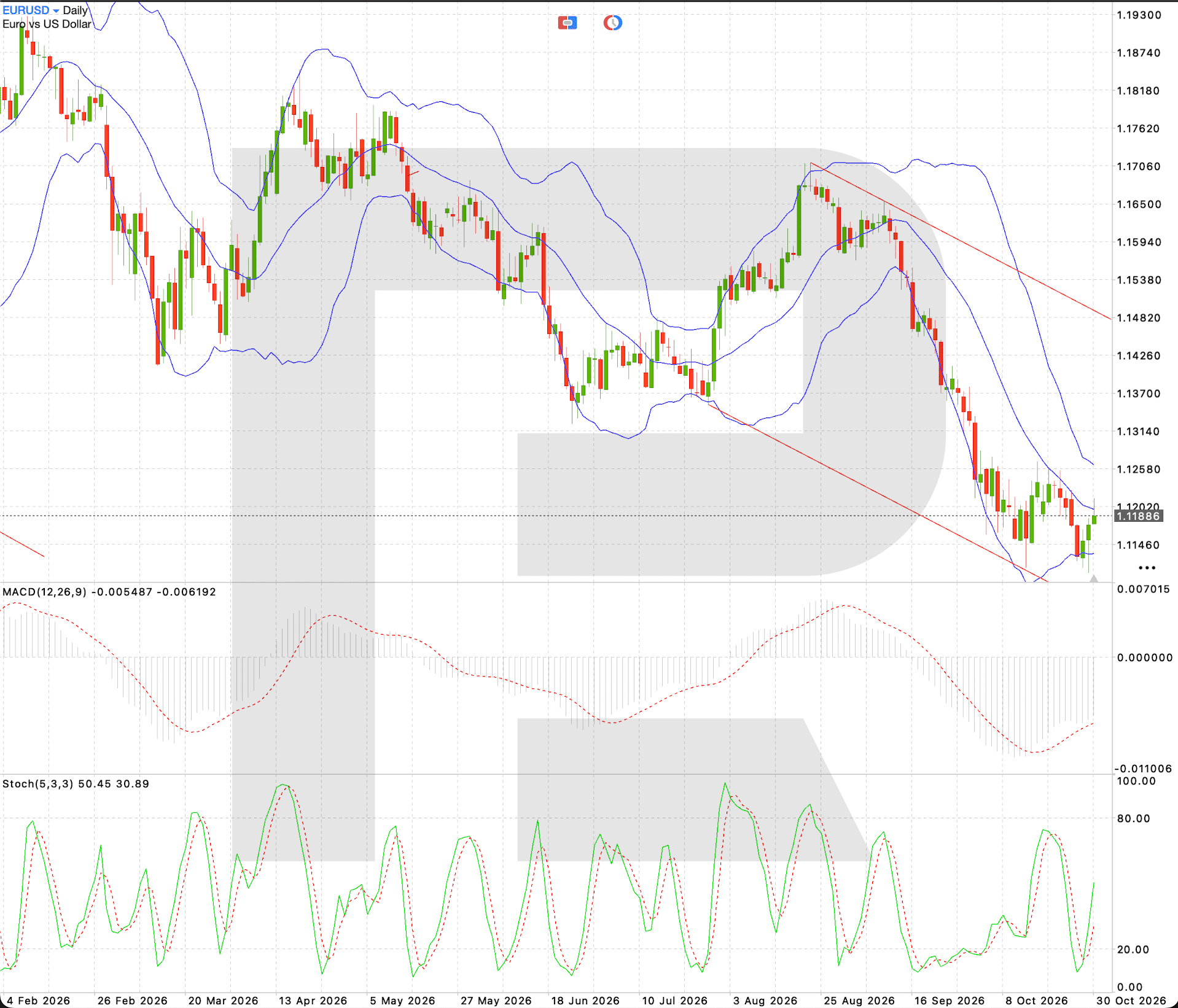
EURUSD trading scenario for next week
The recovery from the October lows remains corrective for now. Buying becomes relevant only after the EURUSD pair consolidates above 1.1260, confirming a breakout from the local consolidation range and stronger upward momentum.
A return below 1.1100 would invalidate the recovery scenario and once again make a continuation of the downtrend the priority.
EURUSD trading scenario
What would change the forecast
- A stronger-than-expected NFP report and sustained wage growth could send Treasury yields higher again and strengthen the dollar
- A return below 1.1100 would invalidate the developing technical recovery structure in EURUSD and point to a continued medium-term decline
- Weaker eurozone inflation could reduce expectations of further ECB monetary tightening and limit support for the euro
EURUSD forecast next week: questions and answers
Will the euro rise or fall next week?
The outlook for 2–6 November is moderately positive following a rebound from the October lows. Confirmation will come if the EURUSD pair consolidates above 1.1260, with the next targets 1.1310 and 1.1370.
What are the key EURUSD levels for 2–6 November 2026?
The main support zone is at 1.1120–1.1145, with 1.1100 as the critical level. The nearest resistance level lies at 1.1260, followed by 1.1310 and 1.1370.
What will move the euro next week?
The main drivers will be US labour market data, including JOLTS and Friday's NFP report, as well as preliminary eurozone inflation. US midterm elections on Tuesday could also increase volatility in dollar-denominated assets.
Summary
The EURUSD pair is heading into the new week showing the first signs of a recovery from its October lows. The medium-term downtrend remains intact, but the sellers' technical momentum is weakening.
The EURUSD forecast for 2–6 November suggests the corrective rise could continue if the price consolidates above 1.1260, with the nearest target at 1.1370.
Editors’ picks


EURUSD forecast 2026–2027: technical analysis, price levels & predictions
The EURUSD outlook for 2026 and 2027: key levels on the daily chart, three trading scenarios and the policy gap between the Fed and the ECB that drives the pair.

Gold (XAUUSD) forecast 2026: technical analysis, price levels & predictions
Where gold could trade in 2026: key levels, three trading scenarios with entry triggers and the forecasts from J.P. Morgan, Deutsche Bank and Goldman Sachs.
Forecasts presented in this section only reflect the author’s private opinion and should not be considered as guidance for trading. RoboForex bears no responsibility for trading results based on trading recommendations described in these analytical reviews.