
EURUSD weekly forecast: the euro could continue strengthening ahead of Nonfarm Payrolls
Next week, the EURUSD pair will be influenced by competing expectations of further monetary tightening by the ECB and the Fed. The main factors will be eurozone inflation data, US labour market conditions, and US dollar movements.
The pair is currently trading around 1.0964, recovering after falling to levels last seen in 2025. The euro is attempting to recoup its losses, but a strong dollar and expectations of a Federal Reserve rate hike are limiting the recovery potential.
- Price at the time of writing
- 1.0964
- Bias for the week
- BearishD1
- Weekly range
- 1.0850–1.1020
- Trigger level
- 1.1000
- Forecast invalidation level
- 1.0880
- Main event
- US manufacturing PMI, JOLTS, and Nonfarm Payrolls
Updated 27 November 2026, 15:01 (UTC+3)
What moves EURUSD next week
- Market focus: factors that will influence the EURUSD rate:
- Expectations of a US interest rate hike in December are supporting the dollar. If US data continues to demonstrate the economy's resilience, the US currency could retain its advantage
- European inflation remains high. An acceleration in price growth, particularly in the services sector, could reinforce expectations of an ECB rate hike and support the euro
- Germany's economy is showing an improvement in business sentiment, creating conditions for a recovery in the European currency, although the sustainability of this process still needs to be confirmed by economic indicators
- Markets expect both central banks to tighten monetary policy. Therefore, the key factor will not be the rate hikes themselves but which regulator maintains the more hawkish stance
- Current trend: on the daily chart, the EURUSD pair continues its corrective wave after rebounding from the lower Bollinger Band. The price is testing the 1.1000 level. The Stochastic Oscillator continues to rise and is approaching the 80 level, signalling that the correction may continue
- Weekly outlook: the baseline scenario envisages cautious price action with a moderate advantage for the dollar. Strong US economic data and persistent inflation expectations could limit the EURUSD recovery. At the same time, faster European inflation and signs of cooling in the US labour market could shift the balance in favour of the euro. To strengthen upward momentum, the EURUSD pair needs to break above 1.1020 and consolidate above it. A decline below 1.0880 would invalidate the bullish scenario and restore sellers' advantage
Week calendar
| Day | Event | Why it matters for EURUSD |
|---|---|---|
| 30 November, Monday | German retail sales and preliminary German CPI | The preliminary indicators will show whether the European economy remains resilient. Strong readings would reinforce expectations of a restrictive ECB policy. |
| 1 December, Tuesday | Eurozone Consumer Price Index (CPI/HICP), US ISM manufacturing PMI, and JOLTS | Movements in the indicators will help assess the resilience of domestic demand ahead of the holiday season and the outlook for the US economy. |
| 3 December, Thursday | US ISM services PMI and initial jobless claims | Employment statistics reflect the broader economic picture in the US. |
| 4 December, Friday | US Nonfarm Payrolls (NFP), unemployment rate, and average hourly earnings | NFP data is a key indicator of the US labour market and could either provide significant support for the USD or weaken it. |
EURUSD technical analysis
On the daily chart, the EURUSD pair continues to correct after hitting new local lows. Following a decline towards the 1.0880 level, the market found support, and the price may continue its correction. The 1.1020 level could be the next upside target at this stage.
The price has rebounded from the lower Bollinger Band and may continue to rise. MACD remains below zero, but the histogram is gradually contracting, and the indicator line has emerged from the histogram, suggesting a potential change in trend. The Stochastic Oscillator is pointing upwards, also signalling the possibility of further price gains.
The technical picture therefore remains mixed, but indicator signals suggest that an upward wave may develop soon.
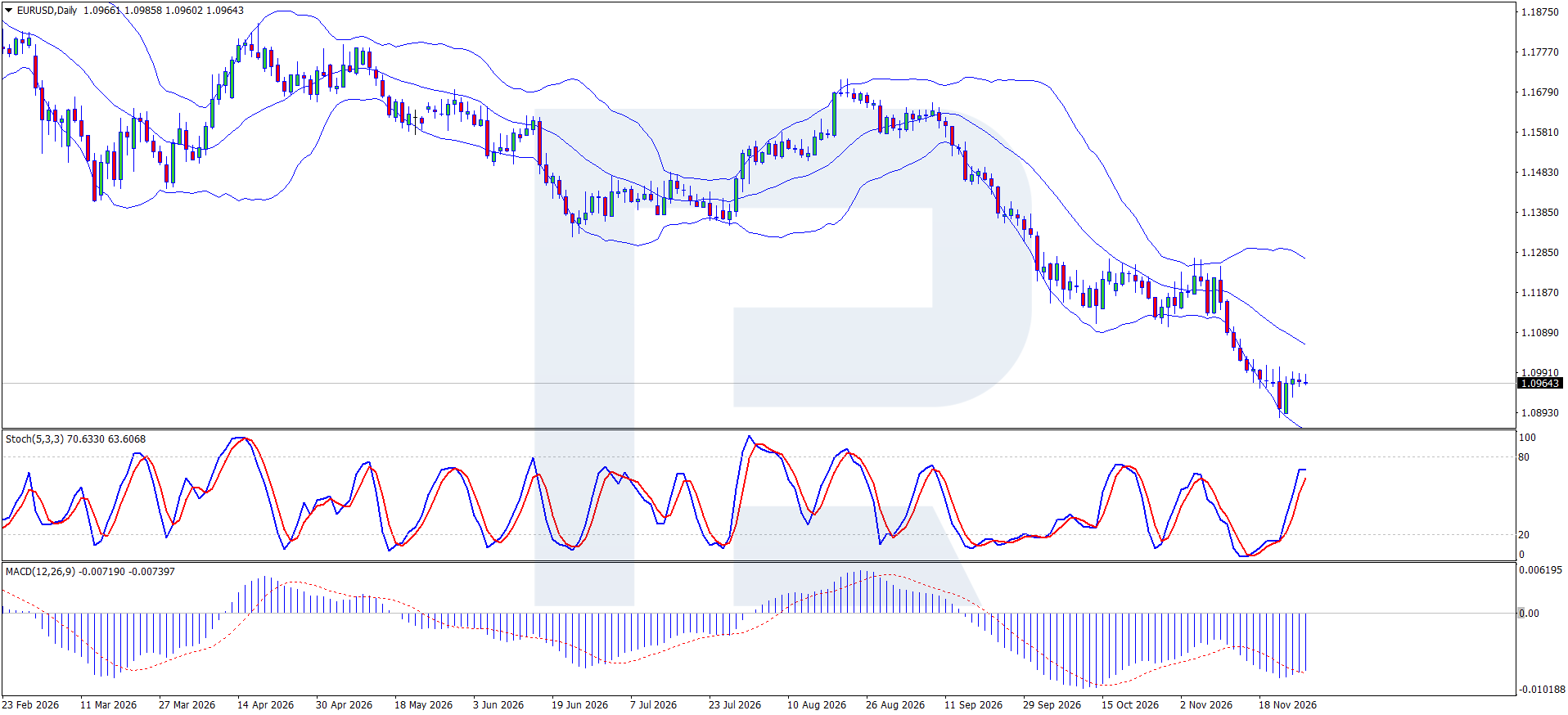
EURUSD trading scenario for next week
The EURUSD pair is undergoing a correction and is trading below the key resistance level at 1.1020 following a prolonged decline.
Buying after a break above this level and subsequent consolidation above it could mark the beginning of a new upward wave.
EURUSD trading scenario
What would change the forecast
- Weak economic data from Germany could weigh on the euro
- Better-than-expected US employment figures could strengthen the USD and trigger a further decline in EURUSD
- More dovish ECB signals regarding a December rate hike could widen the interest rate differential between the US and the eurozone and support the USD
EURUSD forecast next week: questions and answers
Will the euro rise or fall next week?
At this stage, market sentiment temporarily favours buyers. A confirmed break above 1.1020 would allow the EURUSD pair to continue its upward trajectory, but Nonfarm Payrolls data could change the trend.
What are the key EURUSD levels for 30 November to 4 December 2026?
The main support level is located at 1.0950, with the next levels to watch at 1.0900 and 1.0880. The nearest resistance zone is at 1.1060–1.1120, while a stronger barrier stands at 1.1272.
Summary
The EURUSD pair enters the new week attempting to test the 1.1000 level after a prolonged period of dollar strength. The pair may continue to rise ahead of eurozone economic data and the US Nonfarm Payrolls report.
The EURUSD forecast for 30 November–4 December envisages a continued corrective recovery, with the nearest target at 1.1120.
Editors’ picks


EURUSD forecast 2026–2027: technical analysis, price levels & predictions
The EURUSD outlook for 2026 and 2027: key levels on the daily chart, three trading scenarios and the policy gap between the Fed and the ECB that drives the pair.

Gold (XAUUSD) forecast 2026: technical analysis, price levels & predictions
Where gold could trade in 2026: key levels, three trading scenarios with entry triggers and the forecasts from J.P. Morgan, Deutsche Bank and Goldman Sachs.
Forecasts presented in this section only reflect the author’s private opinion and should not be considered as guidance for trading. RoboForex bears no responsibility for trading results based on trading recommendations described in these analytical reviews.