
GBPUSD at a three-month low: pressure is mounting
The GBPUSD pair has dropped to 1.3329, with geopolitical risks and weaker macroeconomic forecasts weighing on the pound. Discover more in our analysis for 4 March 2026.
GBPUSD forecast: key takeaways
- The GBPUSD pair is declining amid external risks and rapid strengthening of the US dollar
- Weak domestic data is also putting pressure on the pound
- GBPUSD forecast for 4 March 2026: 1.3253
Fundamental analysis
The GBPUSD rate fell to its lowest level since 9 December, reaching 1.3329. Pressure on the British currency is intensified by a stronger US dollar, which is in demand as a safe-haven asset amid tensions in the Middle East. Investors are also reacting to revised forecasts for the UK economic growth.
US President Donald Trump stated that the military operation against Iran could last four to five weeks and may be extended if necessary.
An additional factor has been the sharp rise in energy prices following the closure of the Strait of Hormuz and the suspension of LNG exports from Qatar. This could intensify inflationary pressure and potentially push the Bank of England towards a more hawkish monetary stance.
Domestic economic factors are also weighing on the pound. The UK Office for Budget Responsibility (OBR) lowered its 2026 growth forecast to 1.1% from 1.4% expected in November. The estimate does not yet fully account for potential shocks from higher energy prices.
At the same time, forecasts for the longer term were revised upwards, with economic growth in 2027 and 2028 expected at 1.6% annually. The OBR also projects a gradual decline in government borrowing and inflation in the coming years.
The outlook for GBPUSD is negative.
Technical outlook
On the H4 chart, after rising in early February and forming a local high near 1.3690–1.3700, the GBPUSD pair shifted into a steady downtrend. The first reversal signal was the formation of a series of lower highs, followed by a breakout below key support at 1.3595, which intensified selling pressure.
Further decline was accompanied by expanding Bollinger Bands, indicating increased volatility and stronger momentum. The price then broke below 1.3490, which had previously acted as strong support. After this breakout, the fall accelerated, and the pair formed a new low in the 1.3250–1.3270 area.
Currently, the GBPUSD pair is trading around 1.3326, showing a minor technical rebound after the sharp decline. The price remains near the lower Bollinger Band, indicating persistent selling pressure and a heightened risk of further downside after the correction.
The nearest resistance level lies in the 1.3390–1.3400 area, where short-term consolidation previously formed. The next resistance is at 1.3490, which may now act as a strong selling zone after the breakout. The key support level is located at 1.3253. As long as the price holds below 1.3390, the overall H4 structure remains bearish, and the current rise appears to be a corrective move within a broader downtrend.
GBPUSD overview
- Asset: GBPUSD
- Timeframe: H4 (Intraday)
- Trend: downward
- Key resistance levels: 1.3390 and 1.3490
- Key support levels: 1.3270 and 1.3253
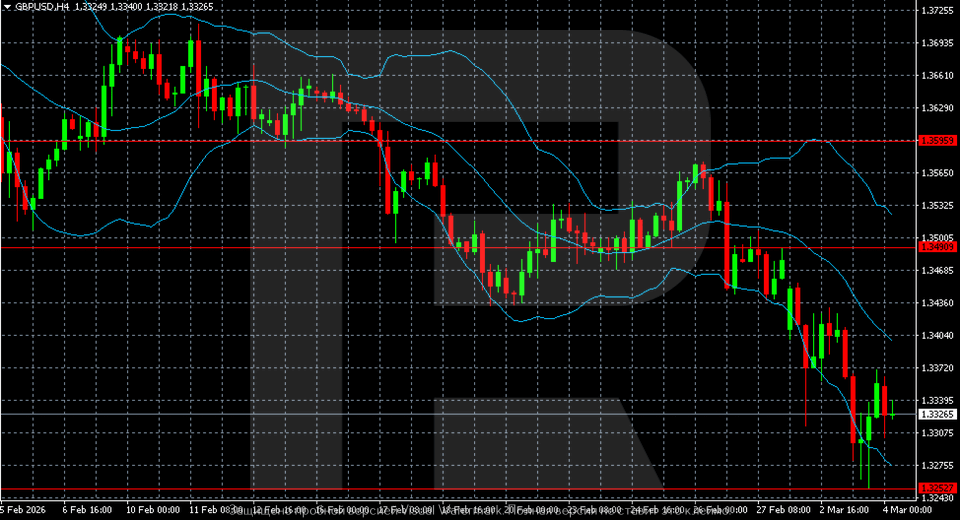
GBPUSD trading scenarios for today
Main scenario (Sell Stop)
A breakout and consolidation below 1.3270 would confirm continued bearish momentum after a series of lower highs and lower lows. In this case, selling pressure may intensify, targeting 1.3253. The potential move is around 15–20 pips with a risk of approximately 10–15 pips. The risk-to-reward ratio is close to 1:2.
- Take Profit: 1.3253
- Stop Loss: 1.3335
Alternative scenario (Buy Stop)
Consolidation above 1.3390 would indicate a deeper correction after the sharp decline and could lead to a test of 1.3490, which previously acted as a strong support level and may now function as resistance.
- Take Profit: 1.3490
- Stop Loss: 1.3345
Risk factors
Risks to the bearish scenario include US dollar weakness amid de-escalation in the Middle East or revised expectations for the Federal Reserve’s rate policy. Additional support for the pound could come from more hawkish signals from the Bank of England or an improved macroeconomic outlook for the UK economy.
Summary
The GBPUSD pair remains under pressure due to a combination of external and domestic factors. The forecast for today, 4 March 2026, does not rule out a further decline towards 1.3253.
Editors’ picks
 EURUSD 2026-2027 forecast: key market trends and future predictions
This article provides the EURUSD forecast for 2026 and 2027 and highlights the main factors determining the direction of the pair’s movements. We will apply technical analysis, take into account the opinions of leading experts, large banks, and financial institutions, and study AI-based forecasts. This comprehensive insight into EURUSD predictions should help investors and traders make informed decisions.
 Gold (XAUUSD) forecast 2026 and beyond: expert insights, price predictions, and analysis
Dive deep into the Gold (XAUUSD) price outlook for 2026 and beyond, combining technical analysis, expert forecasts, and key macroeconomic factors. It explains the drivers behind gold’s recent surge, explores potential scenarios including a move toward 4,500 to 5,000 USD per ounce, and highlights why the metal remains a strong hedge during global uncertainty.
Forecasts presented in this section only reflect the author’s private opinion and should not be considered as guidance for trading. RoboForex bears no responsibility for trading results based on trading recommendations described in these analytical reviews.