
GBPUSD is trying to rise, but there is a catch in the form of energy and prices
The GBPUSD pair rose to 1.3244. March turned out to be a weak month for the pound sterling. More details are in our analysis for 1 April 2026.
GBPUSD forecast: key takeaways
- The GBPUSD pair is strengthening, although the growth looks limited
- For the rise to continue, the pair needs to consolidate above 1.3350
- GBPUSD forecast for 1 April 2026: 1.3200 or 1.3300
Fundamental analysis
The GBPUSD rate is edging higher to 1.3244 on Wednesday. By the end of March, the pair posted its biggest decline in the past five months against the backdrop of the conflict around Iran.
Intraday moves remain restrained.
Rising energy prices are strengthening inflation risks and changing expectations for monetary policy. The market has shifted from expecting two Bank of England rate cuts to forecasting at least two hikes. This led to a sharp rise in UK short-term bond yields — almost 94 basis points over the month. This marked the biggest jump since the end of 2022 and supported the pound.
Nevertheless, the resilience of the British currency raises questions. The energy shock is pressuring economic growth and fiscal sustainability. As the market takes these factors into account, it may revise the current revaluation of the pound.
The GBPUSD forecast remains mixed.
Technical outlook
The H4 chart for GBPUSD shows that after attempts to rise in the first half of March, the market formed a local top near 1.3480–1.3500, from which a steady decline began. The price moved into a pattern of lower highs and lower lows. This points to a structural shift towards downward movement.
The downward impulse strengthened at the end of March: quotes broke below the middle Bollinger Band and consolidated in the lower part of the range. The decline brought the pair into the support zone around 1.3160, from which a technical rebound began. However, the growth remains limited and still looks corrective.
In the latest sessions, the price has stabilised in the 1.3200–1.3300 range, remaining below key resistance levels. Indicators confirm weakness: MACD remains in negative territory, while the stochastic is attempting to recover from oversold conditions. Until the pair consolidates above 1.3330–1.3350, the priority remains with the scenario of a moderate decline.
GBPUSD overview
- Asset: GBPUSD
- Timeframe: H4 (Intraday)
- Trend: sideways with a downward bias
- Key resistance levels: 1.3330 and 1.3350
- Key support levels: 1.3200 and 1.3160
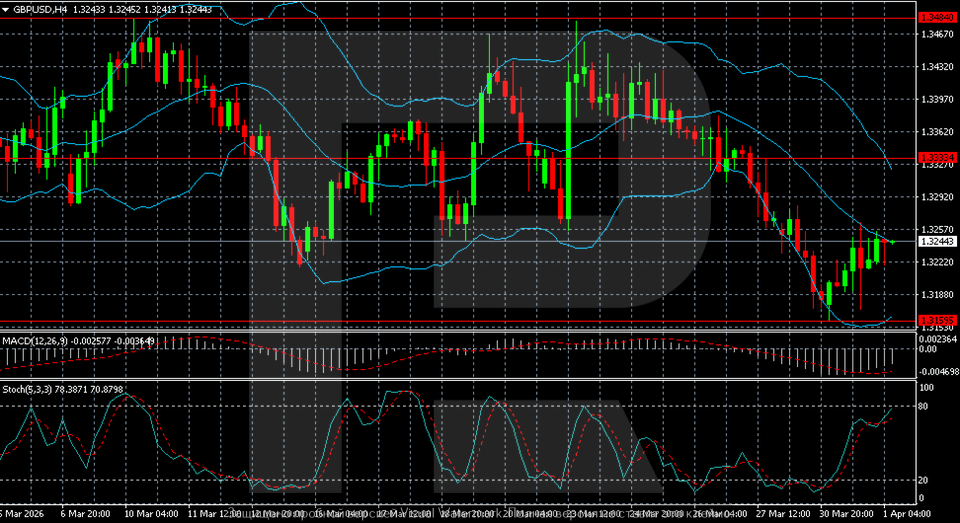
GBPUSD trading scenarios for today
Main scenario (Buy Stop)
Consolidation above 1.3350 will confirm an exit from the corrective phase and create conditions for the development of a recovery. In this case, the pair will be able to continue rising against the backdrop of weaker pressure from sellers.
- Take Profit: 1.3400
- Stop Loss: 1.3280
Alternative scenario (Sell Stop)
A breakout of support at 1.3200 will strengthen downward pressure and indicate the continuation of the decline after the corrective rebound.
- Take Profit: 1.3160
- Stop Loss: 1.3250
Risk factors
The risks to growth are linked to the persistence of geopolitical tension and support for the dollar as a safe-haven asset. Additional pressure may emerge if the pair fails to consolidate above 1.3330–1.3350, as this will strengthen the decline scenario.
Summary
The GBPUSD pair is attempting to rise, but its upside potential still looks limited. The GBPUSD forecast for today, 1 April 2026, suggests consolidation in the 1.3300–1.3400 range.
Editors’ picks
 EURUSD 2026-2027 forecast: key market trends and future predictions
This article provides the EURUSD forecast for 2026 and 2027 and highlights the main factors determining the direction of the pair’s movements. We will apply technical analysis, take into account the opinions of leading experts, large banks, and financial institutions, and study AI-based forecasts. This comprehensive insight into EURUSD predictions should help investors and traders make informed decisions.
 Gold (XAUUSD) forecast 2026 and beyond: expert insights, price predictions, and analysis
Dive deep into the Gold (XAUUSD) price outlook for 2026 and beyond, combining technical analysis, expert forecasts, and key macroeconomic factors. It explains the drivers behind gold’s recent surge, explores potential scenarios including a move toward 4,500 to 5,000 USD per ounce, and highlights why the metal remains a strong hedge during global uncertainty.
Forecasts presented in this section only reflect the author’s private opinion and should not be considered as guidance for trading. RoboForex bears no responsibility for trading results based on trading recommendations described in these analytical reviews.