
GBPUSD needs a driver: the correction is over, but no new ideas have appeared
The GBPUSD pair is holding at 1.3535, with political scandals and the oil situation setting the terms. Find out more in our analysis for 13 May 2026.
GBPUSD forecast: key takeaways
- The GBPUSD pair remains in a broad range, while politics is preventing the market from choosing a direction
- The market does not rule out three rate hikes by the end of the year
- GBPUSD forecast for 13 May 2026: 1.3500 or 1.3580
Fundamental analysis
The GBPUSD rate stood at 1.3535 midweek. This week, the pound pulled back from almost two-month highs as political uncertainty in the UK and the lack of progress in negotiations between the US and Iran are putting pressure on GBP.
UK Prime Minister Keir Starmer stated that he does not intend to resign. This comes despite demands from more than 70 Labour Party MPs to step down following the party’s poor performance in the local elections.
Investors fear that a possible change in leadership may lead to higher budget spending in an attempt to win back voter support. At the same time, Starmer says that the formal leadership challenge procedure has not yet been launched.
Higher oil prices are adding to pressure on sentiment. Brent rose above 104 USD per barrel. Earlier, US President Donald Trump stated that the ceasefire agreement with Iran is on the verge of collapse following Tehran’s latest response to the US peace proposal.
As a result, the market is pricing in stronger expectations of further tightening by the Bank of England, with investors now expecting three additional rate hikes by the end of the year.
The GBPUSD forecast is mixed.
Technical outlook
On the H4 chart, the GBPUSD pair remains in a sideways consolidation phase following its rally in early May. Quotes tested the 1.3645–1.3655 resistance area several times, but buyers have so far failed to gain a foothold above these levels. Against this backdrop, the market has moved into a narrower range with higher intraday volatility.
In recent sessions, the pound underwent a correction towards the 1.3535–1.3500 area, where buyer demand appeared again. The pair is now trading around 1.3535, hovering near the middle Bollinger Band. The fluctuation range is gradually narrowing, which may indicate that the market is preparing for a stronger move after the consolidation period.
The technical picture looks neutral. MACD remains near the zero mark, reflecting a lack of clear momentum, while the Stochastic Oscillator is turning upwards after falling towards oversold territory. The nearest resistance levels are located at 1.3580 and 1.3655, while support lies near 1.3500 and 1.3445. If the price consolidates above 1.3580, buyers may retest the May highs.
GBPUSD overview
- Asset: GBPUSD
- Timeframe: H4 (Intraday)
- Trend: sideways (consolidation after growth)
- Key resistance levels: 1.3580 and 1.3655
- Key support levels: 1.3500 and 1.3445
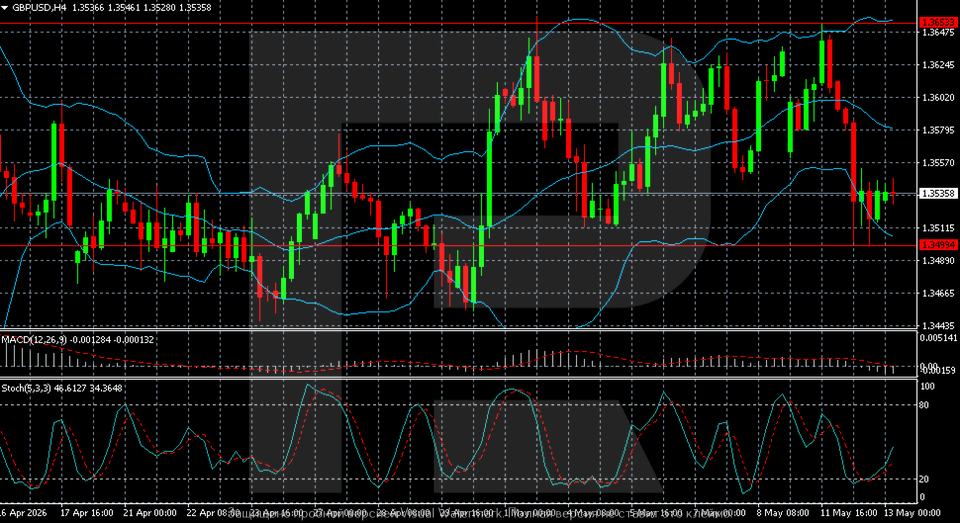
GBPUSD trading scenarios for today
Main scenario (Buy Stop)
Consolidation above 1.3580 would confirm an attempt to break out of the range upwards amid expectations of further tightening by the Bank of England and continued demand for the pound. In this case, the pair may continue to move towards 1.3655.
- Take Profit: 1.3655
- Stop Loss: 1.3535
Alternative scenario (Sell Stop)
A breakout below 1.3500 would increase pressure on the pound amid political uncertainty in the UK and stronger demand for the dollar as a safe-haven asset. In this case, the decline may continue towards 1.3445.
- Take Profit: 1.3445
- Stop Loss: 1.3555
Risk factors
The GBPUSD pair remains in a consolidation phase after the rise in early May. Political risks in the UK and geopolitical tensions around Iran are putting pressure on the market. High oil prices and expectations that the Federal Reserve will maintain a hawkish policy are providing additional support for the dollar, limiting the pound’s potential for further gains.
Summary
The GBPUSD pair has pulled back from the two-month high and looks uncertain. The GBPUSD forecast for today, 13 May 2026, suggests continued sideways movement in the 1.3500-1.3580 range.
Editors’ picks
 EURUSD 2026-2027 forecast: key market trends and future predictions
This article provides the EURUSD forecast for 2026 and 2027 and highlights the main factors determining the direction of the pair’s movements. We will apply technical analysis, take into account the opinions of leading experts, large banks, and financial institutions, and study AI-based forecasts. This comprehensive insight into EURUSD predictions should help investors and traders make informed decisions.
 Gold (XAUUSD) forecast 2026 and beyond: expert insights, price predictions, and analysis
Dive deep into the Gold (XAUUSD) price outlook for 2026 and beyond, combining technical analysis, expert forecasts, and key macroeconomic factors. It explains the drivers behind gold’s recent surge, explores potential scenarios including a move toward 4,500 to 5,000 USD per ounce, and highlights why the metal remains a strong hedge during global uncertainty.
Forecasts presented in this section only reflect the author’s private opinion and should not be considered as guidance for trading. RoboForex bears no responsibility for trading results based on trading recommendations described in these analytical reviews.