
USDCAD is set to move higher: the US dollar is the clear favourite
The USDCAD pair rose to 1.3890, with developments in the Middle East and risk aversion weighing on the Canadian dollar. Find more details in our analysis for 30 March 2026.
USDCAD forecast: key takeaways
- The USDCAD pair continues to rise, supported by external factors
- The rally in oil is partly offsetting the Canadian dollar’s losses
- USDCAD forecast for 30 March 2026: 1.3900 or 1.3925
Fundamental analysis
The USDCAD rate rose to 1.3890 on Monday. Earlier, the Canadian dollar hit a two-month low against the US dollar. Pressure on the currency persists amid expectations of signals of de-escalation in the Middle East conflict. This is driving demand for the US dollar as a safe-haven asset.
Over the past week, the Canadian currency lost around 1.1%, marking the third consecutive week of losses. The main factor remains the external environment, with investors preferring the US dollar amid geopolitical uncertainty.
At the same time, oil prices rose by about 4% and touched 107 USD per barrel, partly holding back the depreciation of the CAD as a commodity-based currency.
Canadian government bond yields showed mixed performance, while the curve became steeper. The yield on 10-year bonds rose to 3.59%, very close to the highs of the past two years.
The USDCAD forecast is positive.
Technical outlook
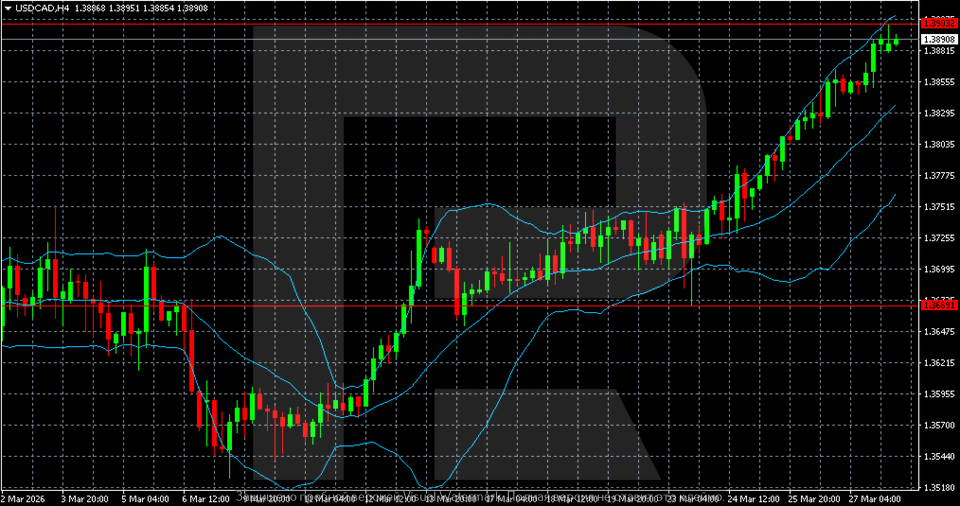
The USDCAD H4 chart shows a stable uptrend, which formed after a reversal from the area around 1.3550 in early March. The price is consistently forming higher highs and higher lows, indicating buyer dominance. The movement is developing mainly in the upper part of Bollinger Bands, confirming strong momentum.
In the middle of the period, there was a consolidation phase in the approximate 1.3650–1.3750 range, where the market gained liquidity before continuing its rise. After breaking out of the range, momentum strengthened, with quotes confidently breaking above intermediate resistance levels and accelerating towards 1.3850–1.3900. The expansion of Bollinger Bands reflects higher volatility amid a stronger trend.
At the moment, the price is testing the resistance zone around 1.3900. Consolidation above this level will open the potential for continued growth. Conversely, a return below 1.3750–1.3700 may signal a transition to a deeper correction. However, for now, the structure remains confidently bullish.
USDCAD overview
- Asset: USDCAD
- Timeframe: H4 (Intraday)
- Trend: upward
- Key resistance levels: 1.3900 and 1.3925
- Key support levels: 1.3750 and 1.3700
USDCAD trading scenarios for today
Main scenario (Buy Stop)
Consolidation above 1.3900 would confirm continued upward momentum and open the way to 1.3925. The risk-to-reward ratio is about 1:3 while external pressure on the CAD persists.
- Take Profit: 1.3925
- Stop Loss: 1.3850
Alternative scenario (Sell Stop)
A breakout below the 1.3750 support level would indicate weaker momentum and a transition to a correction with downside potential towards 1.3700.
- Take Profit: 1.3700
- Stop Loss: 1.3800
Risk factors
Geopolitics and oil prices remain the key influencing factors. Rising energy prices are partly supporting the CAD, but demand for the dollar as a safe-haven asset and expectations of hawkish Fed policy continue to favour further USDCAD growth.
Summary
The USDCAD pair continues to rise amid external market conditions. The USDCAD forecast for today, 30 March 2026, suggests consolidation above 1.3900, followed by movement towards 1.3925.
Editors’ picks
 EURUSD 2026-2027 forecast: key market trends and future predictions
This article provides the EURUSD forecast for 2026 and 2027 and highlights the main factors determining the direction of the pair’s movements. We will apply technical analysis, take into account the opinions of leading experts, large banks, and financial institutions, and study AI-based forecasts. This comprehensive insight into EURUSD predictions should help investors and traders make informed decisions.
 Gold (XAUUSD) forecast 2026 and beyond: expert insights, price predictions, and analysis
Dive deep into the Gold (XAUUSD) price outlook for 2026 and beyond, combining technical analysis, expert forecasts, and key macroeconomic factors. It explains the drivers behind gold’s recent surge, explores potential scenarios including a move toward 4,500 to 5,000 USD per ounce, and highlights why the metal remains a strong hedge during global uncertainty.
Forecasts presented in this section only reflect the author’s private opinion and should not be considered as guidance for trading. RoboForex bears no responsibility for trading results based on trading recommendations described in these analytical reviews.