
USDJPY maintains bullish bias despite correction
The USDJPY pair is undergoing a correction after a sharp rally, holding above 155.25 amid pressure on the yen and expectations that the Federal Reserve will maintain a hawkish stance. The rate currently stands at 155.72. Find out more in our analysis for 25 February 2026.
USDJPY forecast: key takeaways
- The market has reduced expectations of imminent policy tightening by the Bank of Japan
- The US dollar is bolstered by expectations that the Fed will keep rates unchanged
- Market participants consider steady rates justified due to labour market resilience and persistent inflation risks in the US
- USDJPY forecast for 25 February 2026: 157.45
Fundamental analysis
The USDJPY rate is correcting downwards after a sharp rally in the previous session, but buyers continue to firmly defend the 155.25 support level, holding back a deeper downward correction.
The Japanese yen remains under pressure following statements by Prime Minister Sanae Takaichi, who expressed concerns about further interest rate hikes. These comments reduced market confidence in imminent tightening by the BoJ and cast doubt on an active phase of policy normalisation in the near term.
At the same time, the US dollar is supported by growing expectations that the Federal Reserve will keep interest rates unchanged for an extended period. Market participants view this stance as justified amid improvements in the labour market and persistent inflation risks.
Technical outlook
The USDJPY pair is advancing after rebounding from the EMA-65, signalling sustained buying pressure and increasing the probability of continued upward momentum.
Today’s USDJPY forecast suggests a renewed rally towards 157.45. The technical structure remains favourable for bulls, with the Stochastic Oscillator confirming this scenario. The indicator has exited overbought territory and formed a bullish crossover, reinforcing the signal for further growth. A breakout above the upper boundary of the corrective channel with consolidation above 155.95 would further confirm the main scenario. In this case, the market will receive an additional technical signal supporting further upward movement.
An alternative scenario will materialise if the price breaks below the lower boundary of the ascending channel and consolidates below 155.15. Such a move would indicate weakening bullish positions and create conditions for a downward correction.
USDJPY overview
- Asset: USDJPY
- Timeframe: M30 (Intraday)
- Trend: bullish
- Key resistance levels: 156.25 and 157.45
- Key support levels: 155.25 and 154.15
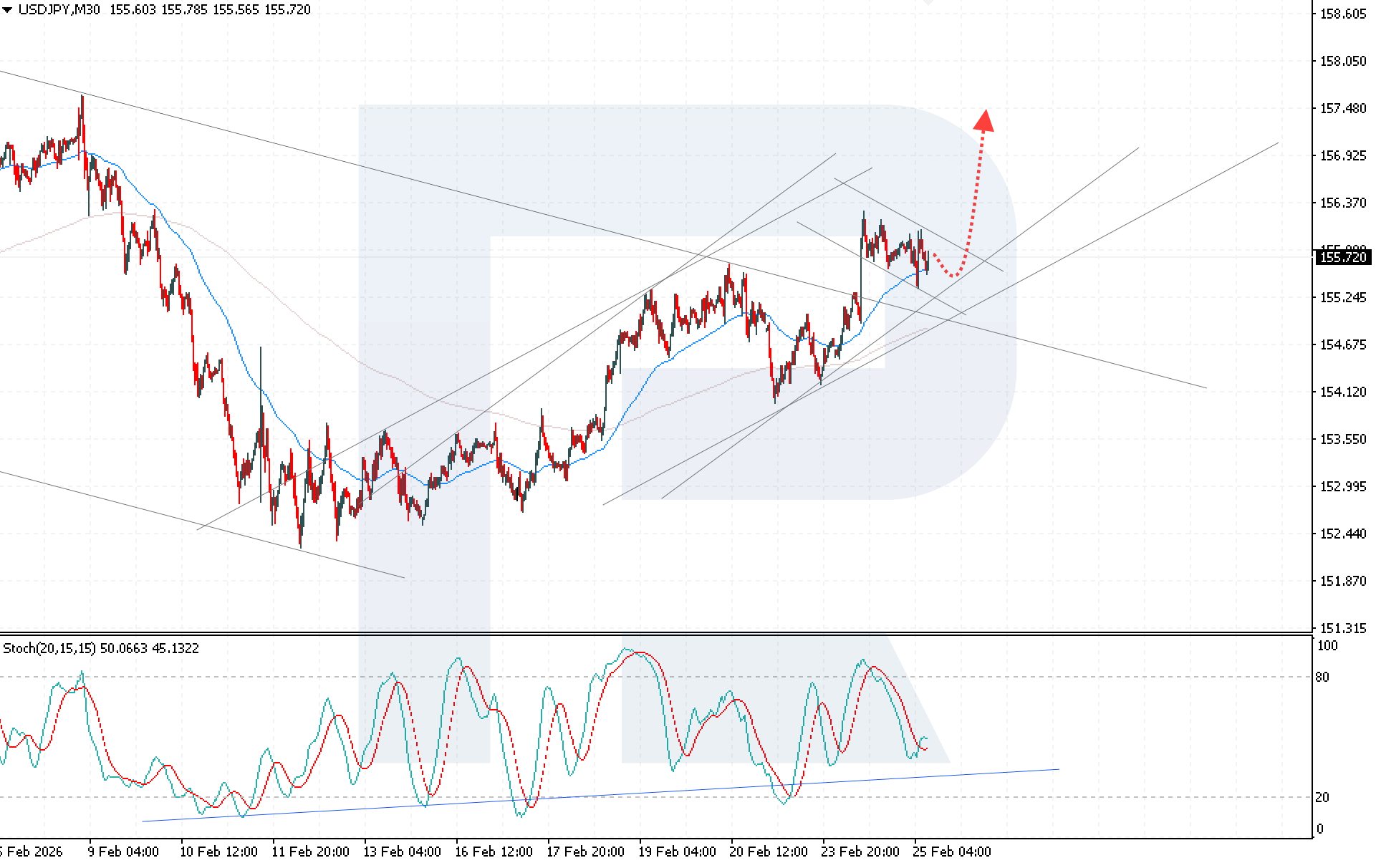
USDJPY trading scenarios for today
Main scenario (Buy Stop)
A breakout above 155.95 would signal consolidation above the upper boundary of the corrective channel and may create conditions for opening long positions. The risk-to-reward ratio stands at 1:3. The potential upside is about 150 pips with a risk of around 50 pips.
- Take Profit: 157.45
- Stop Loss: 155.15
Alternative scenario (Sell Stop)
The bearish scenario will be activated if the price breaks below the lower boundary of the bullish channel and consolidates below 155.15, opening the way for a continued downward correction in the pair.
- Take Profit: 154.15
- Stop Loss: 155.45
Risk factors
A key risk to further USDJPY growth is renewed demand for the yen in the event of revised rate expectations and reduced doubts regarding BoJ tightening. Additional pressure on the pair could come from declining expectations of prolonged high Federal Reserve rates, which would trigger a correction in the US dollar.
Summary
Technical analysis of USDJPY indicates continued upward momentum with a target at 157.45 if the price breaks above 155.95.
Editors’ picks
 EURUSD 2026-2027 forecast: key market trends and future predictions
This article provides the EURUSD forecast for 2026 and 2027 and highlights the main factors determining the direction of the pair’s movements. We will apply technical analysis, take into account the opinions of leading experts, large banks, and financial institutions, and study AI-based forecasts. This comprehensive insight into EURUSD predictions should help investors and traders make informed decisions.
 Gold (XAUUSD) forecast 2026 and beyond: expert insights, price predictions, and analysis
Dive deep into the Gold (XAUUSD) price outlook for 2026 and beyond, combining technical analysis, expert forecasts, and key macroeconomic factors. It explains the drivers behind gold’s recent surge, explores potential scenarios including a move toward 4,500 to 5,000 USD per ounce, and highlights why the metal remains a strong hedge during global uncertainty.
Forecasts presented in this section only reflect the author’s private opinion and should not be considered as guidance for trading. RoboForex bears no responsibility for trading results based on trading recommendations described in these analytical reviews.