
USDJPY in doubt: what will the BoJ ultimately decide
The USDJPY pair has declined to 155.79, with the Bank of Japan still providing no clear signals regarding its rate path. Discover more in our analysis for 27 February 2026.
USDJPY forecast: key takeaways
- The USDJPY pair is edging lower, but overall, the yen is set to end the week with losses
- Disagreements over the appropriate rate level persist within the BoJ and the government
- USDJPY forecast for 27 February 2026: 155.30 or 157.60
Fundamental analysis
The USDJPY rate is retreating to 155.79 on Friday. Although the yen is strengthening intraday, the Japanese currency remains under pressure on a weekly basis and risks posting a second consecutive weekly decline. This is largely due to uncertainty surrounding the Bank of Japan’s policy outlook.
The government has nominated two academic representatives to the central bank’s board, both known for favouring a dovish approach. During a meeting with BoJ Governor Kazuo Ueda, Prime Minister Sanae Takaichi expressed concern about possible further rate hikes.
At the same time, board member Hajime Takata, who supports a more hawkish stance, stated that further tightening may be necessary and noted that the inflation target is close to being achieved.
Governor Ueda emphasised that decisions will be made based on incoming data at the March and April meetings, leaving room for a possible rate increase.
Additional pressure comes from recent data. Tokyo inflation slowed to its lowest level in more than a year thanks to utility subsidies, fuelling expectations that the BoJ will not rush to tighten policy.
The USDJPY outlook is moderate.
Technical outlook
On the H4 chart, the USDJPY pair formed a bottom around 152.30–152.50 after a sharp decline in early February. From this zone, the pair began to recover, developing into a steady upward momentum.
The price confidently broke above 153.90 and then 155.30, accelerating towards highs near 156.80–157.00. The rally was accompanied by widening Bollinger Bands, signalling increased volatility and strong momentum.
In recent sessions, however, the momentum has weakened. Quotes pulled back from local highs and are now trading around 155.70–156.00. Bollinger Bands are beginning to narrow, indicating a transition into a consolidation phase.
The nearest support level lies around 155.30, followed by 153.90, with resistance located near 157.60–157.70. The overall structure remains upward after the rebound from 152.30, but in the short term, the pair has shifted into sideways movement with moderate downward pressure.
USDJPY overview
- Asset: USDJPY
- Timeframe: H4 (Intraday)
- Trend: bullish (shifting to consolidation)
- Key resistance levels: 157.60 and 158.70
- Key support levels: 155.30 and 153.90
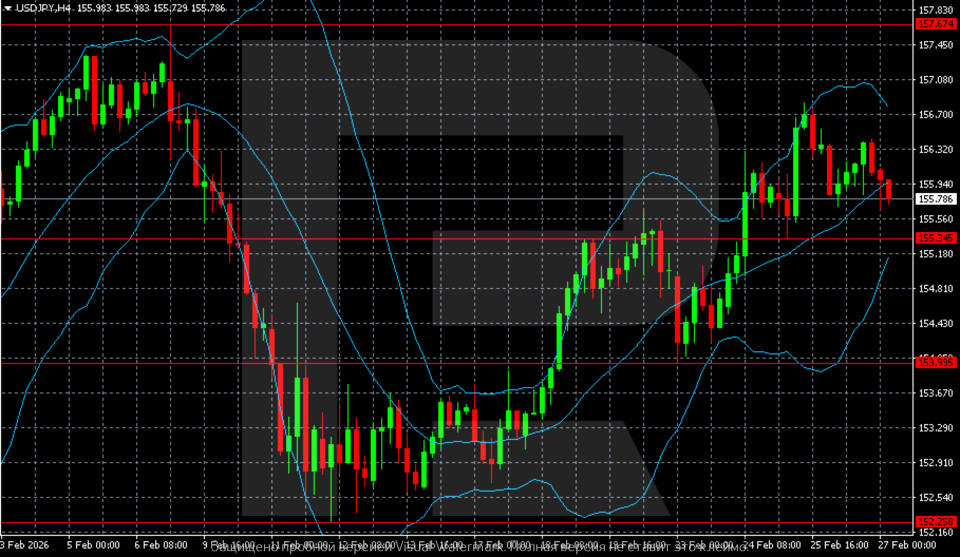
USDJPY trading scenarios for today
Main scenario (Buy Stop)
A breakout and consolidation above 157.60 would confirm renewed upward momentum after a consolidation phase. The potential move towards 158.70 is about 110 pips with a risk of approximately 35 pips. The risk-to-reward ratio exceeds 1:3.
- Take Profit: 158.70
- Stop Loss: 157.25
Alternative scenario (Sell Stop)
Consolidation below 155.30 would intensify corrective pressure and open the way towards 153.90. The potential decline is around 140 pips with a risk of about 40 pips.
- Take Profit: 153.90
- Stop Loss: 155.70
Risk factors
A key risk to the bullish scenario is stronger expectations of BoJ tightening or renewed demand for safe-haven assets. Additional pressure may arise if the Federal Reserve adopts a softer tone and the US dollar weakens.
Summary
The USDJPY pair presents a mixed picture amid conflicting signals. The forecast for today, 27 February 2026, does not rule out sideways movement within the 155.30–157.60 range.
Editors’ picks
 EURUSD 2026-2027 forecast: key market trends and future predictions
This article provides the EURUSD forecast for 2026 and 2027 and highlights the main factors determining the direction of the pair’s movements. We will apply technical analysis, take into account the opinions of leading experts, large banks, and financial institutions, and study AI-based forecasts. This comprehensive insight into EURUSD predictions should help investors and traders make informed decisions.
 Gold (XAUUSD) forecast 2026 and beyond: expert insights, price predictions, and analysis
Dive deep into the Gold (XAUUSD) price outlook for 2026 and beyond, combining technical analysis, expert forecasts, and key macroeconomic factors. It explains the drivers behind gold’s recent surge, explores potential scenarios including a move toward 4,500 to 5,000 USD per ounce, and highlights why the metal remains a strong hedge during global uncertainty.
Forecasts presented in this section only reflect the author’s private opinion and should not be considered as guidance for trading. RoboForex bears no responsibility for trading results based on trading recommendations described in these analytical reviews.