
Tension in USDJPY has eased: what comes next
The USDJPY pair has retreated to 159.62. Peak stress has passed, but external factors continue to put pressure on the yen. Find out more in our analysis for 31 March 2026.
USDJPY forecast: key takeaways
- The USDJPY pair has stopped rising rapidly, but there are still grounds for further growth
- The main forecast suggests consolidation below a resistance level
- USDJPY forecast for 31 March 2026: 159.45 or 160.00
Fundamental analysis
The USDJPY rate has pulled back from its peaks and is hovering near 159.62. The yen is supported by intervention rhetoric and market expectations of possible real intervention.
On Monday, currency official Atsushi Mimura stated that the government is ready for decisive action if necessary, supporting the position previously voiced by Finance Minister Satsuki Katayama. These statements came after the yen had fallen to the key 160 level, the mark at which the authorities had already intervened in the market in 2024.
Pressure on the currency remains due to rising oil prices amid the conflict in the Middle East. This is especially sensitive for Japan as an importer of energy resources.
Despite the current stabilisation, the yen may lose more than 2% over the month. The US dollar remains the main safe-haven asset amid the current crisis.
The USDJPY forecast remains moderate.
Technical outlook
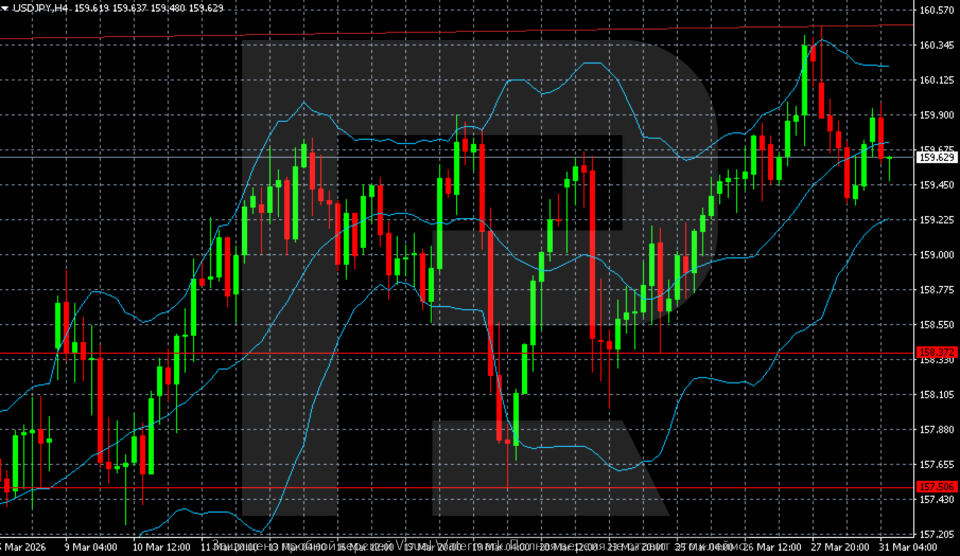
The USDJPY H4 chart shows that the overall upward bias formed since early March remains in place. The price is moving in the upper part of the range and is periodically testing the resistance zone near 160.00–160.50. Recent highs are being updated, but the pair still cannot consolidate above the key level, indicating strong supply.
The middle of the period saw increased volatility, with sharp downward impulses and rapid buybacks. This reflects a struggle between buyers and sellers near a key level. Support is forming in the 157.50–158.30 zone, where active reversals and rebounds occurred earlier.
Current dynamics are characterised by consolidation below resistance. The price is holding above the middle Bollinger Band, indicating continued moderate upward momentum. However, the failure to consolidate above 160.00 increases the likelihood of continued sideways movement or a local correction if selling pressure intensifies.
USDJPY overview
- Asset: USDJPY
- Timeframe: H4 (Intraday)
- Trend: upward
- Key resistance levels: 160.00 and 160.50
- Key support levels: 159.00 and 158.30
USDJPY trading scenarios for today
Main scenario (Buy Stop)
Consolidation above 160.00 would confirm a breakout above a key resistance level and ongoing upward momentum. This would open the way for movement towards 160.50–161.00 amid steady demand for the dollar.
- Take Profit: 161.00
- Stop Loss: 159.70
Alternative scenario (Sell Stop)
A breakout below the 159.00 support level would strengthen selling pressure and indicate a correction with a target in the 158.30–157.50 area.
- Take Profit: 157.50
- Stop Loss: 159.30
Risk factors
The risks to growth are linked to possible intervention by the Japanese authorities as the pair approaches the 160.00 level, as well as to stronger intervention rhetoric. An additional factor could be a decline in oil prices or easing geopolitical tensions, which would support the yen.
Summary
The USDJPY pair has stopped rising and has retreated. The USDJPY forecast for today, 31 March 2026, does not rule out continued consolidation within the 159.45–160.00 range.
Editors’ picks
 EURUSD 2026-2027 forecast: key market trends and future predictions
This article provides the EURUSD forecast for 2026 and 2027 and highlights the main factors determining the direction of the pair’s movements. We will apply technical analysis, take into account the opinions of leading experts, large banks, and financial institutions, and study AI-based forecasts. This comprehensive insight into EURUSD predictions should help investors and traders make informed decisions.
 Gold (XAUUSD) forecast 2026 and beyond: expert insights, price predictions, and analysis
Dive deep into the Gold (XAUUSD) price outlook for 2026 and beyond, combining technical analysis, expert forecasts, and key macroeconomic factors. It explains the drivers behind gold’s recent surge, explores potential scenarios including a move toward 4,500 to 5,000 USD per ounce, and highlights why the metal remains a strong hedge during global uncertainty.
Forecasts presented in this section only reflect the author’s private opinion and should not be considered as guidance for trading. RoboForex bears no responsibility for trading results based on trading recommendations described in these analytical reviews.