
USDJPY has pulled back from its high: the instrument is moving into a sideways range
The USDJPY pair declined to 158.92. The market is reacting to lower geopolitical tension in the world. More details are in our analysis for 1 April 2026.
USDJPY forecast: key takeaways
- The USDJPY pair declined locally, but the upward trend remains in force for now
- Japan’s domestic data looks resilient, with growth in industrial production and sentiment in the sector
- USDJPY forecast for 1 April 2026: 158.50 or 160.00
Fundamental analysis
The USDJPY rate fell to 158.92 on Wednesday in response to rising optimism around a possible de-escalation of the conflict in the Middle East. Sentiment received support from Donald Trump’s statements that the US military operation in Iran may end “in the near future”. The reference point is two to three weeks.
Signals of lower tension also came from Iran. President Masoud Pezeshkian allowed for the possibility of ending the conflict if guarantees are provided that hostilities will not resume.
Japan’s domestic data remains resilient. The index of business sentiment among large manufacturers rose to 17, the highest level since the end of 2021. The March industrial PMI was revised upwards to 51.6 points. At the same time, the indicator is slightly below February’s readings, but overall it points to continued business activity.
The USDJPY forecast remains neutral.
Technical outlook
The H4 chart for USDJPY shows that the upward trend formed since the beginning of March remains in place: the price has consistently updated highs and held in the upper part of the range. The growth led to a test of the 160.00–160.30 zone, where pressure from sellers intensified — this is visible in the sharp pullback after local highs were updated.
After that, the market moved into a phase of higher volatility. Sharp downward impulses followed by quick buying are visible, which points to a struggle between the sides near key levels. Support formed in the 158.40–158.50 area, where the decline stopped several times and rebounds began.
In the latest sessions, the price has been consolidating in the approximate 158.50–160.00 range. The Bollinger Bands have narrowed partly, which reflects the transition to sideways movement after the impulse. While quotes remain below 160.00, the market looks neutral with a risk of correction. Holding above 158.40 preserves the underlying upward bias.
USDJPY overview
- Asset: USDJPY
- Timeframe: H4 (Intraday)
- Trend: upward (with a consolidation phase)
- Key resistance levels: 160.00 and 160.30
- Key support levels: 158.50 and 158.30
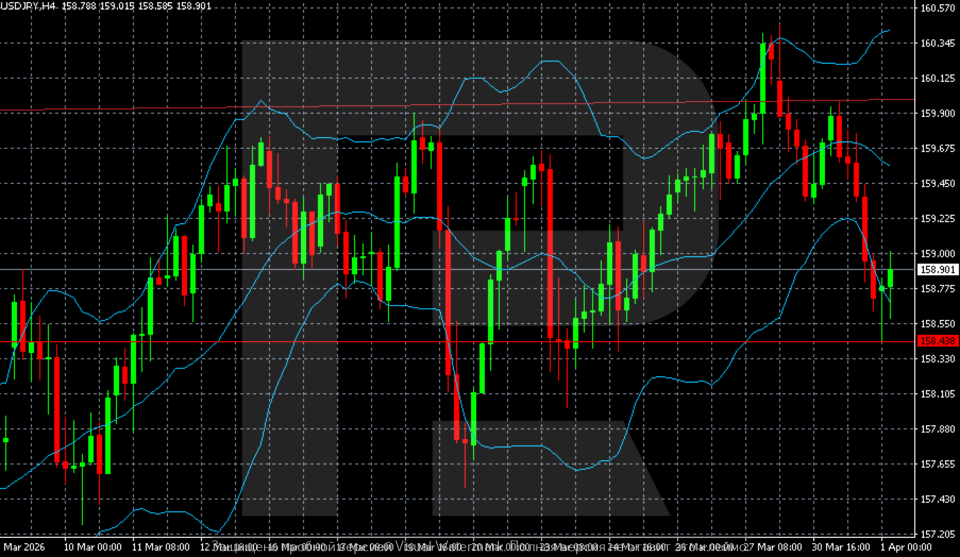
USDJPY trading scenarios for today
Main scenario (Buy Stop)
Consolidation above 160.00 will confirm an exit from the range and the resumption of the upward impulse after consolidation. This will open the way for movement towards 160.30–161.00 if pressure on the yen persists.
- Take Profit: 161.00
- Stop Loss: 159.60
Alternative scenario (Sell Stop)
A breakout of support at 158.50 will strengthen pressure from sellers and indicate the development of a correction within the upward trend, with targets in the 158.30–157.50 area.
- Take Profit: 157.50
- Stop Loss: 159.20
Risk factors
The risks to growth are linked to the de-escalation of the conflict in the Middle East, as this supports the yen as a safe-haven asset. An additional factor may be stronger rhetoric from the Japanese authorities about possible intervention as the pair approaches the 160.00 level.
Summary
The USDJPY pair declined and then paused, while lower external tension is now in focus. The USDJPY forecast for today, 1 April 2026, suggests continued sideways movement within the 158.50–160.00 range.
Editors’ picks
 EURUSD 2026-2027 forecast: key market trends and future predictions
This article provides the EURUSD forecast for 2026 and 2027 and highlights the main factors determining the direction of the pair’s movements. We will apply technical analysis, take into account the opinions of leading experts, large banks, and financial institutions, and study AI-based forecasts. This comprehensive insight into EURUSD predictions should help investors and traders make informed decisions.
 Gold (XAUUSD) forecast 2026 and beyond: expert insights, price predictions, and analysis
Dive deep into the Gold (XAUUSD) price outlook for 2026 and beyond, combining technical analysis, expert forecasts, and key macroeconomic factors. It explains the drivers behind gold’s recent surge, explores potential scenarios including a move toward 4,500 to 5,000 USD per ounce, and highlights why the metal remains a strong hedge during global uncertainty.
Forecasts presented in this section only reflect the author’s private opinion and should not be considered as guidance for trading. RoboForex bears no responsibility for trading results based on trading recommendations described in these analytical reviews.