
USDJPY is entering a range: the market needs news
The USDJPY pair declined to 159.56 at the start of the week, but this is temporary. The Middle East conflict is still influencing market decisions. Discover more in our analysis for 6 April 2026.
USDJPY forecast: key takeaways
- The USDJPY pair is moving into a range amid continued geopolitical pressure
- The market expects the Bank of Japan to raise interest rates soon
- USDJPY forecast for 6 April 2026: 158.50 or 160.00
Fundamental analysis
The USDJPY rate is declining to 159.56 on Monday. Despite the correction, the yen remains near its weakest levels since July 2024, with pressure on the Japanese currency increasing amid the escalating conflict around Iran and rising energy prices.
US President Donald Trump stated that strikes on Iran’s energy and civilian infrastructure may begin within the next few days if the Strait of Hormuz is not reopened. Tehran rejected these demands, and the water route remains effectively blocked.
Against this backdrop, the market is pricing in a more than 70% probability of a Bank of Japan rate hike already this month and is expecting at least two more tightening steps by the end of the year.
In addition, investors are watching for possible currency intervention by the Japanese authorities after recent stern warnings from officials.
The USDJPY forecast is neutral.
Technical outlook
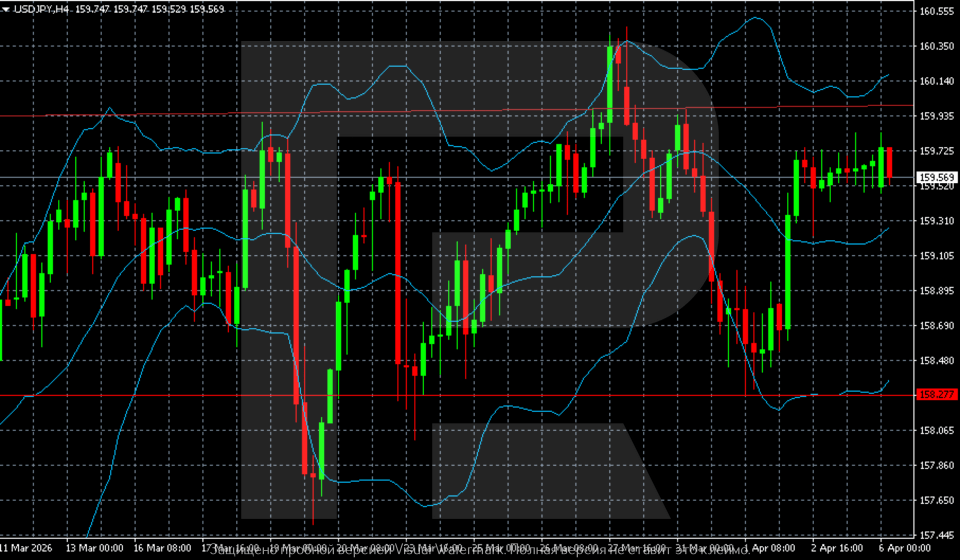
The USDJPY H4 chart shows that the market is in a sideways consolidation phase following a strong momentum rally in late March. The pair reached local highs in the 160.30–160.50 area, failed to consolidate above them, and then a sharp correction followed. This suggests profit-taking and the market’s lack of readiness to continue moving upwards without new drivers.
After declining to the 158.20–158.50 area, the price found support and rebounded upwards. Since then, a range of approximately 158.50–160.00 has formed, within which the price is moving with increased volatility. Bollinger Bands first widened during the decline, then began to narrow, indicating a gradual weakening of momentum and the market’s transition into a balance phase.
At the moment, quotes are holding near the middle Bollinger Band, around 159.50–159.70, which confirms the neutral structure. The absence of directional movement and a series of mixed candlesticks point to uncertainty. A move above 160.00 may restore upward momentum. A breakout of the 158.20 level will increase selling pressure and open the way to a deeper correction.
USDJPY overview
- Asset: USDJPY
- Timeframe: H4 (Intraday)
- Trend: sideways
- Key resistance levels: 160.00 and 160.50
- Key support levels: 158.50 and 158.20
USDJPY trading scenarios for today
Main scenario (Sell Stop)
Consolidation below 158.50 would indicate a breakout out of the range and stronger selling pressure amid profit-taking after the rise.
- Take Profit: 158.20
- Stop Loss: 159.30
Alternative scenario (Buy Stop)
A breakout above the 160.00 level would confirm renewed upward momentum and an attempt to reach new local highs.
- Take Profit: 160.80
- Stop Loss: 159.40
Risk factors
The risks to the decline are linked to heightened geopolitical tensions following Trump’s statements, which may support the dollar. In addition, the yen remains under pressure amid rising energy prices. At the same time, expectations of Bank of Japan policy tightening and possible currency intervention may limit the pair’s growth.
Summary
The USDJPY pair remains in a strong position despite the local correction. The USDJPY forecast for today, 6 April 2026, does not rule out range trading between 158.50 and 160.00.
Editors’ picks
 EURUSD 2026-2027 forecast: key market trends and future predictions
This article provides the EURUSD forecast for 2026 and 2027 and highlights the main factors determining the direction of the pair’s movements. We will apply technical analysis, take into account the opinions of leading experts, large banks, and financial institutions, and study AI-based forecasts. This comprehensive insight into EURUSD predictions should help investors and traders make informed decisions.
 Gold (XAUUSD) forecast 2026 and beyond: expert insights, price predictions, and analysis
Dive deep into the Gold (XAUUSD) price outlook for 2026 and beyond, combining technical analysis, expert forecasts, and key macroeconomic factors. It explains the drivers behind gold’s recent surge, explores potential scenarios including a move toward 4,500 to 5,000 USD per ounce, and highlights why the metal remains a strong hedge during global uncertainty.
Forecasts presented in this section only reflect the author’s private opinion and should not be considered as guidance for trading. RoboForex bears no responsibility for trading results based on trading recommendations described in these analytical reviews.