
USDJPY in a sideways range: the Middle East on one side and the BoJ on the other
The USDJPY pair fell to 158.69. The yen needs clarity from the Bank of Japan. Find more details in our analysis for 9 April 2026.
USDJPY forecast: key takeaways
- The USDJPY pair rose and then stopped, as external factors are sending mixed signals
- The market needs signals from the Bank of Japan on rates before the 28 April meeting
- USDJPY forecast for 9 April 2026: 158.00 or 160.00
Fundamental analysis
The USDJPY rate fell to 158.69 on Thursday. The Japanese yen had earlier attempted to rise, but external pressure persists. Uncertainty around the ceasefire between the US and Iran remains a major market question.
According to Iranian officials, some of the agreement’s terms have already been violated after new strikes in the region. At the same time, the Strait of Hormuz remains largely blocked, maintaining tension in the energy market.
The yen gained almost 1% yesterday following the ceasefire announcement, signalling the Japanese currency’s high sensitivity to risks to oil supplies from the Middle East.
In addition, the market is pricing in a tighter monetary policy stance by the Bank of Japan. According to estimates by former regulator officials, a rate hike is possible as early as this month to curb inflation.
Investors are now awaiting signals from Bank of Japan Governor Kazuo Ueda ahead of the 28 April meeting, which may clarify the regulator’s future course.
The USDJPY forecast is moderate.
Technical outlook
The USDJPY H4 chart shows that the market remains sideways after a strong rally in late March. The price tested the resistance zone around 160.00–160.30 several times, but it could not consolidate above it, indicating strong selling pressure at these levels. After that, a series of sharper downward corrections followed, forming range-bound dynamics.
Bollinger Bands show alternating expansion and contraction phases, reflecting high volatility and the absence of a sustained trend. The latest move – a sharp decline towards the 158.00 zone followed by a rebound – suggests demand at lower levels. The current price is below the middle line of the indicator, signalling moderate selling pressure.
Indicators confirm a neutral-to-bearish bias. The Stochastic Oscillator has exited oversold territory and is pointing upwards, signalling a short-term recovery. At the same time, MACD remains in negative territory, indicating continued downward momentum in the broader context. In the near term, movement within the 158.00–160.00 range remains likely, with sensitivity to the news backdrop.
USDJPY overview
- Asset: USDJPY
- Timeframe: H4 (Intraday)
- Trend: sideways with a downward bias
- Key resistance levels: 160.00 and 160.30
- Key support levels: 158.00 and 157.50
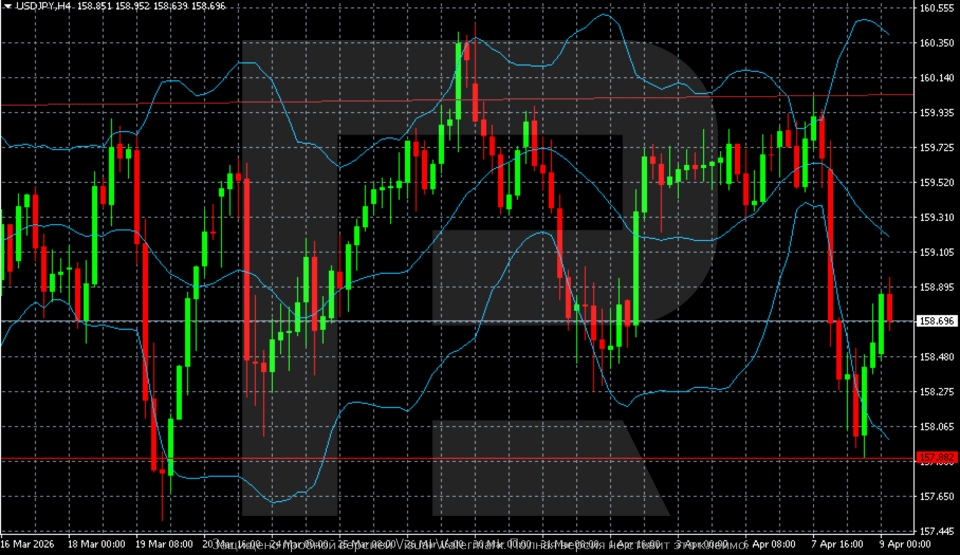
USDJPY trading scenarios for today
Main scenario (Sell Stop)
Consolidation below the 158.00 level would indicate increased selling pressure and a continued correction after failed attempts to secure above 160.00.
- Take Profit: 157.50
- Stop Loss: 158.80
Alternative scenario (Buy Stop)
A breakout above the 160.00 level would confirm renewed upward momentum and an attempt to reach new local highs.
- Take Profit: 160.80
- Stop Loss: 159.20
Risk factors
Risks to the decline are linked to heightened geopolitical tensions, which will support the dollar as a safe-haven asset. At the same time, expectations of tighter Bank of Japan policy and signals from Kazuo Ueda may limit the pair’s gains and increase pressure on the USDJPY pair.
Summary
The USDJPY pair remains highly sensitive to news. The USDJPY forecast for today, 9 April 2026, expects continued sideways movement within the 158.00-160.00 range.
Editors’ picks
 EURUSD 2026-2027 forecast: key market trends and future predictions
This article provides the EURUSD forecast for 2026 and 2027 and highlights the main factors determining the direction of the pair’s movements. We will apply technical analysis, take into account the opinions of leading experts, large banks, and financial institutions, and study AI-based forecasts. This comprehensive insight into EURUSD predictions should help investors and traders make informed decisions.
 Gold (XAUUSD) forecast 2026 and beyond: expert insights, price predictions, and analysis
Dive deep into the Gold (XAUUSD) price outlook for 2026 and beyond, combining technical analysis, expert forecasts, and key macroeconomic factors. It explains the drivers behind gold’s recent surge, explores potential scenarios including a move toward 4,500 to 5,000 USD per ounce, and highlights why the metal remains a strong hedge during global uncertainty.
Forecasts presented in this section only reflect the author’s private opinion and should not be considered as guidance for trading. RoboForex bears no responsibility for trading results based on trading recommendations described in these analytical reviews.