
USDJPY is moving lower as the yen is gaining widespread support
The USDJPY pair fell to 159.15, with the yen bolstered by local weakness in the US dollar and the loss of the risk premium in oil prices. Discover more in our analysis for 14 April 2026.
USDJPY forecast: key takeaways
- The USDJPY pair is declining amid signs of optimism about the Middle East issue
- Expectations of intervention support the yen
- USDJPY forecast for 14 April 2026: 158.00
Fundamental analysis
The USDJPY rate fell to 159.15 on Tuesday. The yen thus halted its three-day decline, supported by a weaker US dollar and lower oil prices amid expectations of a possible agreement between the US and Iran.
Donald Trump stated that Tehran contacted Washington shortly after the introduction of a naval blockade on supplies of Iranian oil through the Strait of Hormuz. In turn, Iranian President Masoud Pezeshkian noted Iran’s readiness to continue negotiations provided that international law is observed.
Additional support for the yen came from fears of currency intervention. The pair approached the key 160.00 level, which had previously triggered intervention by the Japanese authorities.
Bank of Japan Governor Kazuo Ueda stressed the need to take into account the economic impact of the Middle East conflict. He also noted that higher oil prices may put pressure on Japan’s growth rate.
The USDJPY forecast is moderately negative.
Technical outlook
The USDJPY H4 chart shows that after a strong rally in late March, the pair entered a sideways phase. The price tested the 160.00–160.30 area several times, but could not consolidate above it, indicating stable resistance. Subsequent movements became more uneven, with alternating upward and downward impulses, forming a broad range.
Bollinger Bands reflect increased volatility: there are regular breakouts beyond the channel boundaries and quick returns – a typical sign of a market without a clear trend. At the moment, the price is hovering below the middle line of the indicator, signalling moderate selling pressure after another failed attempt to rise.
Indicators confirm a neutral-to-bearish sentiment. MACD is fluctuating near the zero line without forming a sustained momentum, while the Stochastic Oscillator is turning downwards from the middle zone, signalling a possible continuation of the short-term decline. In the near term, movement within the range remains likely, with the support level around 158.00 and resistance around 159.80–160.00.
USDJPY overview
- Asset: USDJPY
- Timeframe: H4 (Intraday)
- Trend: sideways with a downward bias
- Key resistance levels: 159.80 and 160.30
- Key support levels: 158.80 and 158.00
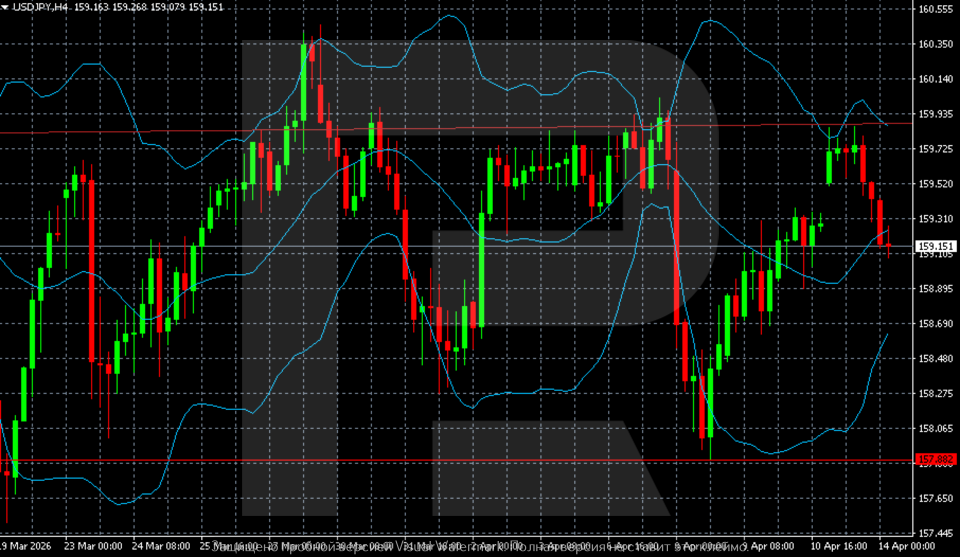
USDJPY trading scenarios for today
Main scenario (Sell Stop)
A breakout of the 158.80 level would confirm a downward breakout from the range and increased selling pressure amid a weaker dollar and a lower oil premium.
- Take Profit: 158.00
- Stop Loss: 159.60
Alternative scenario (Buy Stop)
Consolidation above 159.80 would indicate a return to the upper boundary of the range and a retest of the 160.00–160.30 zone.
- Take Profit: 160.30
- Stop Loss: 159.20
Risk factors
Risks to the downside scenario include a possible strengthening of the US dollar or a new round of geopolitical tensions. Expectations of intervention and the Bank of Japan’s stance remain an additional factor supporting the yen, limiting USDJPY's upside potential.
Summary
The USDJPY pair is moving lower amid improving external conditions. The USDJPY forecast for today, 14 April 2026, does not rule out movement towards 158.00.
Editors’ picks
 EURUSD 2026-2027 forecast: key market trends and future predictions
This article provides the EURUSD forecast for 2026 and 2027 and highlights the main factors determining the direction of the pair’s movements. We will apply technical analysis, take into account the opinions of leading experts, large banks, and financial institutions, and study AI-based forecasts. This comprehensive insight into EURUSD predictions should help investors and traders make informed decisions.
 Gold (XAUUSD) forecast 2026 and beyond: expert insights, price predictions, and analysis
Dive deep into the Gold (XAUUSD) price outlook for 2026 and beyond, combining technical analysis, expert forecasts, and key macroeconomic factors. It explains the drivers behind gold’s recent surge, explores potential scenarios including a move toward 4,500 to 5,000 USD per ounce, and highlights why the metal remains a strong hedge during global uncertainty.
Forecasts presented in this section only reflect the author’s private opinion and should not be considered as guidance for trading. RoboForex bears no responsibility for trading results based on trading recommendations described in these analytical reviews.