
USDJPY is full of strength: there are few reasons for a trend reversal
The USDJPY pair moved to 158.91 on Tuesday, with the yen remaining under pressure due to uncertainty over Bank of Japan policy. Discover more in our analysis for 21 April 2026.
USDJPY forecast: key takeaways
- The USDJPY pair is in positive territory due to the Bank of Japan’s ambiguous stance
- Japan remains dependent on energy imports
- USDJPY forecast for 21 April 2026: 159.50
Fundamental analysis
The USDJPY rate is hovering near 158.91, with the Japanese yen remaining under pressure amid unclear signals from the regulator. The Bank of Japan will most likely keep the rate unchanged this month. It needs time to assess the economic impact of the Middle East conflict. At the same time, a signal to resume policy normalisation may be given as early as June.
There is a possibility that the regulator will raise its inflation forecasts while lowering its growth estimates, given rising energy prices and the overall negative backdrop.
Talks between the US and Iran remain in focus. The sides are preparing for a new round of discussions in Islamabad before the ceasefire expires.
Lower oil prices and a weaker dollar are partly supporting the yen, given Japan’s dependence on energy imports. However, this is still not enough to reverse the trend.
The USDJPY forecast is moderately positive.
Technical outlook
The USDJPY H4 chart shows a predominantly sideways movement after the decline from local highs around 160+. The price has attempted several times to recover, but each upward impulse has encountered resistance, forming a range of roughly 158.50–159.70. The overall structure looks like consolidation with a downward bias.
Bollinger Bands signal lower volatility: after sharp movements, the range is narrowing, with the price mostly hovering near the middle line. The upper boundary around 159.50–159.70 is acting as resistance, while the 158.00–158.30 zone remains key support, where buyers had appeared earlier.
Candlestick movement is becoming less impulsive, confirming the accumulation phase. The market is not showing a sustained trend: attempts to rise are quickly capped, while declines are bought up. This indicates anticipation of a new driver – a breakout from the range is likely, but the direction is yet to be determined.
USDJPY overview
- Asset: USDJPY
- Timeframe: H4 (Intraday)
- Trend: sideways with a downward bias
- Key resistance levels: 159.70 and 160.00
- Key support levels: 158.80 and 158.00
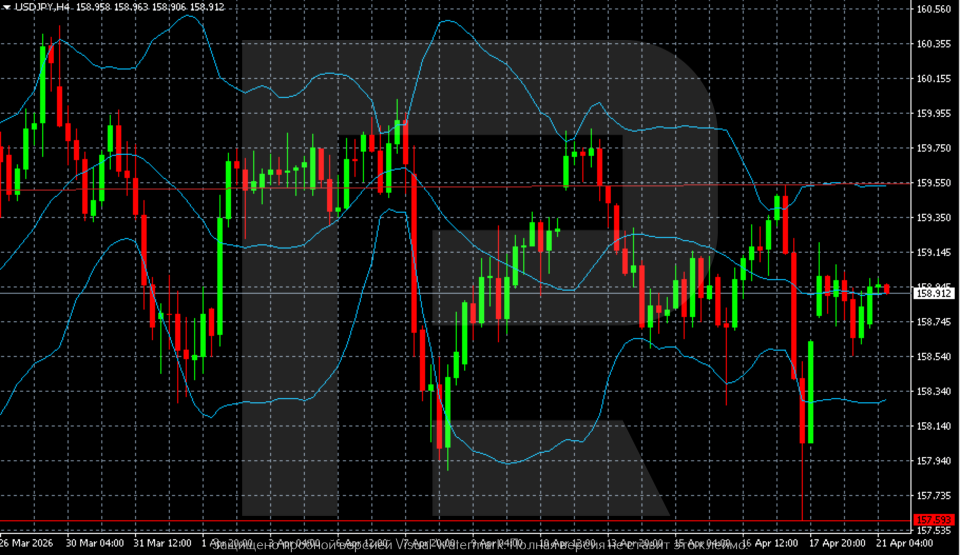
USDJPY trading scenarios for today
Main scenario (Sell Stop)
A breakout below 158.80 would confirm a downward breakout from the range and increasing selling pressure. Weak upward momentum and consolidation indicate the risk of a continued decline.
- Take Profit: 158.00
- Stop Loss: 159.60
Alternative scenario (Buy Stop)
Consolidation above 159.70 would signal a return to the upper boundary of the range and an attempt to test 160.00.
- Take Profit: 160.00
- Stop Loss: 159.20
Risk factors
Risks to the decline are linked to a possible strengthening of the dollar amid geopolitical tensions and Fed rate expectations. The Bank of Japan’s signals about policy normalisation or lower energy prices could further support the yen.
Summary
The USDJPY pair rose on Tuesday and is stabilising. The USDJPY forecast for today, 21 April 2026, does not rule out a renewed rise towards 159.50, subject to favourable conditions.
Editors’ picks

EURUSD 2026-2027 forecast: key market trends and future predictions
This article provides the EURUSD forecast for 2026 and 2027 and highlights the main factors determining the direction of the pair’s movements. We will apply technical analysis, take into account the opinions of leading experts, large banks, and financial institutions, and study AI-based forecasts. This comprehensive insight into EURUSD predictions should help investors and traders make informed decisions.

Gold (XAUUSD) forecast 2026 and beyond: expert insights, price predictions, and analysis
Dive deep into the Gold (XAUUSD) price outlook for 2026 and beyond, combining technical analysis, expert forecasts, and key macroeconomic factors. It explains the drivers behind gold’s recent surge, explores potential scenarios including a move toward 4,500 to 5,000 USD per ounce, and highlights why the metal remains a strong hedge during global uncertainty.
Forecasts presented in this section only reflect the author’s private opinion and should not be considered as guidance for trading. RoboForex bears no responsibility for trading results based on trading recommendations described in these analytical reviews.